Clear Sky Science · en
Cost-effective plant-based medium for enhanced spore production of B. amyloliquefaciens CN12 for biofertilizer application
Why better plant food matters
As farmers search for ways to grow more food without harming soil, interest is rising in biofertilizers—living microbes that help plants thrive. This study explores a hardy soil bacterium that can boost vegetable growth and shows how to grow it cheaply using everyday plant materials instead of expensive lab chemicals. The work points toward affordable, more sustainable fertilizers that could support both smallholders and larger farms.
Helpful microbes from a quiet forest
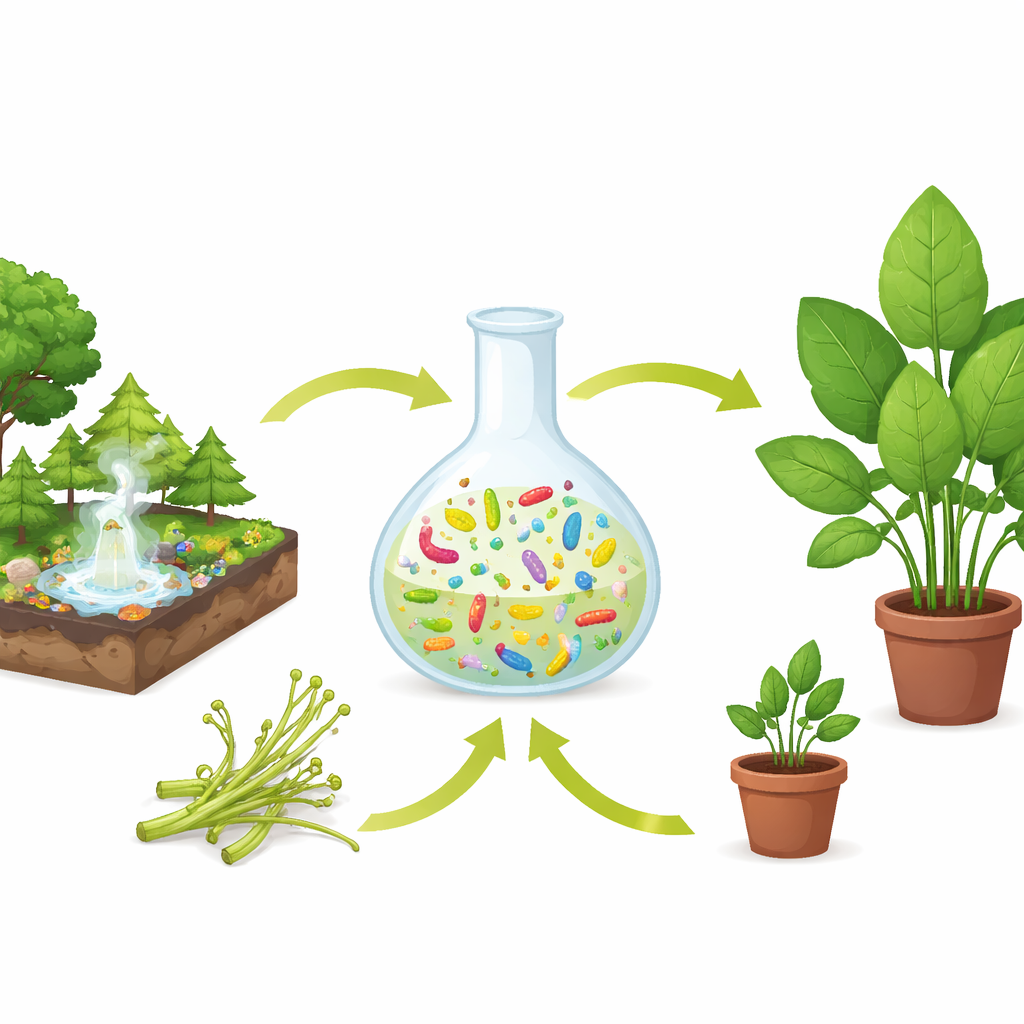
The researchers began in Tan Phu protection forest in Southeast Vietnam, a relatively undisturbed area rich in wildlife and, importantly, in microscopic life. From forest soils and a nearby hot spring, they collected samples and isolated 53 strains of bacteria that can form spores—tough, dormant structures that help microbes survive dryness, heat, and other harsh conditions. These spore-forming strains were then tested for their ability to make a plant hormone called IAA, which encourages root growth, and for several other traits linked to healthier plants and better access to nutrients in the soil.
Finding a standout bacterium
Out of the many strains examined, one called CN12 clearly stood out. It produced more IAA than the others and showed strong activity for several helpful functions: breaking down plant material, freeing up phosphorus and potassium locked in soil particles, and producing siderophores, compounds that help plants access iron. Genetic analysis identified CN12 as a type of Bacillus amyloliquefaciens, a species already known for being safe and useful around plants. Because it combines several plant-friendly abilities with robust spore formation, CN12 was chosen as the most promising candidate for use in a biofertilizer.
Turning kitchen crops into a microbe factory
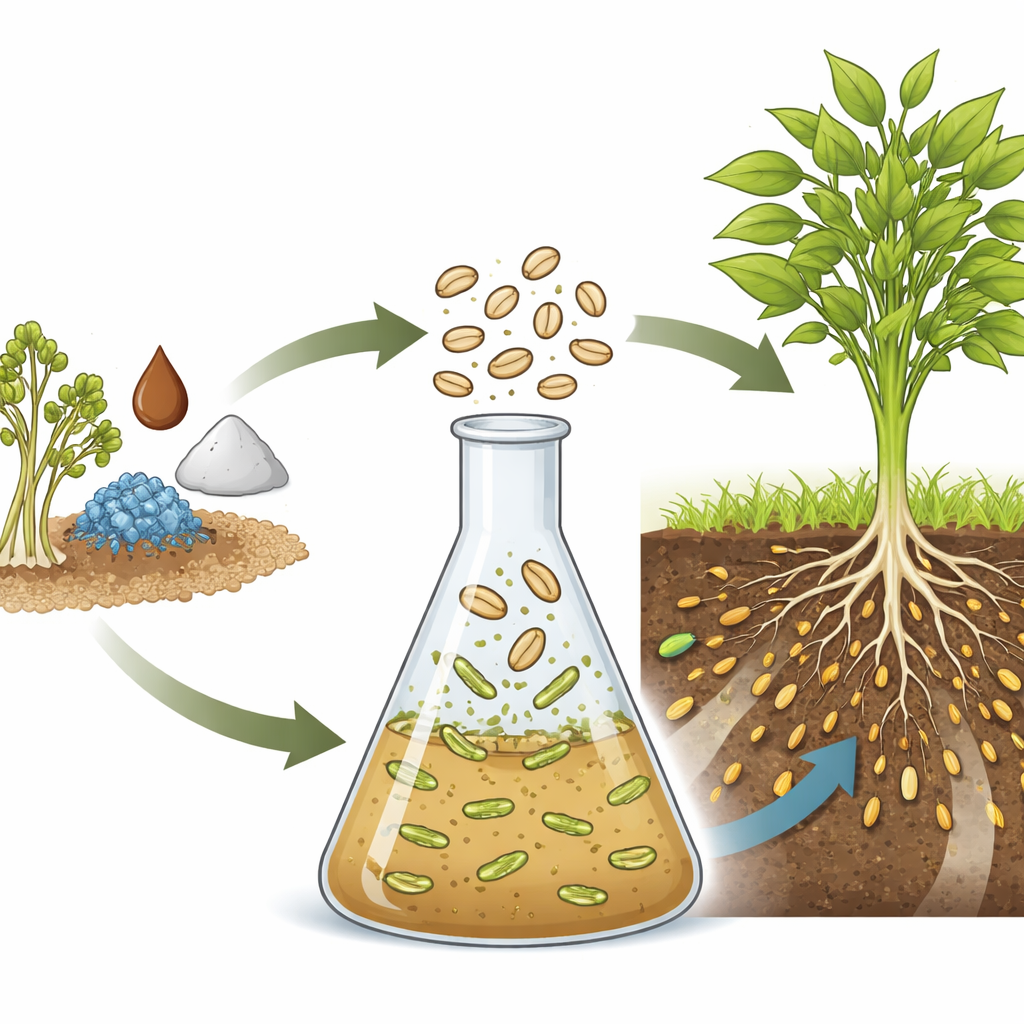
To turn CN12 into a practical product, the team needed a way to grow large numbers of spores without relying on costly laboratory media. They tested liquid broths made from common plant ingredients—mung bean sprouts, potatoes, rice, corn, and soybeans—prepared much like simple soups. Mung bean sprout extract supported the best spore production, so it became the base recipe. The scientists then refined this medium by adding low-cost additives such as cane molasses for extra sugar, urea as a nitrogen source, and magnesium sulfate as a mineral supplement. Using statistical tools to fine-tune the recipe, they arrived at a mix that produced hundreds of millions of spores per milliliter, all from inexpensive, widely available materials.
Putting the biofertilizer to the test
Having a dense, low-cost culture is only useful if the product works on real plants, so the team performed pot experiments with Malabar spinach, a leafy vegetable valued for its rapid growth and nutrition. Seedlings grown in sterile soil either received the CN12 spore suspension or were left untreated. After three weeks, the treated plants were dramatically larger: they were several times taller, had much heavier shoots, and thicker roots than the controls. The researchers also stored the liquid spore formulation for a full year, both in a refrigerator and at warm room temperature. Most spores remained alive even after 12 months, especially at cooler storage, suggesting the product could be made, stored, and shipped without quickly losing its effectiveness.
What this means for future fertilizers
In simple terms, this study shows that a robust forest bacterium can be turned into a practical plant booster using ingredients not far removed from a kitchen pantry. The selected strain, Bacillus amyloliquefaciens CN12, grows well, forms durable spores, and significantly improves vegetable growth, all while being cultivated on a cost-saving, plant-based medium. With further field trials and product development, such a biofertilizer could help farmers reduce reliance on chemical inputs, keep soils healthier, and still harvest strong yields.
Citation: Nguyen, T.N., Ly, T.C., Tran, N. et al. Cost-effective plant-based medium for enhanced spore production of B. amyloliquefaciens CN12 for biofertilizer application. Sci Rep 16, 12276 (2026). https://doi.org/10.1038/s41598-026-42679-6
Keywords: biofertilizer, plant growth bacteria, Bacillus amyloliquefaciens, sustainable agriculture, soil health