Clear Sky Science · en
Pendulum column with inclined negative stiffness as a novel hybrid seismic isolation mechanism integrated into soil with pile-like characteristics
Why protecting buildings from shaking matters
Earthquakes can turn everyday buildings into deadly hazards, especially when they stand on soft or weak ground. Engineers have long tried to shield structures from violent shaking, but most solutions treat the building and the soil beneath it as separate problems. This study introduces a new device that tackles both at once: it helps a building ride out an earthquake more gently while also behaving like a strong foundation pile in poor soil. 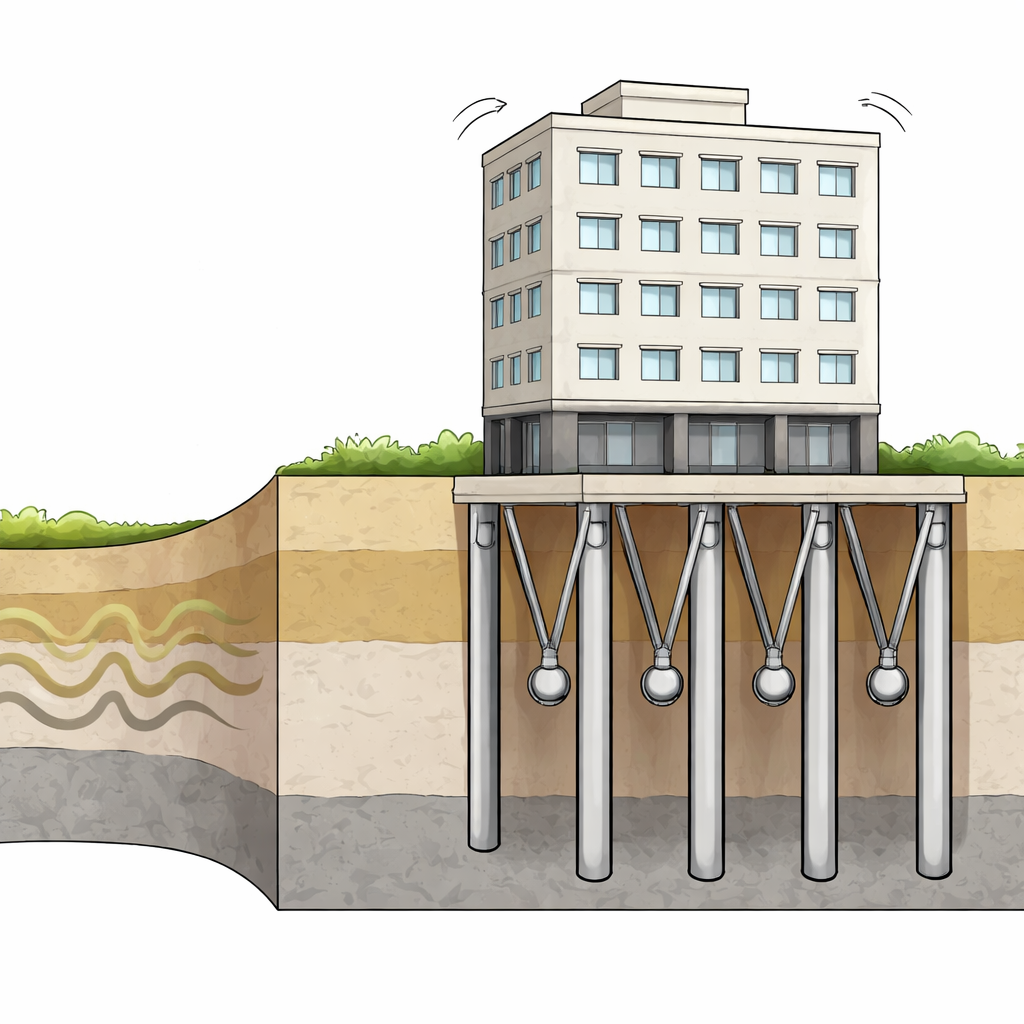
A new way to hang a building
The authors propose a system called a pendulum column with inclined negative stiffness, or PC-INS. Imagine the building’s weight hanging from cables inside a hollow pile buried in the ground, much like a pendulum hanging from a ceiling. When the ground moves, the hanging mass tends to swing more slowly and smoothly than the shaking below, so the building feels less of the jolt. The outer steel shell of this device looks and works like an ordinary foundation pile, carrying vertical loads into deeper, stronger soil, which makes it practical for weak ground where many cities are built.
A gentle push in the opposite direction
On its own, a simple pendulum still has some stiffness that can allow certain earthquake motions to pass through. To soften this further, the researchers add a compressed internal member—like a spring—installed at an angle beneath the hanging mass. This angled piece pushes upward as the mass moves, partly cancelling the pull in the cables. The result is a “quasi-zero stiffness” region around the normal position of the building: for small and moderate movements, the system offers very little resistance, so it hardly passes horizontal shaking up to the structure. The team derives detailed equations describing this motion and identifies how mass, cable length, and compression level must be tuned so the system stays stable while still providing strong isolation. 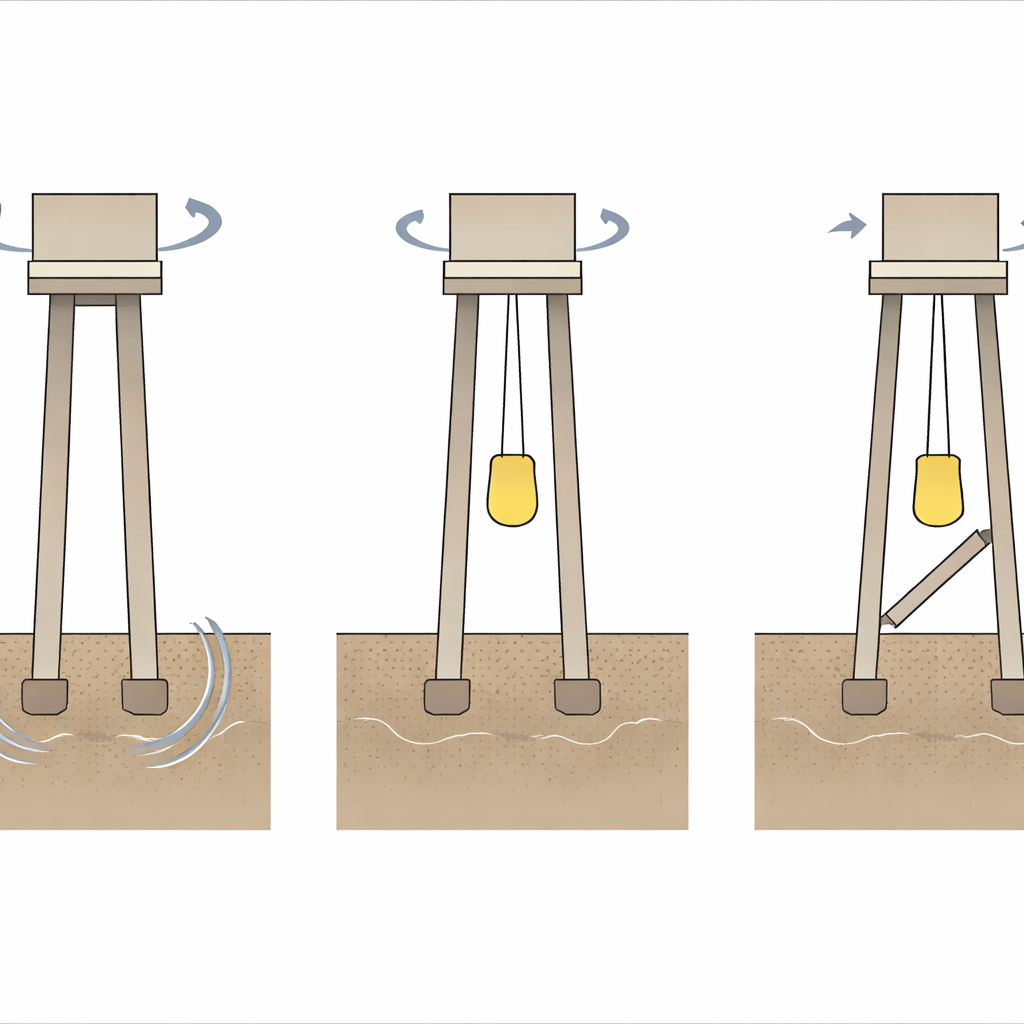
Putting the idea through earthquakes
To see how PC-INS behaves in real conditions, the authors ran computer simulations using records from five well-known earthquakes, including Kobe and Northridge. They compared a building supported on the new piles to a similar building without isolation. The results show that with PC-INS, the building’s acceleration drops to very low levels, while its sideways displacement is also kept small—unlike many traditional isolators that trade lower acceleration for larger drift. Frequency analysis revealed that the system avoids dangerous resonance peaks even with minimal damping, thanks to its quasi-zero stiffness and nonlinear behavior. Energy calculations further showed that less earthquake energy enters the building, and more is stored harmlessly as a change in height of the hanging mass rather than as damaging strain in beams and columns.
Helping the ground as well as the structure
Because PC-INS is built as a pile embedded in soil, the authors also examined how it changes the response of the ground. Using 2D and 3D models with standard soil behavior rules, they compared ordinary piles with their hybrid pile-isolator under cyclic lateral loading. With the new system, stresses and strains in the surrounding soil dropped sharply, and deformations remained more uniform and stable over many load cycles. When they added the piles to full building frames and shook them with historical earthquakes, floor drifts and base shears were reduced by up to about 80 percent compared with conventional piles. The resulting drifts stayed comfortably within performance limits set by seismic design guidelines, indicating that buildings using PC-INS could remain operational after strong shaking.
What this means for safer cities
In simple terms, the PC-INS system lets a building “hang” inside its own foundation piles, while a cleverly compressed internal element quietly counters the pull of gravity. This combination lengthens the building’s natural rhythm, filters out a wide range of earthquake frequencies, and limits both shaking and sideways sway. At the same time, the pile-like shell strengthens weak soil and reduces damage underground. The study’s simulations and numerical checks suggest that this dual-purpose device could offer a practical new tool for protecting structures in earthquake-prone regions, especially where soft or reclaimed ground makes traditional solutions difficult or expensive.
Citation: Azizi, A., Barghian, M. Pendulum column with inclined negative stiffness as a novel hybrid seismic isolation mechanism integrated into soil with pile-like characteristics. Sci Rep 16, 12238 (2026). https://doi.org/10.1038/s41598-026-42674-x
Keywords: seismic isolation, earthquake engineering, foundation piles, soil-structure interaction, vibration control