Clear Sky Science · en
Effects of combined blood flow restriction and neuromuscular electrical stimulation on skeletal muscle hypertrophy in adults: a systematic review and meta analysis
Why muscle size matters for everyday health
Most of us think about muscle mainly in terms of strength or appearance, but muscle mass is also a powerful shield against diabetes, heart disease, and age-related frailty. When we lose muscle and gain fat, everyday tasks become harder and our risk of chronic illness rises. Traditional strength training can build and preserve muscle, yet many people recovering from injury, surgery, or serious illness simply cannot lift weights. This article explores an emerging "hands-off" approach that aims to grow or preserve leg muscles without any active movement from the patient.
A new way to work muscles without moving
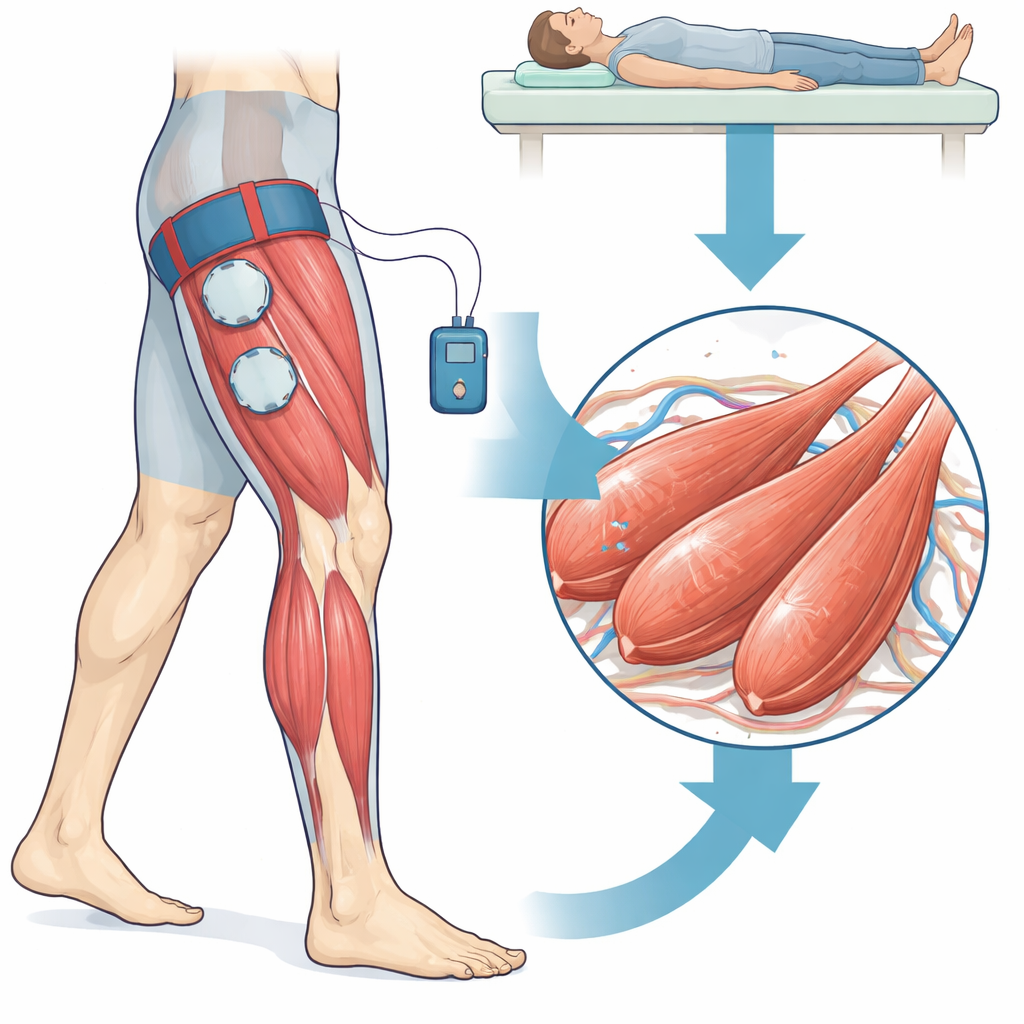
The technique at the heart of this review combines two existing rehabilitation tools: blood flow restriction and neuromuscular electrical stimulation. In blood flow restriction, an inflatable cuff is tightened around a limb to partially limit blood flow, temporarily creating a low-oxygen, high-stress environment inside the muscle. In electrical stimulation, small sticky pads on the skin deliver pulses that cause the muscle to contract involuntarily. On their own, these methods can help slow muscle loss, but each has limits. The authors examined whether using them together as a fully passive intervention could nudge adult leg muscles toward growth, even when the person is not actively exercising.
How the researchers searched the evidence
The authors carried out a systematic review and meta-analysis, a structured way of pooling results across many studies. They combed five major medical databases for experiments involving healthy but untrained adults aged 18 to 64. To qualify, a study had to compare the combined approach against a control condition such as blood flow restriction alone, electrical stimulation alone, or no intervention, and it had to track changes in lower-leg muscle size over at least two weeks. Out of 615 papers initially identified, only three met all of these criteria and provided enough data to be included, together covering 37 participants and seven separate comparisons of muscle growth.
What the studies found about muscle growth
Across all data, the combined method tended to produce more leg muscle growth than the comparison conditions, with a medium-sized advantage in favor of the combined approach. However, because the total number of volunteers was small and results varied, this trend did not rise to the level scientists call statistically significant. When the team looked more closely at how muscle was measured, they found that ultrasound-based measures of muscle thickness showed larger effects than full-leg scans using x-ray based imaging. This suggests that the changes may be quite local within the muscle and easier to detect with targeted imaging than with whole-limb measures.
Why the exact setup makes a difference
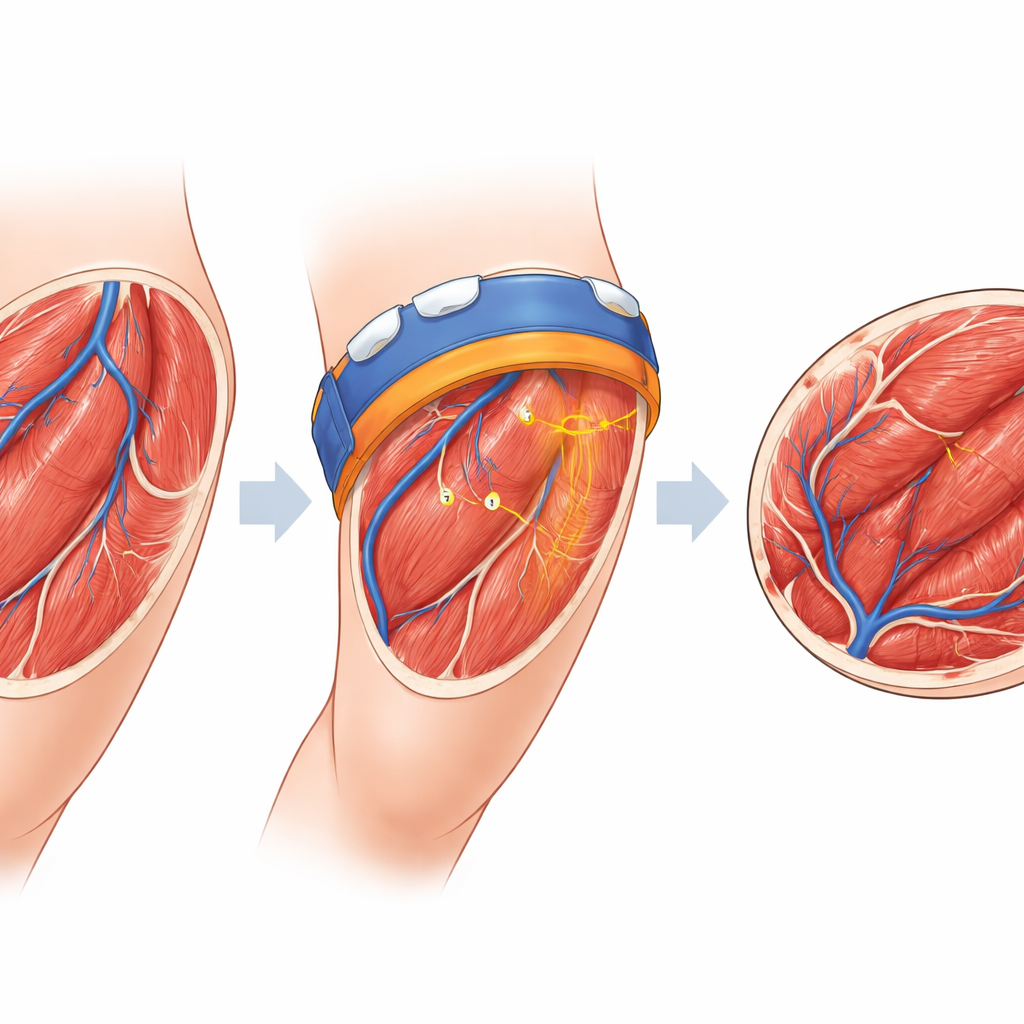
The review also probed which technical choices seemed to matter most. Studies that tailored cuff pressure to each person, rather than using a one-size-fits-all pressure, reported large and statistically clear gains in muscle size. Likewise, when the intensity of the electrical stimulation was set as a defined fraction of the person’s maximal voluntary muscle effort, the combined method again showed a strong advantage. In contrast, using the same cuff pressure for everyone or setting stimulation simply to each person’s maximum tolerable level produced only small or unclear benefits. These findings hint that careful individualization of both the squeeze on the limb and the strength of the electrical pulses is crucial for getting meaningful muscle adaptation.
What this could mean for patients and the public
Overall, the evidence so far suggests that pairing blood flow restriction with electrical stimulation may be a promising way to maintain or modestly increase leg muscle mass in adults who cannot perform regular resistance exercise. The method is entirely passive: people can lie still while the cuff and electrodes do the work, potentially helping to preserve muscle during periods of immobilization or severe deconditioning. At the same time, the small number of studies, their differing protocols, and the lack of clear statistical certainty mean that this approach is not yet a guaranteed substitute for traditional strength training. Larger, carefully controlled trials in diverse age groups and in upper-body muscles are needed before the technique can be widely recommended. For now, the take-home message is hopeful but cautious: with the right settings and supervision, it may be possible to protect muscles even when movement is not an option.
Citation: Mangahas, J.K., Dalleck, L.C., Drummond, C. et al. Effects of combined blood flow restriction and neuromuscular electrical stimulation on skeletal muscle hypertrophy in adults: a systematic review and meta analysis. Sci Rep 16, 14200 (2026). https://doi.org/10.1038/s41598-026-42672-z
Keywords: muscle hypertrophy, blood flow restriction, electrical stimulation, rehabilitation, passive training