Clear Sky Science · en
Enhanced terminal sliding mode control for gait exoskeleton device: experimental investigation and validation
Helping Kids Walk More Easily
For many children with movement disorders like cerebral palsy, simply taking a step can demand enormous effort and careful therapy. Robotic leg braces, known as exoskeletons, promise more consistent practice and less strain on therapists. This study explores a new way to control a pediatric walking exoskeleton so it can guide a child’s legs safely, smoothly, and accurately, even when the child’s movements are irregular and the hardware is not perfect.
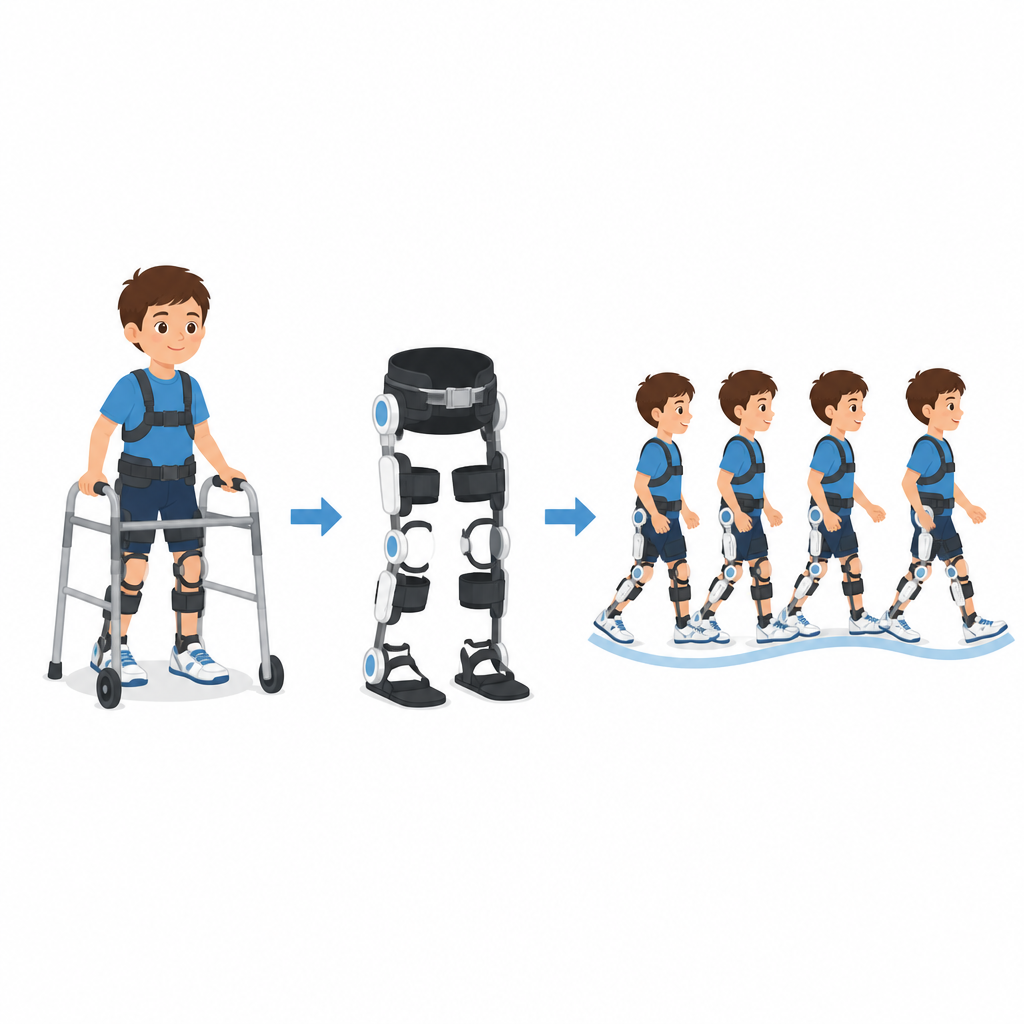
What a Robotic Leg Brace Tries to Do
A pediatric exoskeleton is a wearable frame with powered joints that straps onto a child’s hips, knees, and ankles. In this work, the researchers use a device called LLESv2, paired with a wheeled walker for balance. The goal is to move the child’s legs along a motion pattern that mimics how a healthy 12-year-old walks, step after step, while keeping joint angles within safe limits. Achieving this in real time is difficult because the system must cope with the combined weight and motion of the child and robot, small delays in sensors and motors, and unpredictable effects such as muscle stiffness or slight misalignment of the straps.
Why Ordinary Control Falls Short
Many existing exoskeletons rely on simple control schemes that work well in clean computer simulations but struggle when noise, friction, and user variability enter the picture. Small mismatches between the mathematical model and the real device can grow into noticeable tracking errors, where the robot’s joints lag behind or overshoot the desired path. Classic “sliding mode” methods are more robust to uncertainty, but they can make the motors chatter and may react too slowly when the system starts far away from the target motion. For a child, that can translate into jerky or delayed steps that feel unnatural and may compromise comfort and safety.
A Smarter Way to Guide Each Step
The authors introduce an improved fast terminal sliding mode (IFTSM) control approach tailored to the pediatric exoskeleton. In simple terms, the controller constantly compares the actual joint angles to the desired gait and computes how hard the motors should push to make up the difference. The new scheme adjusts how quickly it “rushes” toward the desired motion depending on how large the error is: it reacts strongly when the exoskeleton strays far from the target, then gently eases off as it nears the correct path. Mathematical analysis based on energy-like functions shows that, as long as the disturbances remain within reasonable bounds, the errors shrink to near zero within a finite time rather than just drifting closer without limit. This design aims to keep the motion both responsive and smooth, helping avoid the buzzing behavior that can occur in cruder sliding mode approaches.
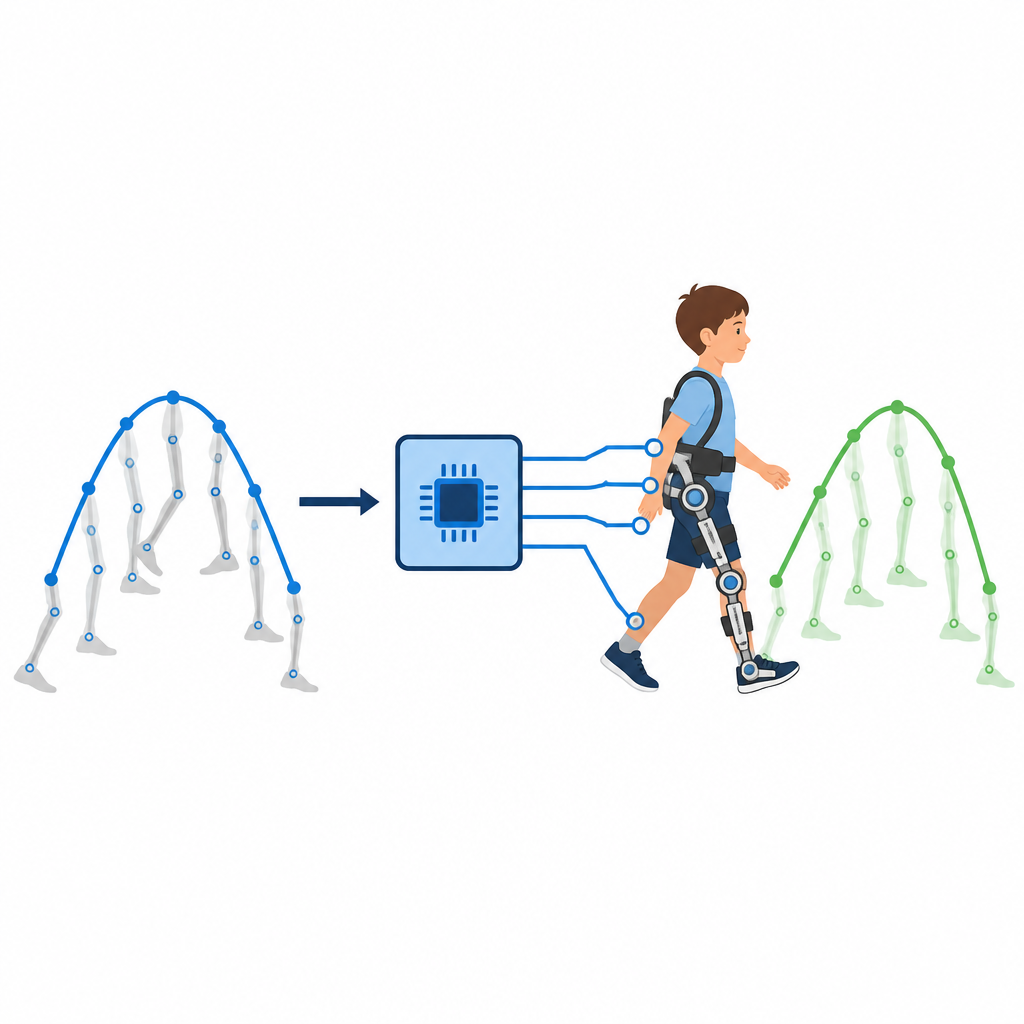
What the Experiments Showed
To test the controller, the team ran experiments with one typically developing 12-year-old and one 12-year-old with spastic cerebral palsy, both using the LLESv2 device in a passive-assist mode where the exoskeleton leads the movement. For the healthy child, the researchers compared their new controller to several well-known methods, all tuned under the same conditions. The new approach reduced joint tracking errors by roughly 40 to 65 percent relative to standard controllers and by about 5 to 20 percent relative to more advanced sliding mode variants, while using less electrical effort and generating smoother motor commands. For the child with cerebral palsy, the study followed 25 training sessions over several months. Over this period, errors in tracking the healthy reference gait dropped by about 38 percent at the hip, 49 percent at the knee, and 16 percent at the ankle. When the child later walked without the exoskeleton, his joint motions showed a modest shift, on the order of 10 percent, toward those of a healthy peer.
What This Means and What Comes Next
In plain terms, the study shows that the new control method can drive a pediatric walking exoskeleton more accurately and gently than several existing strategies, under real-world conditions and with real children. The system keeps the guided steps close to a healthy pattern while limiting sudden jolts and unnecessary power use, which are important for comfort and safety. The work does not claim medical benefits or long-term recovery based on these early results; with only two participants, the findings mainly demonstrate that the technology works reliably in practice. Future studies with larger groups and richer clinical measures will be needed to see how such finely controlled exoskeletons might fit into everyday rehabilitation and whether they can help children gain more independent, confident walking over time.
Citation: Narayan, J., Abbas, M., Randhawa, P. et al. Enhanced terminal sliding mode control for gait exoskeleton device: experimental investigation and validation. Sci Rep 16, 15403 (2026). https://doi.org/10.1038/s41598-026-42670-1
Keywords: pediatric exoskeleton, gait training, cerebral palsy, robotic rehabilitation, sliding mode control