Clear Sky Science · en
Nonlinear dynamics of seizure suppression via optogenetic modulation of neuron-astrocyte interaction
Shining Light on Seizures
Epileptic seizures arise when brain cells fire in sudden, runaway bursts, often resisting today’s drugs and electrical implants. This study asks a bold question: can we tame seizures by directing light not only at neurons, but also at their lesser-known partners, astrocytes—support cells that quietly manage the brain’s chemical balance? Using a detailed computer model, the authors explore how light-sensitive proteins in these cells might work together to calm stormy brain activity by restoring the flow of key ions such as sodium, potassium, and calcium.
Brain Cells That Keep the Peace
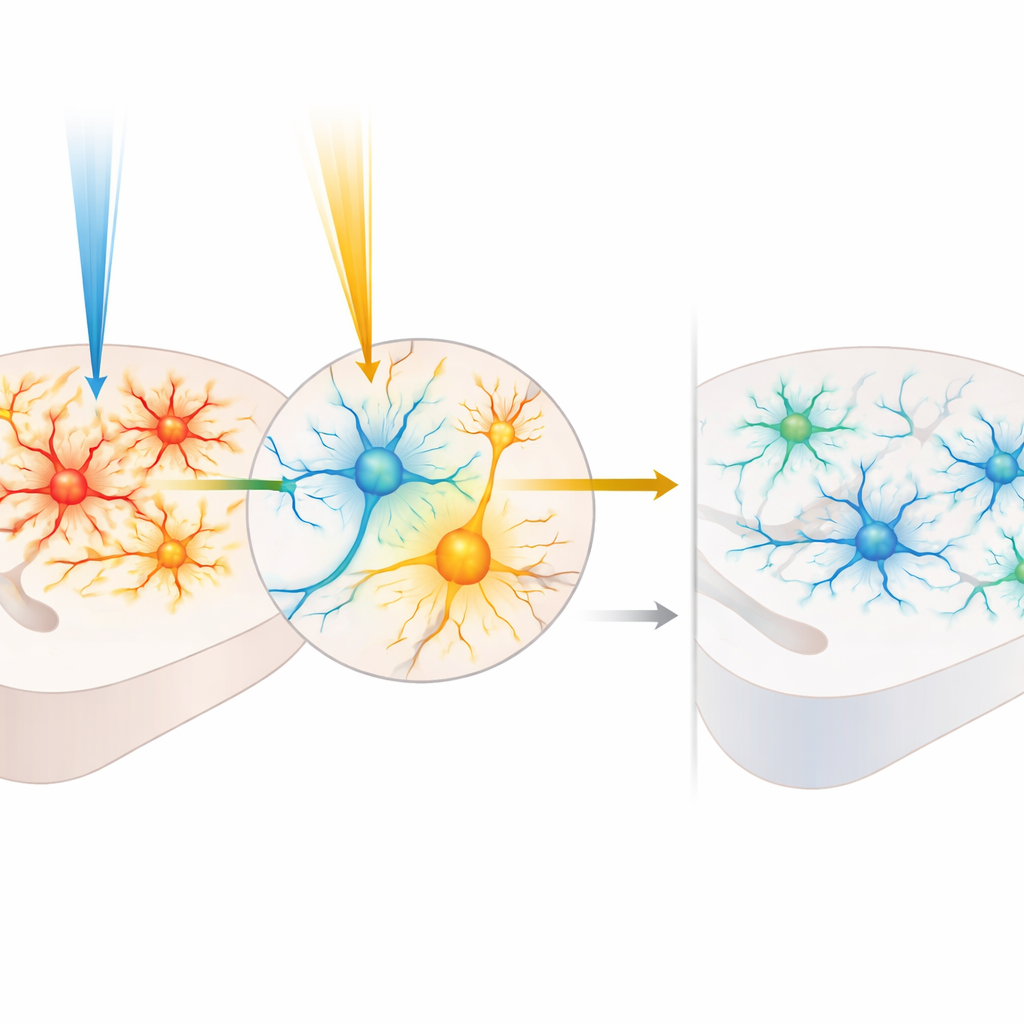
Most epilepsy treatments have focused on neurons, the cells that transmit electrical signals. Yet neurons share their environment with astrocytes, star-shaped glial cells that mop up excess chemicals and help keep the brain’s electrical activity in check. In epilepsy, this balance breaks down, especially for potassium, an ion that strongly affects how easily neurons fire. When potassium builds up outside neurons, they become hyperexcitable and more likely to join in seizure-like bursts. Astrocytes normally prevent this by taking in potassium and operating sodium–potassium pumps that continually reset ion levels. The new work builds a three-compartment model—neuron, astrocyte, and the space between them—to see how this partnership behaves under normal and seizure conditions.
Controlling Cells with Light
Optogenetics makes certain cells respond to light by adding light-sensitive proteins to their membranes. In this study’s simulations, astrocytes are equipped with channelrhodopsin-2 (ChR2), which opens when blue light shines on it and lets sodium and other ions flow into the astrocyte. Neurons carry a different protein, ArchT, that responds to yellow light by pushing charges in a way that makes neurons less likely to fire. By turning these light inputs on and off in the model, the authors can test a wide range of “virtual therapies”—from stimulating only astrocytes to combining astrocyte activation with direct neuronal silencing—and watch how seizures change over seconds to minutes.
How Astrocytes Pull the System Back from the Edge
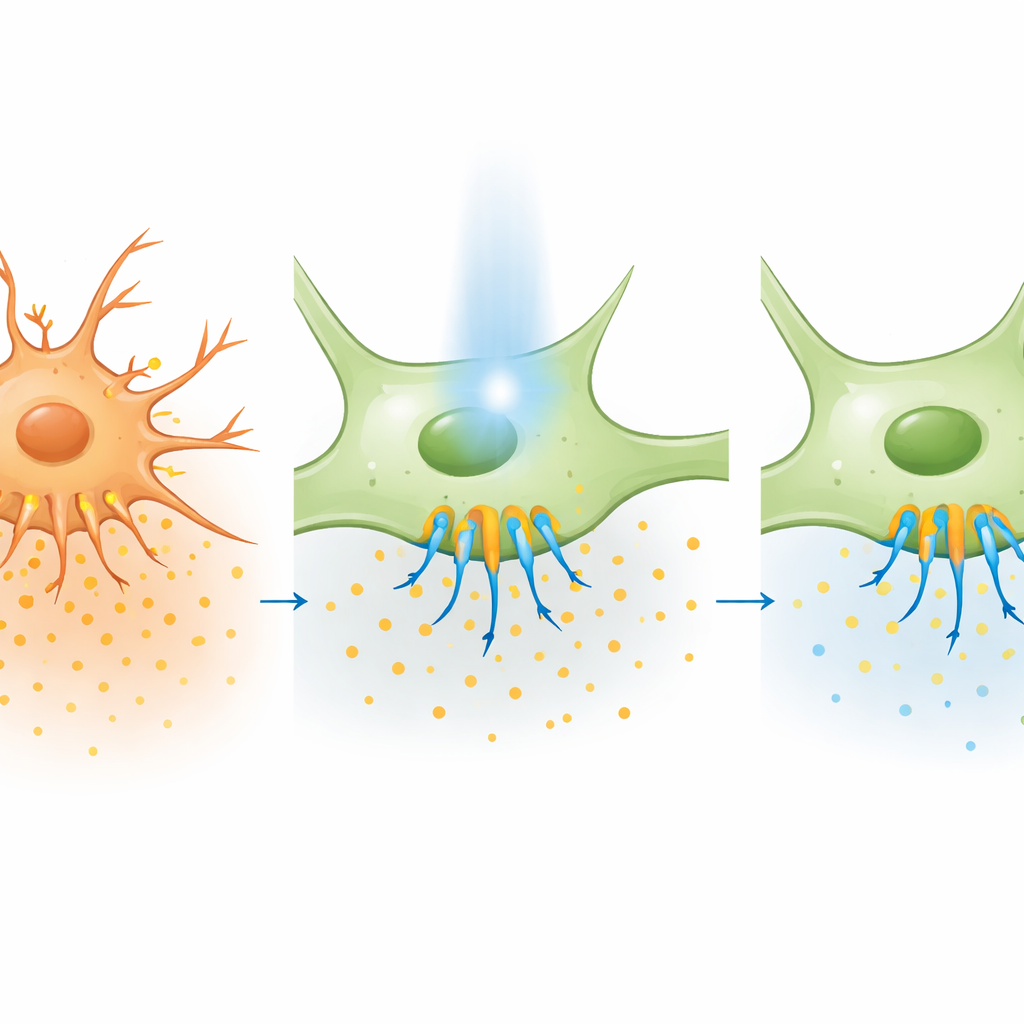
Simulations show that activating astrocytes with blue light powerfully dampens seizure-like activity. When ChR2 is switched on, sodium floods into the astrocyte, strongly driving its sodium–potassium pump. This pump, in turn, pulls potassium out of the space around neurons, lowering the external potassium level and making neurons less excitable. Remarkably, the seizure-suppressing effect persists even if astrocytic calcium signals or certain potassium channels (Kir4.1) are weakened, suggesting that the pump itself is the star player. When the researchers mathematically remove this pump, astrocyte stimulation no longer curbs seizures: potassium remains high outside neurons and the network stays hyperactive.
Timing and Teamwork Matter
The model also reveals that when the light is applied can be as important as where it is aimed. Turning on astrocyte stimulation before the system tips into a seizure prevents the pathologic firing from taking hold, but applying the same light after the seizure is underway offers little benefit. This suggests a “preemptive” window in which boosting astrocyte function keeps potassium in check and blocks the feedback loop that sustains seizures. When astrocyte stimulation is combined with direct neuronal inhibition via ArchT, the effect is even stronger: potassium levels in the surrounding space fall more, and neurons fire fewer spikes than with either approach alone. A global sensitivity analysis of model parameters further points to astrocyte-related quantities—especially those linked to calcium and ion pumps—as key levers controlling seizure severity.
What This Means for Future Treatments
To a non-specialist, the central message is that seizures are not just a problem of “overactive neurons,” but of a disturbed chemical environment that astrocytes normally regulate. This study’s model suggests that therapies which boost astrocyte sodium–potassium pump activity—especially when applied before a seizure fully unfolds—could help restore ion balance and quiet the network. Light-based tools are one way to achieve this in the lab, but the underlying concept may guide drug development and brain–machine interfaces as well. By highlighting astrocytes as active partners in seizure control, the work broadens the search for treatments, particularly for people whose epilepsy does not respond to current medications.
Citation: Maboodi, M., Arabameri, A. & Bahrami, F. Nonlinear dynamics of seizure suppression via optogenetic modulation of neuron-astrocyte interaction. Sci Rep 16, 13990 (2026). https://doi.org/10.1038/s41598-026-42663-0
Keywords: epilepsy, astrocytes, optogenetics, ion homeostasis, computational modeling