Clear Sky Science · en
Real-Time stability enhancement of DDPMSG-based tidal hybrid power systems using heuristic optimization
Why calmer tides matter for our power grid
Tidal currents rise and fall with the moon, not with our daily demand for electricity. As more coastal regions look to the sea for clean energy, they face a tricky problem: how to keep the lights steady when the water, wind, and loads on the grid are always changing. This paper explores a smarter way to tame those swings in a hybrid power system that blends tidal turbines, wind power, and diesel backup, aiming for a grid that stays calm even when nature does not.
Mixing ocean power with a steady grid
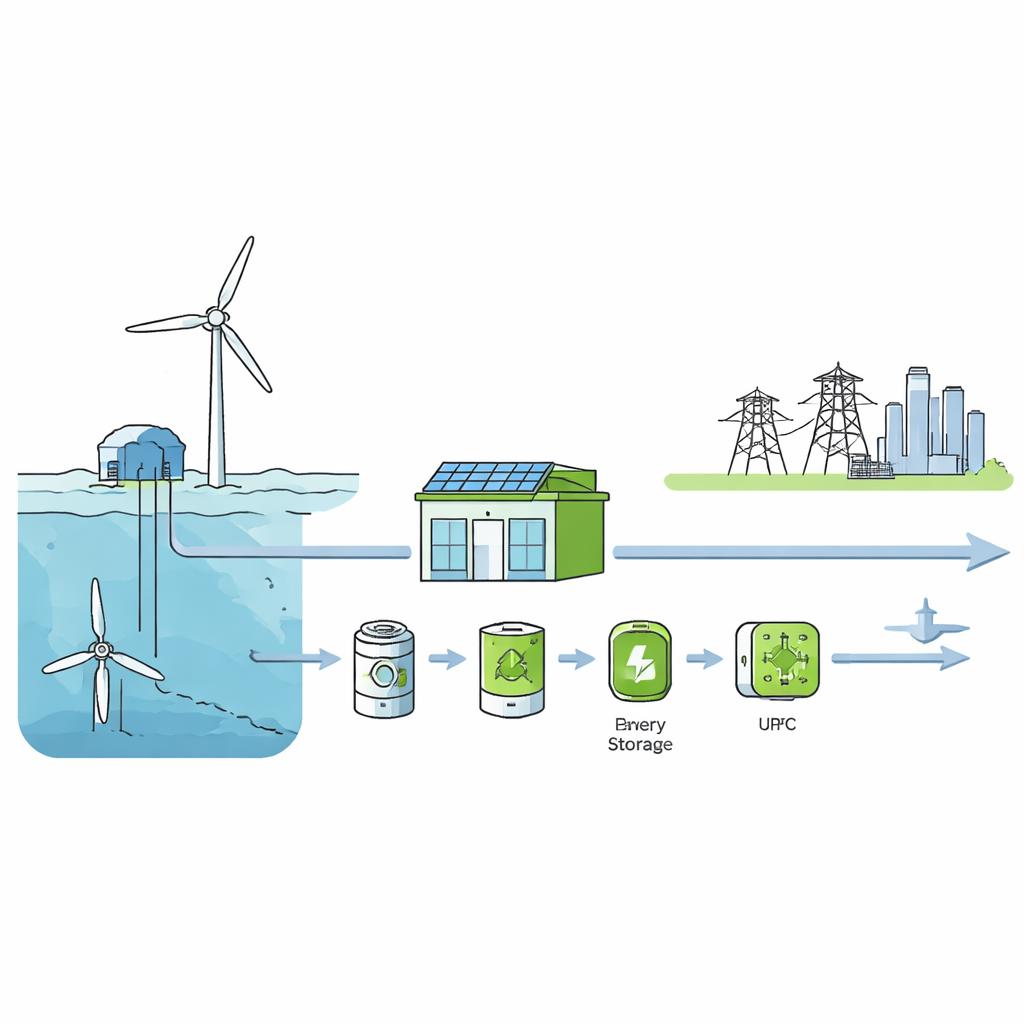
The study focuses on a hybrid power setup where a tidal turbine uses a direct-drive permanent magnet synchronous generator (DDPMSG), a design that avoids gearboxes and can be very efficient and reliable under harsh marine conditions. This tidal unit works alongside wind generation, energy storage, and a conventional diesel generator, all feeding into the same grid. Because tidal and wind flows constantly shift and coastal loads can change quickly, the system is prone to voltage dips, power oscillations, and general instability if left uncontrolled. The authors analyze how these different pieces interact and how small disturbances can grow into larger swings in voltage and frequency.
Giving the grid a smart traffic cop
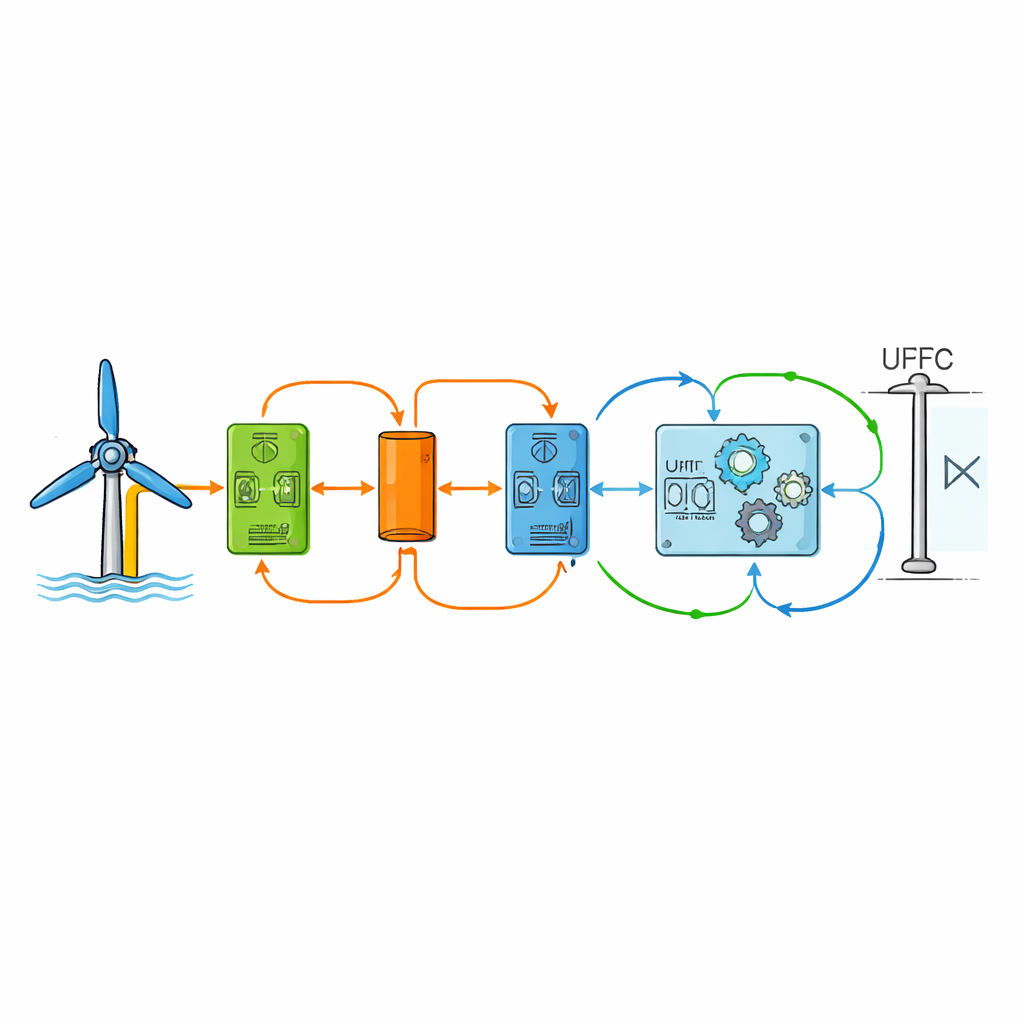
To keep power flowing smoothly, the researchers turn to a device called a unified power flow controller, or UPFC. Placed between the hybrid plant and the wider grid, the UPFC can inject or absorb electrical energy in both series and parallel, acting like a highly flexible traffic cop for power flows. It adjusts reactive power and line conditions on the fly so that terminal voltage remains within safe limits and oscillations are damped before they spread. The team builds detailed mathematical models of the tidal turbine, generators, converters, and UPFC, then simplifies them to study how the system responds to small shocks, using standard tools from control engineering to judge stability and robustness.
Borrowing strategies from nature and evolution
A key idea in the paper is that the UPFC controller itself must be tuned very carefully; the wrong settings can worsen instability instead of curing it. Rather than rely on trial and error, the authors use metaheuristic optimization methods inspired by natural processes. One is differential evolution, which mimics how populations evolve by mutation and recombination. Another is the firefly algorithm, which imitates how fireflies move toward brighter flashes. The researchers combine these into a hybrid firefly method that uses the wide search capability of fireflies and the fine-tuning strength of differential evolution. This hybrid algorithm automatically searches for controller settings that minimize voltage error over time, effectively teaching the UPFC how to react best to disturbances.
From equations to real-time hardware
To ensure their solution is practical, the team does more than run computer simulations. They implement the hybrid tidal system and UPFC control logic on a real-time digital platform called OPAL‑RT. This hardware-in-the-loop setup lets them feed the controller with realistic signals and see how it behaves under sudden load increases and uncertain tidal or wind inputs. By comparing different optimization methods, they show that the hybrid firefly-tuned controller consistently shortens settling time, reduces the peak size of voltage swings, and increases damping, meaning oscillations die out more quickly. Importantly, these improvements hold up even when system parameters are varied, suggesting that the approach is robust to modeling errors and real-world uncertainties.
What this means for future ocean energy
In plain terms, the study demonstrates that smarter control of a flexible power device like the UPFC can transform a jittery mix of tidal, wind, and diesel sources into a much calmer and more reliable supply of electricity. By using a hybrid firefly optimization scheme to tune the controller, the authors achieve better stability metrics than with earlier methods, both in simulations and in real-time tests. For coastal grids hoping to lean more heavily on marine renewables, this work points to a path where advanced algorithms and power electronics work together behind the scenes, so that customers experience steady lights rather than feel every pulse of the tide.
Citation: Bhutto, J.K., Mohanty, A., Mohanty, P.P. et al. Real-Time stability enhancement of DDPMSG-based tidal hybrid power systems using heuristic optimization. Sci Rep 16, 12597 (2026). https://doi.org/10.1038/s41598-026-42638-1
Keywords: tidal energy, hybrid power systems, grid stability, power electronics control, metaheuristic optimization