Clear Sky Science · en
Policy-aware GPU resource allocation for national supercomputing
Why supercomputers need more than just speed
Behind today’s breakthroughs in AI, climate modeling, and new materials lies a hidden workhorse: national supercomputers packed with powerful graphics processing units (GPUs). These machines are so in demand that not everyone can get the time they want on them. This article asks a deceptively simple question with big consequences for science policy: instead of letting these precious GPUs go mostly to whoever shouts the loudest, can we allocate them in a way that also reflects a country’s strategic priorities, without wasting capacity or slowing research?
The problem with first-come, first-served power
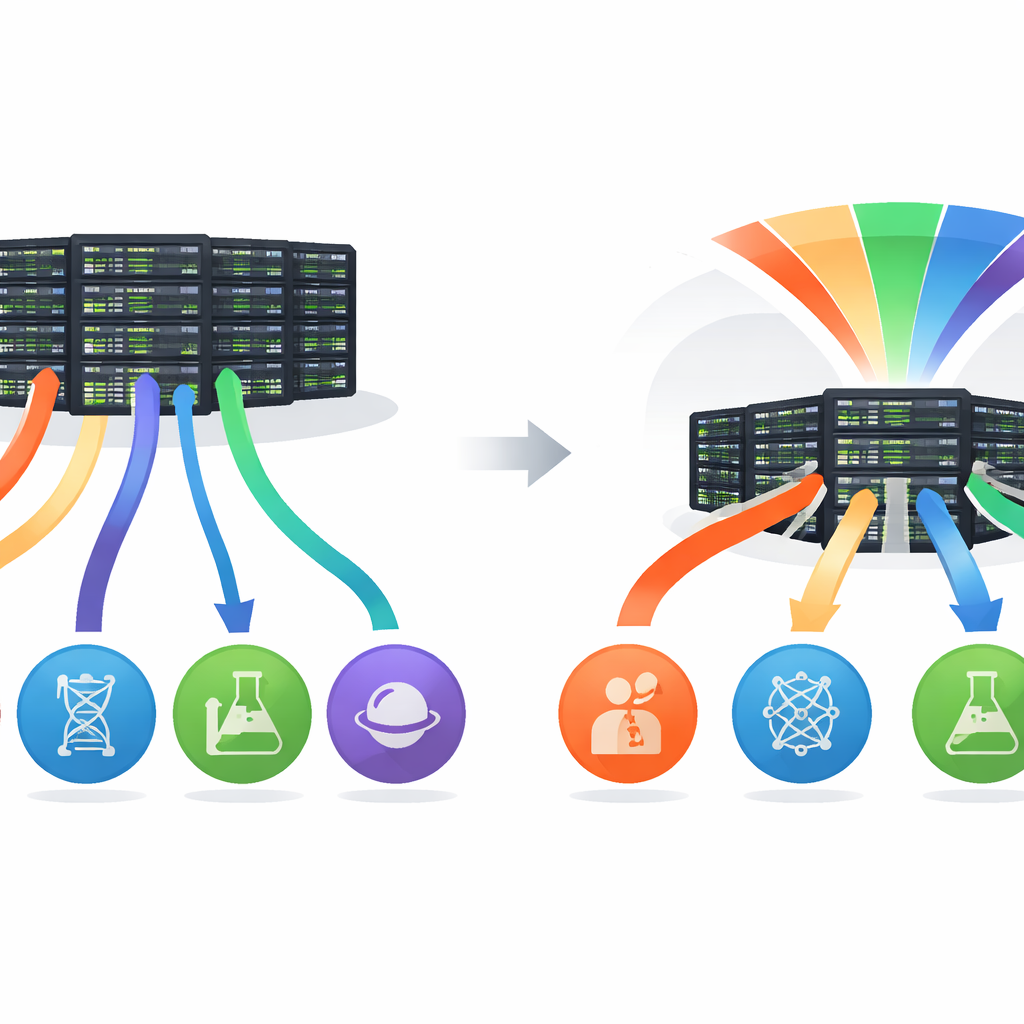
Most large computing centers today use scheduling rules that focus on keeping the machines busy and clearing job queues efficiently. Systems in the United States, Europe, Japan, and elsewhere often favor long-running, high-volume workloads because those keep utilization high and scheduling predictable. But this demand-driven approach creates a quiet bias: fields that already generate huge numbers of GPU jobs—such as certain corners of computer science—tend to receive a growing share of the pie, while strategically important but less GPU-intensive areas, like some materials or Earth sciences, can be squeezed out. As competition for GPU hours intensifies and countries tie supercomputing more closely to economic and security goals, this imbalance becomes not just a technical issue but a question of public value and fairness.
Bringing policy goals into the math
The study proposes a framework that bakes policy priorities directly into the formulas that guide GPU allocation. Instead of treating policy as an afterthought—say, by manually setting caps or quotas—the author defines a “policy target vector,” essentially a desired percentage share of GPU resources for each scientific domain. This target is built from three ingredients: national research spending patterns, officially highlighted priority fields, and historical GPU usage, all blended evenly so that no single factor dominates. Then, for each domain, the framework analyzes how jobs actually behave on the system—how long they run and how often very long jobs appear—summarizing this in simple numerical profiles.
Finding the sweet spot between demand and fairness
Using these profiles, the framework constructs two signals for each field: one that measures how similar its usage pattern is to the system’s overall behavior, and another that reflects how intensely it uses GPUs. These signals are combined using two adjustable weights that can be tuned to emphasize either structural fit or raw demand. By searching across many possible combinations on past data, the model finds a pair of weights that best match the policy target. In tests using logs from Korea’s Neuron system and a U.S. supercomputing center, the optimized blend leaned more heavily toward demand but still gave meaningful pull toward policy goals. This static estimator alone substantially reduced the mismatch between desired and predicted allocations, though some fields—such as materials science—remained notably under-served.

A smart feedback loop for real-time sharing
To close this gap, the study adds a second layer: a dynamic controller that operates as the system runs. Time is divided into short windows, and in each one the controller checks whether a field’s demand is surpassing both its policy share and what its recent history would reasonably justify. When a domain tries to use more than this effective upper bound, the extra is treated as reclaimable surplus. Those reclaimed GPU “slices” are then redistributed to domains that are falling short of their targets, in proportion to how under-served they are. This cap-and-redistribute process repeats over time, creating a feedback loop that steadily nudges actual allocations toward the policy vector while keeping the machine nearly fully utilized.
What the tests say about performance and stability
Simulations over a week of realistic demand patterns show that this combined approach dramatically tightens the fit to policy goals: average allocation error drops from about eight percent to just over one percent, and a similar improvement appears in a stricter error measure. Importantly, these gains do not come at the cost of wasted capacity or longer queues. GPU utilization stays above 92 percent, throughput remains comparable to standard schedulers, and wait times do not grow. Stress tests where one domain artificially inflates its demand—either with a sudden spike or a sustained plateau—show that the controller resists such strategic behavior, trimming errors by roughly 40 to 45 percent compared with an uncontrolled baseline. Sensitivity checks over key parameters indicate that the behavior remains stable across a reasonable range of settings.
What this means for the future of shared computing
Translated into everyday terms, the article shows that we do not have to choose between fast, efficient supercomputers and thoughtful national strategy. By encoding policy goals as clear numerical targets and building them into both planning and real-time control, the proposed framework offers a way to steer GPU time toward a balanced portfolio of scientific fields without slowing down the machines or bogging researchers in red tape. While the work is demonstrated in simulation on a single system and assumes fixed policy targets, it points toward a future in which national computing centers act not only as powerful calculators but also as carefully tuned instruments of science and technology strategy.
Citation: Shim, H. Policy-aware GPU resource allocation for national supercomputing. Sci Rep 16, 12438 (2026). https://doi.org/10.1038/s41598-026-42625-6
Keywords: GPU scheduling, supercomputing policy, resource allocation, science infrastructure, AI computing