Clear Sky Science · en
Drought and fragmentation shape successional trajectories of isolated urban forests in South Korea
Why city trees and tiny woods matter
As more people move into cities, the small patches of forest tucked between roads and buildings are doing a lot of quiet work: cooling hot streets, cleaning the air, storing carbon, and giving wildlife—and people—a place to breathe. But these urban forests are under growing pressure from heat, drought, and the way cities slice green space into scattered fragments. This study looks at hundreds of forest patches across South Korea’s largest cities to ask a simple but vital question: are these city woods getting healthier and more mature over time, or slipping backward into more fragile, degraded states?
How forests move forward or fall back
Forest “succession” describes how plant communities change as a forest grows and ages. In many temperate forests, fast-growing pioneer trees are gradually replaced by slower-growing, longer-lived species that build dense canopies and richer habitats. The researchers used this idea to classify 1,220 study plots in 327 isolated forest patches as either moving forward (progressive succession) toward more mature, stable communities, or backward (retrogressive succession) toward simpler, more disturbed conditions. They did this by comparing which tree species dominated the canopy and which were coming up underneath, treating oak-dominated stands as a practical benchmark for a relatively well-developed urban forest.
Good news and warning signs
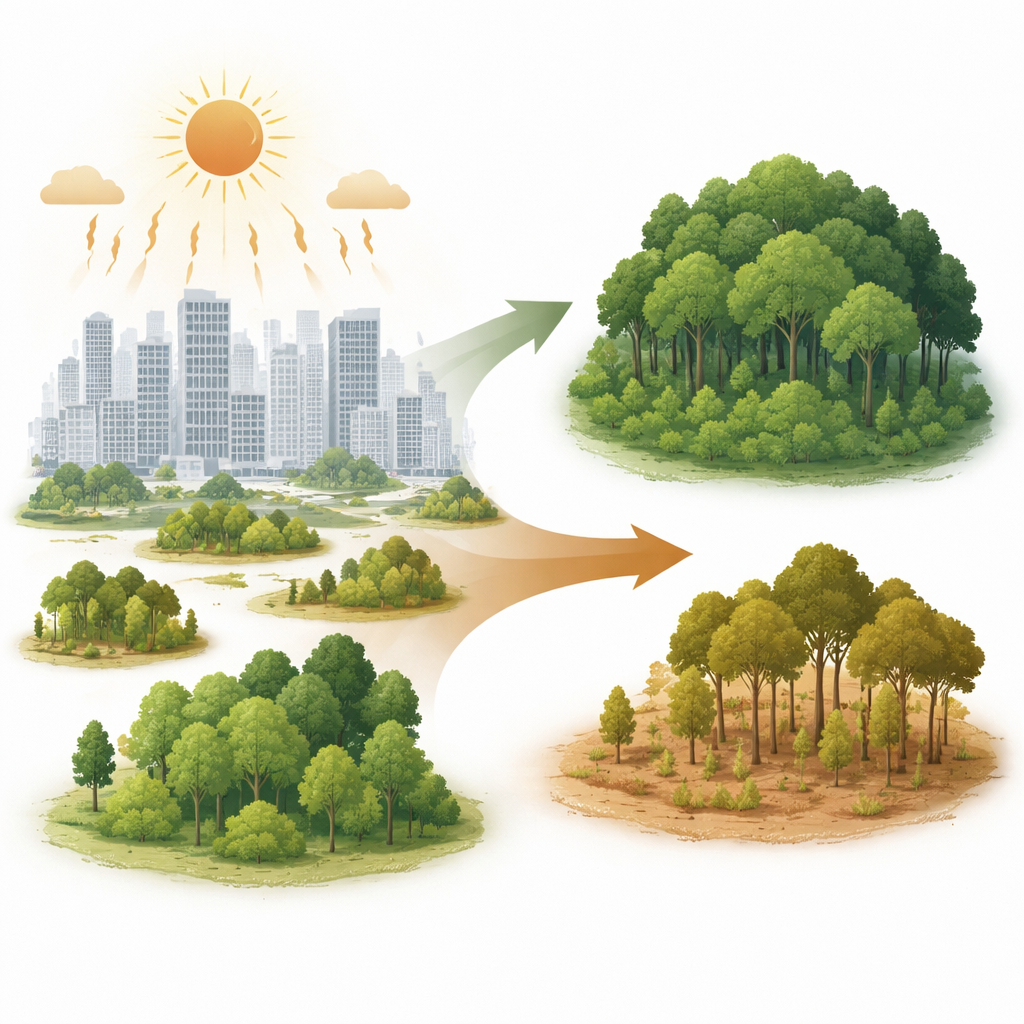
Across South Korea’s seven major cities, most plots—about 83%—were on a progressive or stable path. In many places, non-native trees planted after the Korean War, including pines and imported species, were being replaced by native oaks and other later-stage species. This suggests that, despite traffic, buildings, and long histories of disturbance, many city forests are still capable of moving toward more complex, ecologically rich states. However, 17% of plots showed retrogressive succession. Here, oak stands were giving way to species that cope better with heat, dryness, and urban stress, leading to simpler canopies that may provide fewer cooling and carbon-storage benefits, even if they still support some wildlife.
Heat, drought, and the problem of tiny patches
To uncover what pushes forests forward or backward, the team combined two powerful statistical tools: structural equation modeling, which teases apart direct and indirect influences, and random forest analysis, which ranks the most important predictors. Two factors stood out clearly across cities: long-term drought stress and the size of the forest patch. Where cumulative drought was more severe and forest patches were smaller, the chance of progressive succession dropped sharply, and retrogressive pathways became more likely. In contrast, air pollution measures, though harmful in principle, explained little of the variation among sites under today’s cleaner conditions in South Korea.
How city stress reshapes forest communities
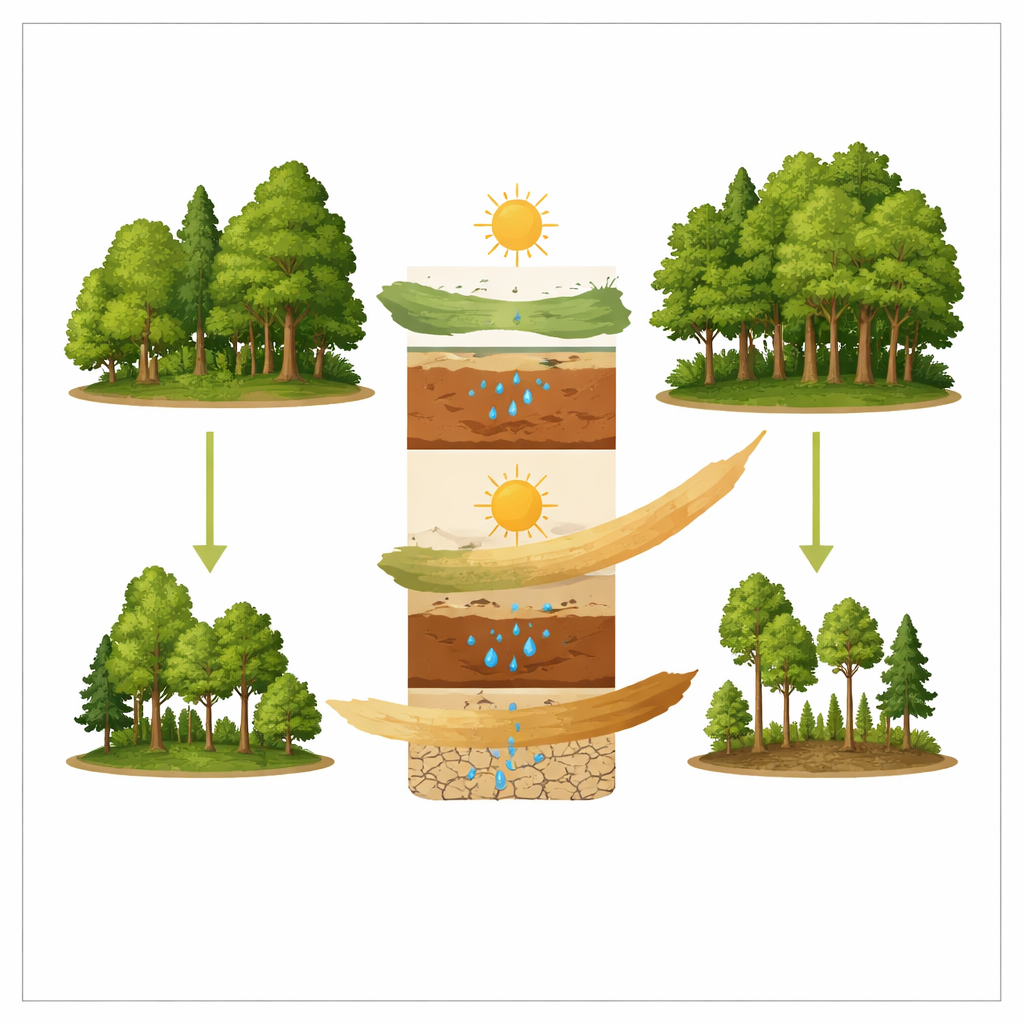
Urban forests sit inside a web of heat islands, altered water flows, compacted soils, and frequent human interventions such as understory clearing. These pressures act as filters, favoring species that can tolerate drought and disturbance. The study found that a particular group of native trees and shrubs—such as Aria alnifolia, Styrax japonicus, and Prunus sargentii—often emerged in both directions: they replaced non-native plantation trees in progressive plots, but also replaced oaks in retrogressive ones. Their success reflects traits that fit harsh city conditions: resilience to dry spells and damaged leaves, and the ability to grow in poor soils and fragmented habitats. As a result, urban succession does not simply follow textbook patterns from remote forests but instead reflects a tug-of-war between climatic stress, patch isolation, and past management.
What this means for greener, cooler cities
For planners and residents who care about livable cities, the message is both hopeful and cautionary. Many urban forest patches are on a healthy trajectory, building more complex canopies that cool neighborhoods, store more carbon, and support greater biodiversity. Yet drought and fragmentation can tip smaller patches into a feedback loop of decline, where late-stage trees falter and are replaced by simpler, stress-tolerant stands. The authors suggest focusing conservation on maintaining and enlarging forest patches, protecting areas less exposed to heat and dryness, and rethinking routine practices like blanket understory clearing. In some places, favoring tough native species may help forests survive a hotter, drier future, even if they look less like classic mature woods. Understanding and guiding these successional pathways can make urban greening efforts more resilient, cost-effective, and beneficial for people and nature alike.
Citation: Kim, I., Sou, HD., Kim, JS. et al. Drought and fragmentation shape successional trajectories of isolated urban forests in South Korea. Sci Rep 16, 11847 (2026). https://doi.org/10.1038/s41598-026-42621-w
Keywords: urban forests, forest succession, drought, habitat fragmentation, ecological restoration