Clear Sky Science · en
Effective manipulation of multi-state memory in bulk PtCo/IrMn via spin-orbit torque
Smarter Memory for a Data-Hungry World
As our phones, computers, and AI systems grow more powerful, they need memory that is not only faster and smaller, but also far more energy-efficient. Today’s memory chips mainly move electrical charge around, which wastes power as heat. This study explores a different route that uses the magnetic “spin” of electrons instead of charge alone. The authors show how a carefully engineered metal stack can store multiple stable memory levels in a single cell, switch them using low electrical currents, and even mimic the gradual learning behavior of biological synapses.
A New Kind of Magnetic Building Block
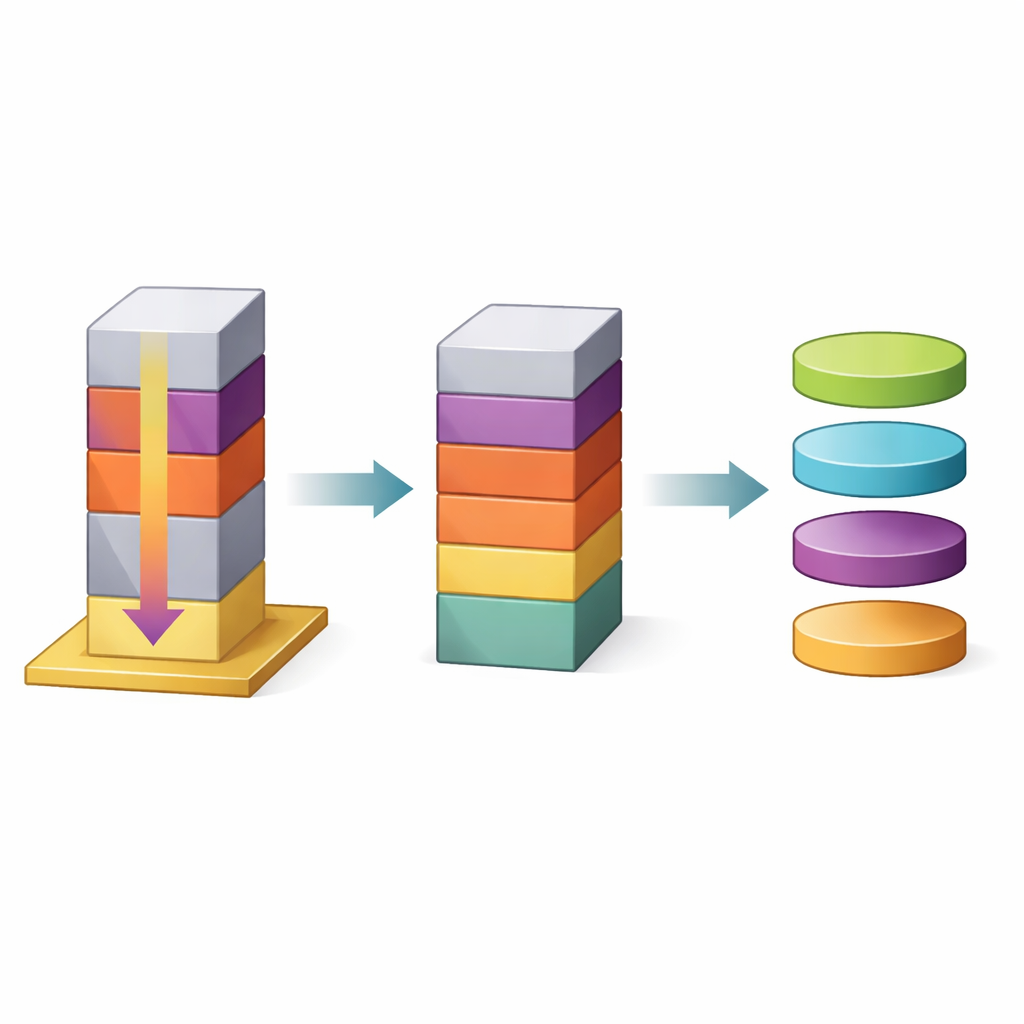
At the heart of this work is a tiny sandwich of ultra-thin metal layers made of platinum, cobalt, and an antiferromagnet called IrMn. Rather than using one thick platinum layer next to a cobalt layer, the team stacks several alternating Pt/Co sheets whose thicknesses change gradually from bottom to top. This graded structure turns the whole stack into a powerful internal source of spin currents when an ordinary charge current is applied. These spin currents exert a “torque” on the magnetization, allowing the direction of the tiny magnetic bits to be switched without the need for an external magnetic field.
More Signal, Less Power
The researchers compared their graded “bulk PtCo/IrMn” design with a more conventional Pt/Co/IrMn structure. They patterned both into microscopic Hall bar devices, which let them read out the magnetic state electrically through a voltage signal called the anomalous Hall resistance. The new bulk design produced a much stronger signal—several times larger than that of the conventional stack—making it easier to detect the stored state reliably. At the same time, it required significantly lower current to flip the magnetization. When they accounted for how the current is shared among the layers, the resulting current density needed for switching was clearly reduced, indicating better energy efficiency and less heat generation.
Many Stable States in a Single Cell
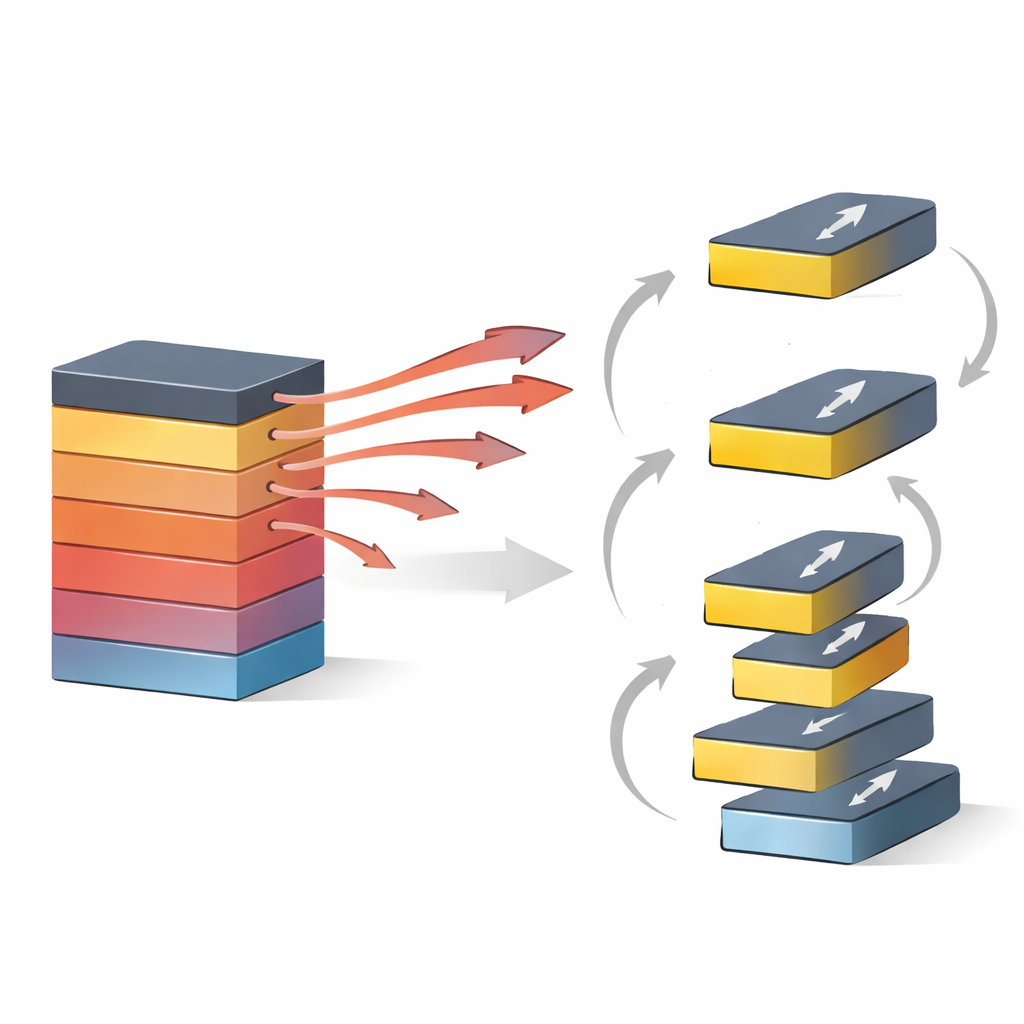
Beyond simple “0” and “1” states, the authors show that their structure can host multiple stable magnetic configurations. This is possible because the IrMn layer “pins” the adjacent cobalt layers through an effect known as exchange bias, shifting the preferred direction of magnetization. By sending current pulses of different strength and polarity, they can gradually reshape the magnetic domains at the interface between PtCo and IrMn. Electrical measurements reveal hysteresis loops with shifted centers and even two-step switching, clear fingerprints of mixed up- and down-oriented regions. Microscopy images of the domains confirm that these current pulses nucleate and expand regions with different magnetization, enabling several distinct, non-volatile resistance levels within the same device.
Artificial Synapses from Magnetic Metals
The ability to fine-tune the resistance level with trains of electrical pulses makes these devices behave like artificial synapses—the junctions between neurons in the brain that strengthen or weaken with use. The team demonstrates that by varying the number and amplitude of current pulses, the Hall resistance can be smoothly increased or decreased, much like synaptic potentiation and depression. This gradual, analog-like updating of “synaptic weight” is essential for neuromorphic hardware that aims to run learning algorithms directly on chips. Because the new structure combines strong readout signals with low switching currents, it promises lower energy consumption, better noise margins, and improved stability in large-scale neural networks implemented in hardware.
Why This Matters
In simple terms, this work shows how a cleverly layered metal stack can store more than just on and off, switch reliably with less power, and respond to electrical pulses in a way that resembles biological learning. By exploiting spin-orbit torque and exchange bias in a graded PtCo/IrMn structure, the authors create a compact platform that unites multi-level memory, analog tuning, and efficient operation. Such spintronic devices could form the basis of future memory chips and brain-inspired processors that are both faster and far more energy-efficient than today’s charge-based electronics.
Citation: Wu, B., Fan, H., Feng, Z. et al. Effective manipulation of multi-state memory in bulk PtCo/IrMn via spin-orbit torque. Sci Rep 16, 11936 (2026). https://doi.org/10.1038/s41598-026-42617-6
Keywords: spintronic memory, spin-orbit torque, multi-state storage, neuromorphic hardware, exchange bias