Clear Sky Science · en
Exploring the new classes of optical soliton solutions with diverse structure for the (2+1)–dimensional paraxial equation in fiber optics via two analytical methods
Why keeping light pulses in shape matters
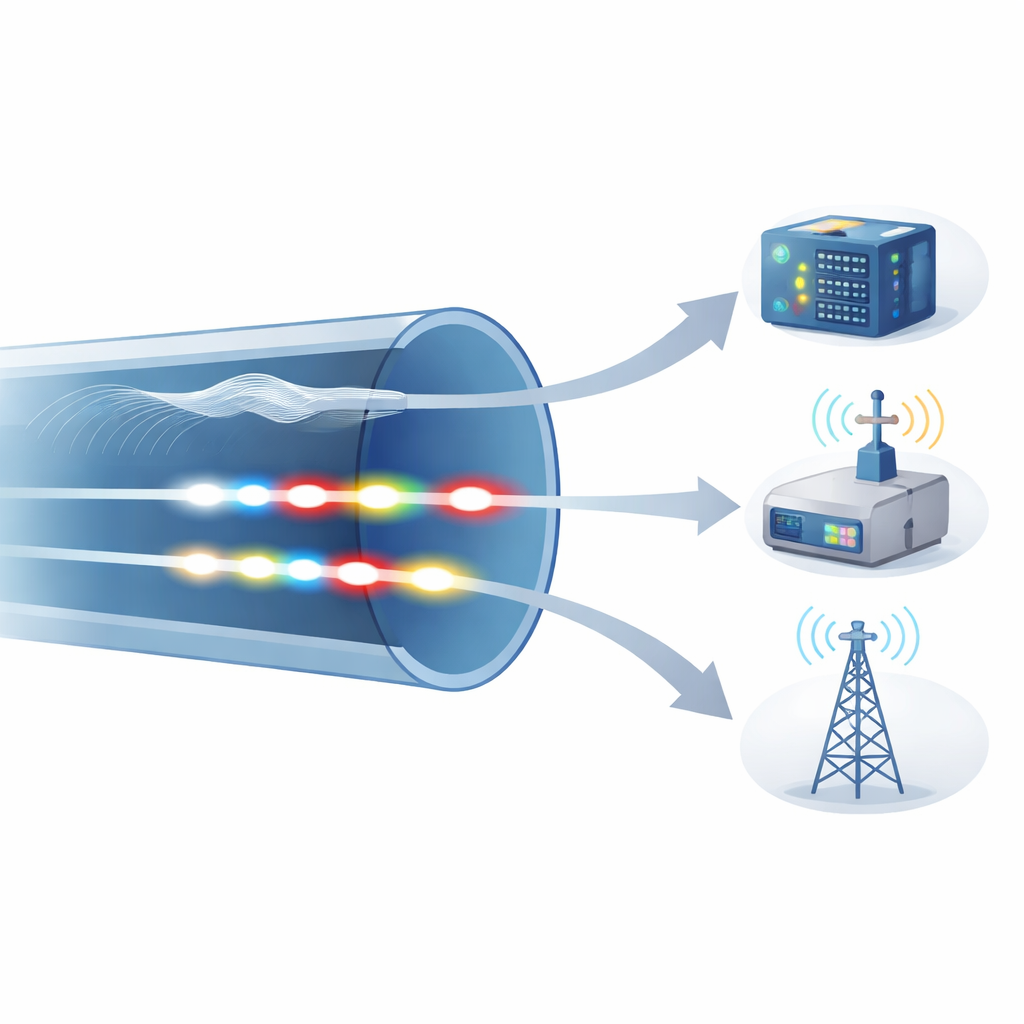
Modern technologies such as high‑speed internet, laser machining, and advanced sensing all depend on light pulses traveling long distances without blurring out. Normally, as light moves through glass fibers or other materials, it spreads and distorts, degrading the information it carries. This paper explores special self‑preserving light pulses, called solitons, and shows how a powerful mathematical framework can predict many different kinds of these robust pulses in realistic optical settings.
Light that resists spreading
In optical fibers and other media, two competing effects shape how a light beam evolves: dispersion, which tends to spread a pulse in time, and diffraction, which spreads it in space. At the same time, the material’s response to intense light can be nonlinear, meaning the medium changes as the light passes through it. Under the right balance of these ingredients, a light pulse can lock into a stable form that travels without changing shape. The authors focus on a widely used model, the so‑called paraxial equation, which captures how beams evolve in both space and time in such nonlinear media, and which underpins simulations for fiber optics, lenses, mirrors, and beam‑shaping systems.
Two mathematical lenses on the same problem
Instead of relying on numerical simulations alone, the study pursues exact analytical expressions for these self‑preserving light structures. The authors apply two enhanced solution techniques—the improved Sardar sub‑equation method and an improved Riccati equation method—to the paraxial equation. Both approaches start by converting the original wave equation, which depends on space and time, into a simpler equation for a single traveling profile. They then use carefully chosen auxiliary equations, whose solutions are well known, to build families of exact wave shapes that the original optical system can support.
A zoo of stable light pulses
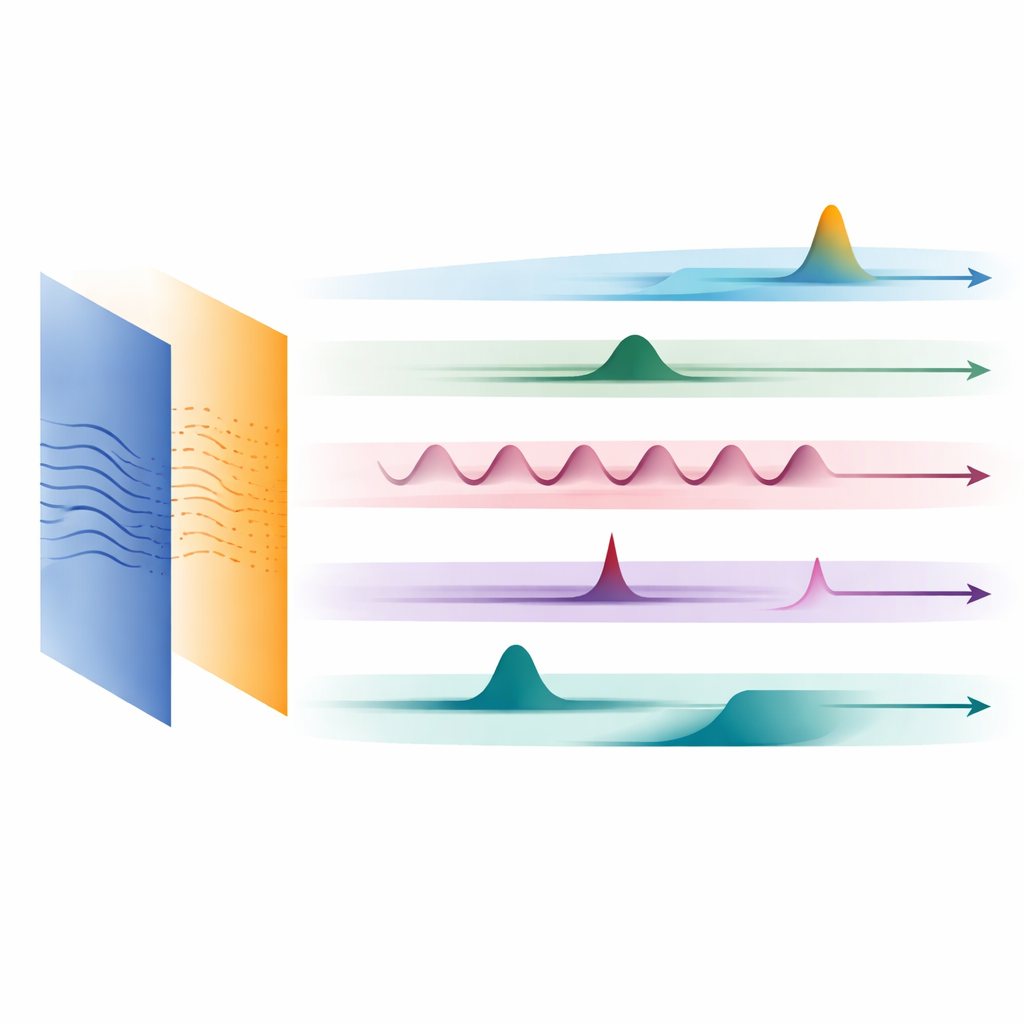
Using these two methods, the researchers uncover an unusually rich variety of soliton structures. They obtain pulses that are localized bright peaks riding on a dark background, dips of light intensity known as dark solitons, regularly repeating wave trains, sharp kink‑like steps, and even rogue‑wave‑like spikes that appear from an otherwise calm field. In total, the improved Riccati method yields 20 distinct solution families, while the Sardar‑based method produces 16 families, significantly extending earlier work that had identified far fewer solutions. The team visualizes these structures with three‑dimensional and two‑dimensional plots of amplitude, as well as of the real and imaginary parts of the light field, to show how each pattern behaves as it propagates.
From theory to future photonic devices
Although these results are mathematical, the waveforms they describe are directly relevant to practical devices. Bright solitons, for example, are promising information carriers in long‑haul fiber links because they maintain their shape and timing over large distances. Dark solitons offer robust signal channels in systems where a continuous light background is present, while periodic and kink‑type structures are linked to patterned energy flows and switching behavior in nonlinear media. Rogue‑like pulses, meanwhile, can represent extreme events that designers may wish either to harness or to avoid. By cataloging so many exact solutions, the paper provides a toolbox for engineers working on optical communication, beam shaping, pulsed lasers, and related technologies.
What the study ultimately shows
At its core, this work demonstrates that the standard model for light in nonlinear optical media can host a far broader spectrum of stable pulse shapes than previously recognized, and that these shapes can be written down in closed mathematical form. The two analytical methods introduced act like powerful searchlights, revealing families of solitons that earlier techniques missed. For non‑specialists, the takeaway is that we now have a more complete map of how light can organize itself into resilient structures inside fibers and other optical components. That deeper understanding should help guide the design of faster, more reliable, and more efficient photonic systems in communications, sensing, and even areas such as plasma waves and coastal engineering where similar wave equations arise.
Citation: Ibrahim, I.S., Sabi’u, J., Iqbal, M. et al. Exploring the new classes of optical soliton solutions with diverse structure for the (2+1)–dimensional paraxial equation in fiber optics via two analytical methods. Sci Rep 16, 12621 (2026). https://doi.org/10.1038/s41598-026-42607-8
Keywords: optical solitons, fiber optics, nonlinear waves, paraxial equation, laser pulse propagation