Clear Sky Science · en
Experimental and microstructural investigation on the strength and frost resistance of basalt fiber reinforced steel slag foamed concrete
Turning Waste into Winter-Ready Building Blocks
Modern cities generate mountains of industrial leftovers, and steelmaking slag is one of the biggest. This study shows how that gritty by‑product, when blended with a volcanic rock fiber and trapped air bubbles, can be transformed into an ultra‑light concrete that stays strong even through repeated freezing and thawing. For anyone interested in greener buildings and safer roads in cold climates, the work offers a glimpse of how re‑engineered micro‑bubbles and tiny fibers can make waste-based materials both lighter on the planet and tougher in service.
Why Steel Slag and Foamed Concrete Matter
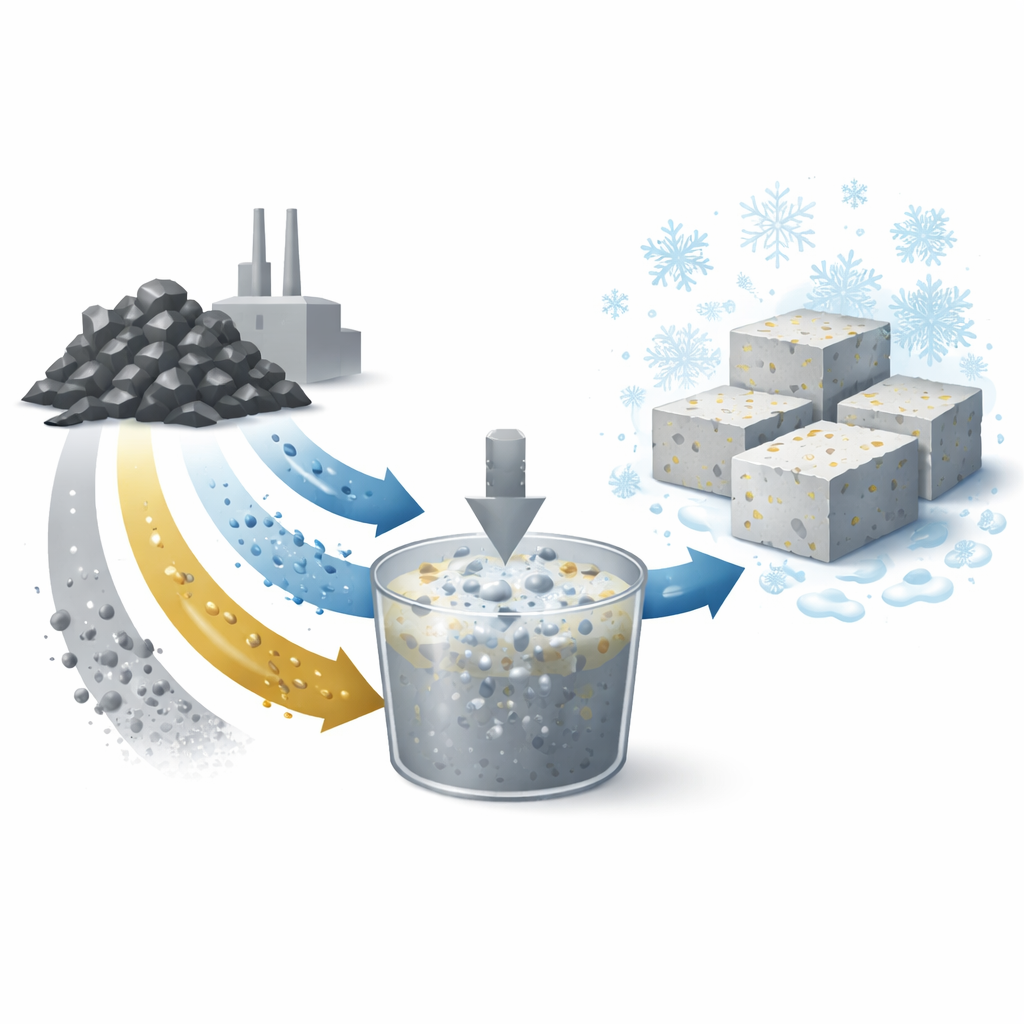
Steel slag normally piles up near mills, taking up land and posing long‑term environmental concerns. At the same time, the construction industry is searching for lighter, better‑insulating materials that cut cement use and carbon emissions. Foamed concrete—essentially concrete filled with tiny air pockets—is attractive because it is light and insulates well, but those same pores can make it weak and vulnerable to damage when water inside them freezes. By using steel slag powder as a partial substitute for cement, and then tailoring the bubbles and internal structure, the authors aim to create a light, insulating concrete that also recycles industrial waste.
Adding Volcanic Fibers for Extra Toughness
The researchers focused on reinforcing steel‑slag foamed concrete with basalt fibers, which are drawn from molten volcanic rock. These short, hair‑like strands have high strength and withstand heat, yet they are more environmentally friendly than many synthetic fibers. The team produced four versions of the material containing 0%, 0.15%, 0.30%, and 0.45% fiber by volume, while keeping the overall density low. They then measured how well each mix resisted compression and bending after seven and 28 days of curing. The 0.30% fiber mix stood out: its 28‑day compressive strength was about 12% higher than the fiber‑free version, and its ability to resist bending jumped by roughly two‑thirds. When too many fibers were added, however, the concrete actually became weaker, showing that more reinforcement is not always better.
How Tiny Pores Control Big Performance
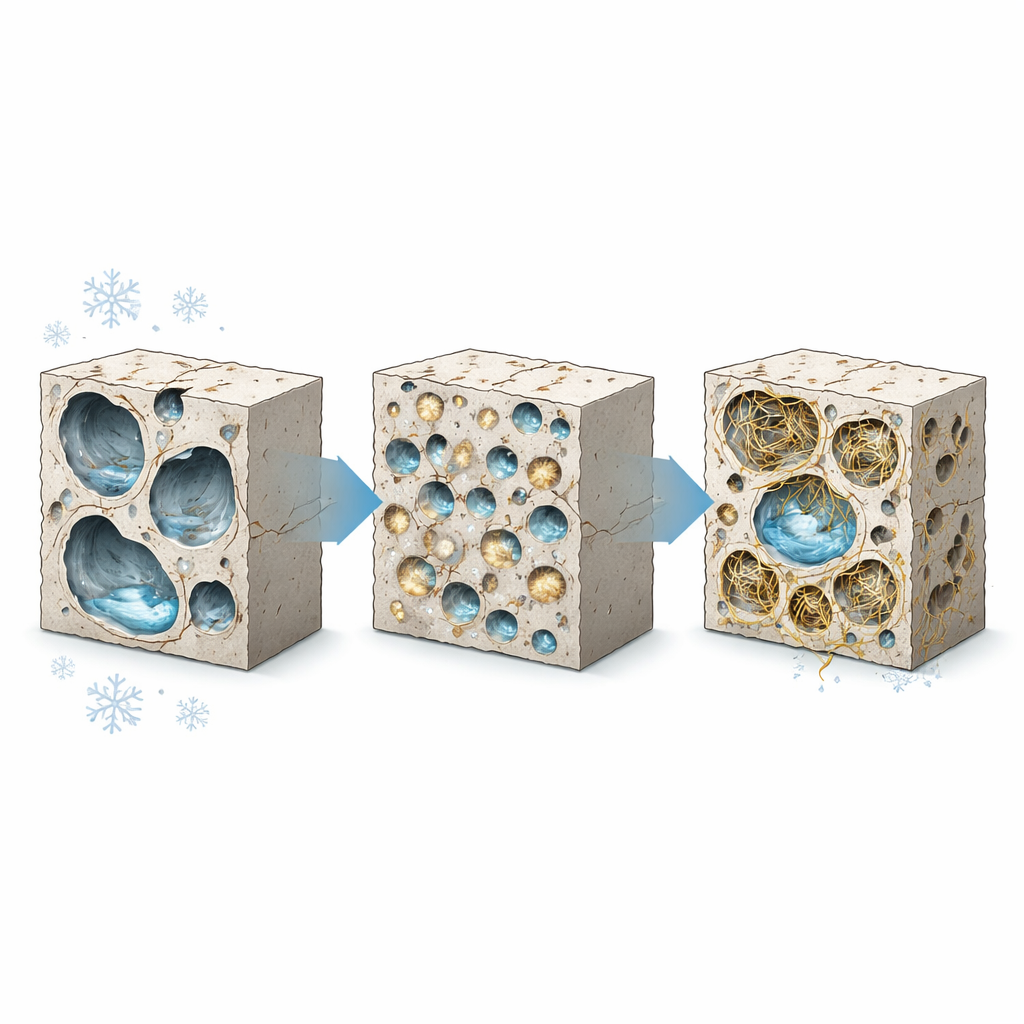
To understand why a modest dose of fibers worked best, the team peered inside the material using X‑ray CT scanning and electron microscopes. These tools revealed the three‑dimensional network of pores and the way fibers wove through the hardened paste. With about 0.30% fibers, the material contained more small, almost spherical pores and fewer large, irregular voids. The pore network was also less convoluted, meaning fewer complex, interconnected pathways for water to move through. Under the microscope, fibers could be seen bridging potential cracks and hugging the surrounding cement products and slag particles, creating a denser and more even internal structure. When fiber content was pushed higher, clumps formed, walls between pores thickened unevenly, and more large, connected voids appeared, undermining the gains.
Standing Up to Freeze–Thaw Punishment
The crucial test for cold regions is how well a material survives repeated cycles of freezing and thawing. The researchers soaked their samples, then exposed them to 15 controlled cycles of sub‑zero air and warm water. The fiber‑free concrete lost more than 30% of its strength and shed enough mass to fall outside engineering limits. In contrast, the mix with 0.30% basalt fiber lost less than 9% of its strength and kept mass loss under 5%, passing the relevant standards. Microscopic images after cycling showed that, in fiber‑reinforced mixes, pore walls remained more continuous and crack growth was restrained, while in the plain material, pores grew, micro‑cracks multiplied, and more fragile crystal forms filled the weakened matrix.
Connecting Invisible Features to Real‑World Durability
To link these observations, the authors used a statistical approach that ranks which pore features matter most. They found that the overall complexity of the pore network and the share of very large pores were most strongly tied to strength loss during freezing. Basalt fibers mainly influenced that network complexity: at the right dosage, they helped keep pores smaller, rounder, and less connected, making it harder for water and ice to create damaging pressures. For a lay reader, the message is straightforward: by carefully tuning the amount of natural rock fiber in a foamed, slag‑based mix, engineers can turn industrial waste into lightweight concrete that better survives harsh winters—offering both environmental benefits and improved safety for structures and roadbeds in cold regions.
Citation: Jiang, J., Chen, M., Yu, X. et al. Experimental and microstructural investigation on the strength and frost resistance of basalt fiber reinforced steel slag foamed concrete. Sci Rep 16, 13207 (2026). https://doi.org/10.1038/s41598-026-42606-9
Keywords: steel slag, foamed concrete, basalt fiber, freeze-thaw durability, pore structure