Clear Sky Science · en
Sustainable adhesive from waste expanded polystyrene: Performance governed by solvent-substrate interplay
Turning Foam Waste into Useful Glue
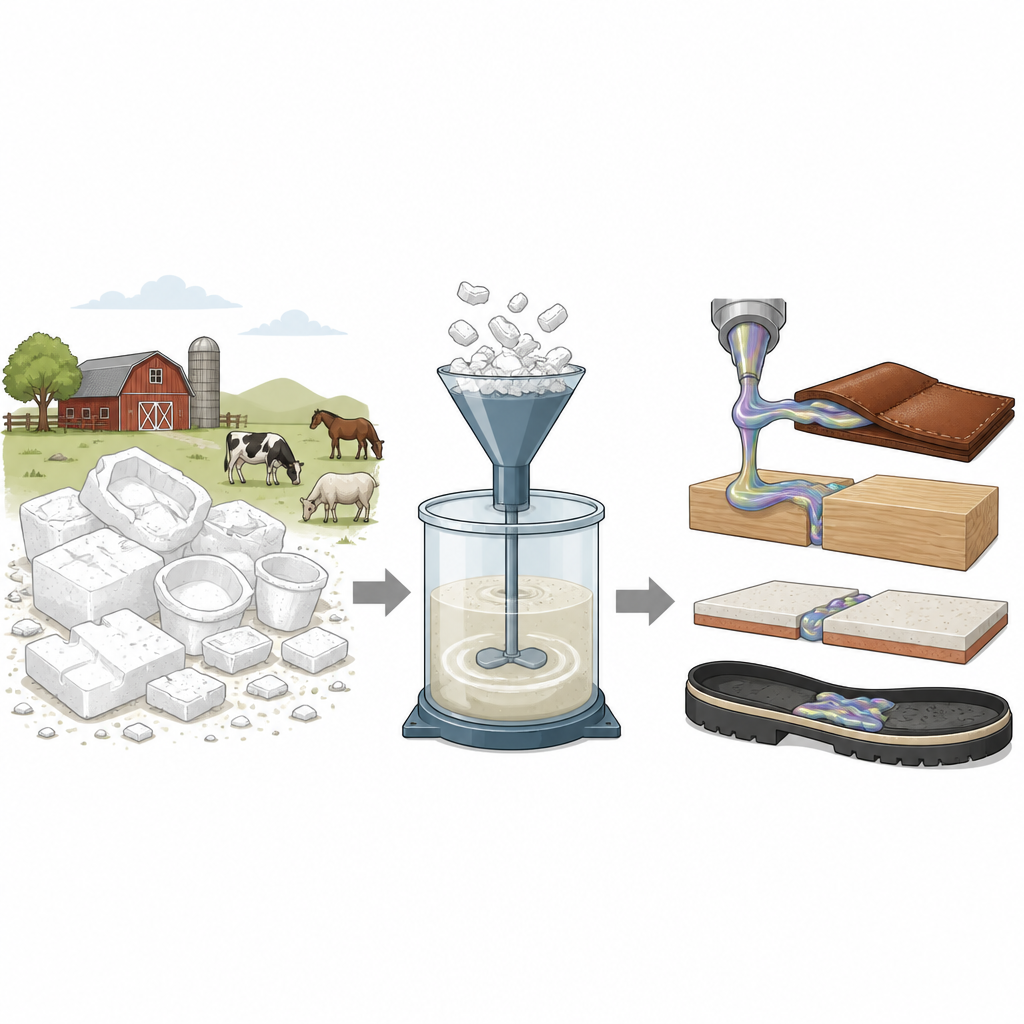
Most people know expanded polystyrene as the squeaky white foam that protects electronics or keeps take-out food warm. It is light, bulky, and hard to recycle, so it often ends up in landfills or scattered across fields and waterways. This study explores a clever way to turn that problem material into something useful: a strong, versatile glue that can stick wood, leather, ceramics, and even shoe soles together.
Why Foam Waste Is a Growing Problem
Expanded polystyrene (EPS) is produced in huge quantities worldwide for packaging and insulation. Because it is mostly air, a cubic meter weighs only about one and a half kilograms, yet takes up an entire cubic meter of space in a landfill. Winds easily blow the light pieces away, where they can break into fragments and litter farms, rivers, and oceans. Farmers have even seen sheep and goats nibbling on foam pieces, which can clog their digestive systems and harm their health. With current recycling rates very low, finding useful second lives for EPS is an urgent environmental need.
From Trash Foam to Sticky Solutions
The researchers collected used EPS packaging, shredded it, and dissolved it in several common organic liquids to create glue-like mixtures. They tested four main solvents: benzene, toluene, xylene, and methyl ethyl ketone (MEK). In some recipes they also added a second plastic, PMMA, to strengthen the mixture. By carefully measuring how well the foam dissolved, how quickly the liquid thickened as solvent evaporated, and how the glue flowed under stirring, they could predict how easy each formula would be to spread and how well it might grip different surfaces.
How Solvent Choice Shapes Glue Behavior
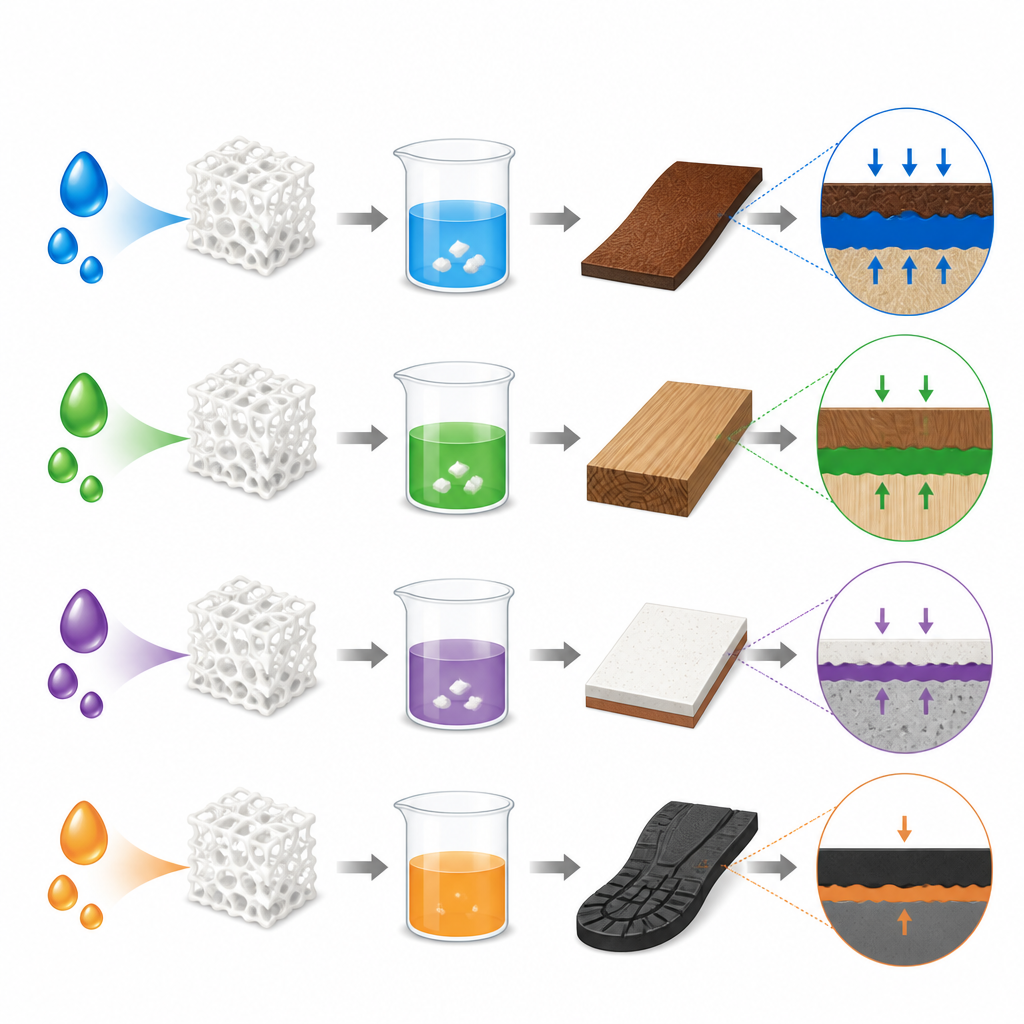
Different liquids pulled the foam apart with different success. Toluene dissolved EPS most readily, while MEK was least effective. The way the mixtures flowed was also important. Some behaved almost like simple oils, keeping a steady thickness as they were stirred, while others thinned slightly when moved. Glues that stayed nearly steady in thickness were easier to spread in smooth layers. Solvents also evaporated at different rates. Fast-evaporating mixtures formed a skin on the surface, which could trap solvent inside and change how the glue set. These combined effects of dissolving power, flow, and evaporation turned out to control how well the glue bonded to each material.
Finding the Best Match for Each Material
When the team tested the new glues, they found that no single recipe was best for everything. On non-polar leather, the xylene-based glue gave the highest bonding strength, helped by its stable flow and balanced evaporation that let the glue seep into tiny pores before setting. On wood, which is rich in water-loving groups, MEK-based glue worked better, likely because MEK can form temporary attractions with the surface, helping the glue grip more tightly. Adding PMMA to the MEK system created an even stronger network, tripling the measured strength on wood compared with many other recipes. All versions bonded so well to polyurethane foam, used in shoe soles, that the foam itself tore before the glue joint failed. On fragile ceramic tiles, standard pull tests were difficult, but simple hand tests showed that the bonded pieces resisted being pulled apart.
Balancing Strength and Safety
Turning EPS waste into glue supports a circular economy by shrinking landfill volumes and reducing the need to make new polystyrene from fossil fuels. However, some of the liquids used to dissolve the foam, such as benzene, are hazardous to health and the environment, and even the safer solvents must be handled carefully. The authors suggest that future work should look for greener liquids and study the exact bonding mechanisms in more detail, using surface tests and chemical probes to refine the recipes.
What This Means for Everyday Products
In simple terms, the study shows that waste foam can be transformed into a strong, practical adhesive if the liquid ingredients are matched to the surface being glued. By choosing non-polar liquids for materials like leather and more polar ones for wood, the team achieved glue strengths similar to commercial products, while giving used EPS a second life. This approach offers a way to reduce plastic waste and supply industries such as footwear and construction with new, waste-based materials that work with rather than against the chemistry of the surfaces they join.
Citation: Jobarani, R.A., Alkurdi, H. & Deri, F. Sustainable adhesive from waste expanded polystyrene: Performance governed by solvent-substrate interplay. Sci Rep 16, 15929 (2026). https://doi.org/10.1038/s41598-026-42596-8
Keywords: expanded polystyrene, recycled adhesive, plastic waste, wood bonding, sustainable materials