Clear Sky Science · en
Application of quick group search optimizer with passive congregation algorithm in cable force optimization of completed bridge of cable-stayed bridge
Why straighter bridges matter
Modern cable-stayed bridges are among the most eye-catching pieces of infrastructure on the planet. But behind their elegant lines lies a delicate balancing act: if the forces in the cables are not tuned just right, the towers can lean, the roadway can sag, and internal stresses can shorten a bridge’s life. This paper explores a new computer-based method to “retune” the forces in the cables of a large Chinese river crossing so that its towers stand straighter and its deck stays more level, all without changing the visible design.
How cable-stayed bridges keep their shape
In a cable-stayed bridge, dozens or even hundreds of steel cables fan out from tall towers to support the road deck. Under the bridge’s own weight, engineers want the finished structure to meet a simple rule of thumb: “straight towers and level girders.” In practice, this means limiting sideways movement at the top of the towers, keeping the roadway from drooping between supports, and avoiding excessive bending in the deck. Traditional calculation methods can satisfy some of these goals, but they often ignore tower stresses or require engineers to adjust cable forces by trial and error—a slow process for such complex structures.
Teaching a computer swarm to adjust the cables
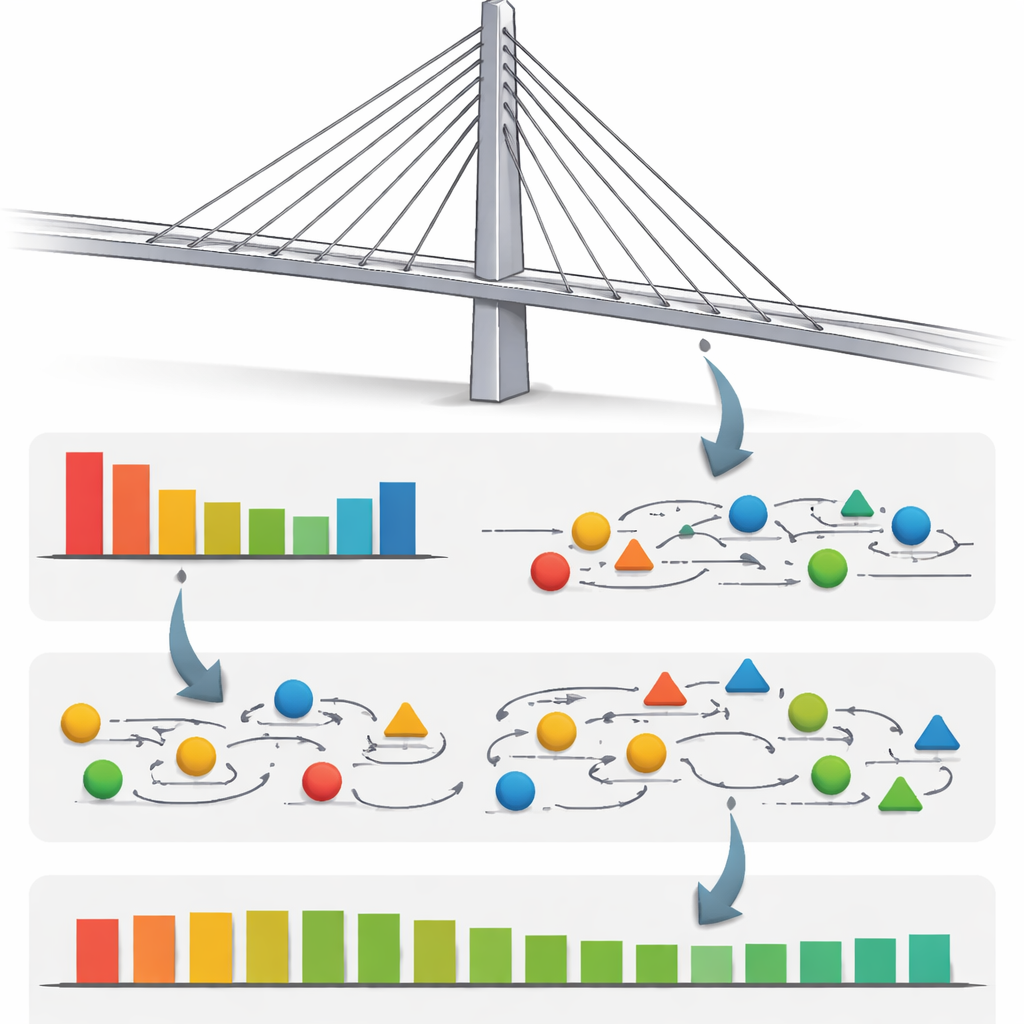
The authors turn to a family of search methods inspired by animal swarms to tackle this tuning problem more directly. They combine a standard engineering tool—an “influence matrix” that tells how each cable affects tower movement, deck deflection, and bending in the main girder—with an advanced search routine called the Quick Group Search Optimizer with Passive Congregation (QGSOPC). In simple terms, the computer treats each possible pattern of cable forces as an individual in a flock. Some individuals “explore” new combinations, some “follow” the best current solution, and others wander to keep the group from getting stuck. The influence matrix lets the program quickly predict how any trial pattern of forces will change the shape and stresses of the whole bridge.
Putting the method on a real giant bridge
To test the approach, the researchers applied it to a five-span, twin-tower cable-stayed bridge over the Xijiang River in Guangdong, China, with 208 stay cables and a main span of 580 meters. They built a detailed computer model of the bridge using standard structural software and then allowed only 26 representative cable pairs to vary, reflecting the bridge’s symmetry. The search algorithm’s task was to find cable forces that, under permanent weight alone, would reduce sideways drift at the tower tops, vertical sag of the deck, and peak bending in the main girder. At the same time, it had to keep cable forces within safe limits and avoid sudden jumps between neighboring cables, which could create local weak spots.
How much straighter and smoother the bridge became
The gains from the new method were striking. Compared with the original design, the optimized cable forces found by QGSOPC cut the tower-top sideways movement by about 84 percent, from 84.1 millimeters to just 13.6 millimeters—essentially turning a noticeable lean into a barely perceptible shift. The maximum sag of the roadway under its own weight dropped by around 42 percent, and the peak bending in the main girder fell by 11 percent. For comparison, a simpler relative of the algorithm, called Group Search Optimizer (GSO), did improve deck sag slightly more but actually made tower leaning worse and increased bending in the girder. Overall, a combined score measuring all three effects fell by 40.7 percent with QGSOPC, versus 40.3 percent with GSO, revealing that the newer method gives a more balanced and structurally friendly solution.
What the changes mean in practice
The optimized cable forces are generally higher than originally specified, sometimes by as much as 60 percent for individual cables, but still well below their strength limits. That may require stronger jacks and careful planning during construction, yet it does not demand thicker towers or a heavier deck, and safety checks remain satisfied. The study also notes that its results apply to the finished bridge under its own weight; long-term effects such as concrete creep, steel relaxation, temperature changes, and traffic loads are left for future work, as are direct comparisons with other popular search methods like genetic algorithms and particle swarms.
Simpler bridges through smarter tuning
For non-specialists, the takeaway is that computers can now “tune” cable-stayed bridges in much the same way a musician tunes a guitar—by subtly adjusting tensions until the whole system behaves as desired. The QGSOPC approach helps engineers find cable force patterns that keep towers upright, decks level, and internal stresses better balanced, all within realistic construction and safety limits. As this type of intelligent optimization is extended to include time, temperature, and traffic, it promises more reliable, longer-lasting landmark bridges without fundamentally changing their appearance—only the invisible balance of forces that holds them up.
Citation: Qin, G., Wang, L., Wu, Z. et al. Application of quick group search optimizer with passive congregation algorithm in cable force optimization of completed bridge of cable-stayed bridge. Sci Rep 16, 12770 (2026). https://doi.org/10.1038/s41598-026-42581-1
Keywords: cable-stayed bridge, cable force optimization, swarm intelligence, structural engineering, finite element analysis