Clear Sky Science · en
Avenanthramide C and chondroitin sulphate promote chondrogenic differentiation of adipose-derived mesenchymal stem cells
Why Joint Repair Matters
As people age, many develop aching, stiff joints that can make everyday activities painful. A key culprit is the slow breakdown of cartilage, the smooth, springy tissue that cushions bones in our knees, hips, and other joints. Because the cells that maintain cartilage have limited ability to renew themselves, damage often accumulates faster than the body can repair it. This study explores a new way to coax a patient’s own fat-derived stem cells to become cartilage-making cells more efficiently, using a natural oat compound and a common cartilage sugar as helpers.
Turning Fat Cells into Joint Builders
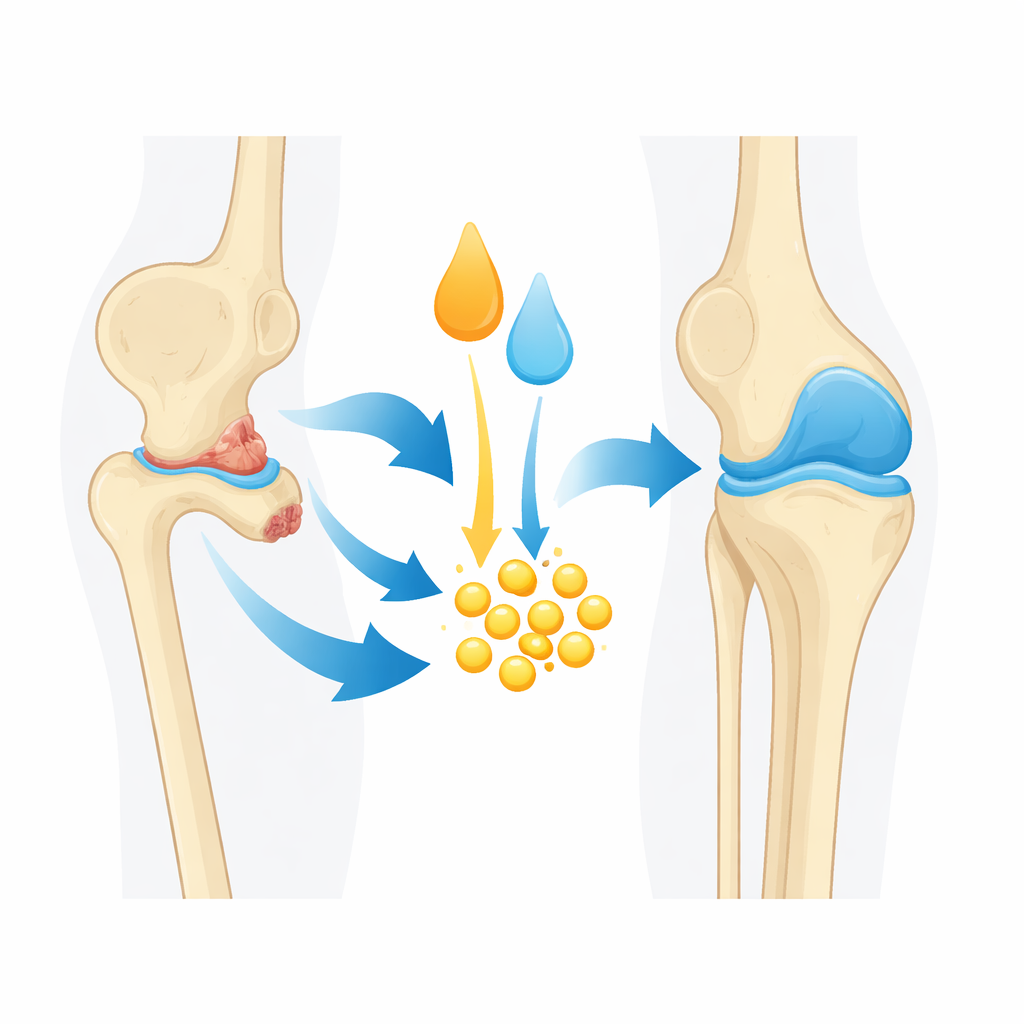
One promising strategy for fixing worn joints is to harvest mesenchymal stem cells from a person’s own body and nudge them to become cartilage-forming cells before putting them back into the damaged joint. Fat tissue is an attractive source because it is easier and less invasive to collect than bone marrow. However, existing lab recipes for steering these adipose-derived stem cells toward a cartilage fate do not work as well as doctors would like. The authors set out to see whether adding two specific ingredients—Avenanthramide C, a natural molecule found in oats, and chondroitin sulphate, a structural component of cartilage—could make these stem cells more likely to mature into robust cartilage cells.
Oat Compound Gives Cartilage Proteins a Boost
The researchers first grew human fat-derived stem cells in a standard cocktail known to promote cartilage-like behavior, and confirmed that over three weeks the cells changed shape and began to deposit the gel-like molecules typical of cartilage. They then tested different amounts of Avenanthramide C added to this cocktail. At a particular dose, the compound markedly increased the amount of type II collagen made by the cells. This collagen is the main fibrous protein in healthy cartilage and is usually absent from undifferentiated fat-derived stem cells. The finding suggests that Avenanthramide C does more than just protect existing cartilage from inflammation, as earlier work had shown—it also helps push stem cells toward a more authentically cartilage-like identity.
Cartilage Sugar and Oat Molecule Work Better Together
Next, the team combined Avenanthramide C with chondroitin sulphate, a sugar-rich molecule already known to support cartilage health and often taken as a dietary supplement. When both were added to the standard differentiation medium, the stem cells showed stronger signs of becoming true cartilage cells than with either ingredient alone. Under the microscope, the cells produced more intense staining for cartilage matrix, and they expressed higher levels of key genes linked to healthy articular cartilage, including those that encode major cushioning molecules and a receptor protein associated with protecting cartilage from breakdown. This combination appeared to make the lab-grown cells more similar to the specialized cells that line our joints.
Signals from the Cells Hint at Added Protection
Beyond looking at individual markers, the authors examined the collection of proteins that the cells secreted into their surroundings. Stem cells driven toward cartilage using the enhanced cocktail released more of certain protein families that help maintain tissue balance. These included inhibitors of enzymes that can chew up the cartilage matrix, as well as components of the immune complement system that help regulate inflammation. Although the full mix of proteins did not perfectly match that of native human cartilage cells, the pattern clearly shifted toward a profile associated with cartilage maintenance and protection, hinting that the treated cells might be better equipped to support joint health.

What This Could Mean for Sore Joints
Together, the results show that a natural oat compound and a cartilage sugar can act in concert to steer fat-derived stem cells more convincingly toward a cartilage-making role, and to encourage them to release proteins that help safeguard the joint environment. While these experiments were done in dishes rather than in living joints, they point toward a practical way to improve future cell-based therapies for arthritis and other cartilage injuries. If the approach holds up in animal studies and, eventually, in patients, it could bring us closer to using a person’s own cells, fine-tuned with gentle molecular cues, to rebuild worn-out joint surfaces and ease long-term pain.
Citation: Sun, P., Lim, W., Talchai, S.C. et al. Avenanthramide C and chondroitin sulphate promote chondrogenic differentiation of adipose-derived mesenchymal stem cells. Sci Rep 16, 13192 (2026). https://doi.org/10.1038/s41598-026-42579-9
Keywords: cartilage repair, mesenchymal stem cells, chondroitin sulfate, Avenanthramide C, regenerative medicine