Clear Sky Science · en
AI-assisted age estimation from occlusal tooth wear using biofluorescence imaging
Why Your Teeth Can Tell Your Story
As we go through life, our teeth quietly record the years. Every meal, every snack, and every nighttime clench leaves tiny marks on their biting surfaces. This study shows how a combination of special light-based imaging and artificial intelligence (AI) can read those marks to estimate a person’s age without drilling, X-rays, or guesswork. The approach could one day help in forensic investigations, large health studies, and even routine dental checkups.
Shining Light on Hidden Tooth Clues
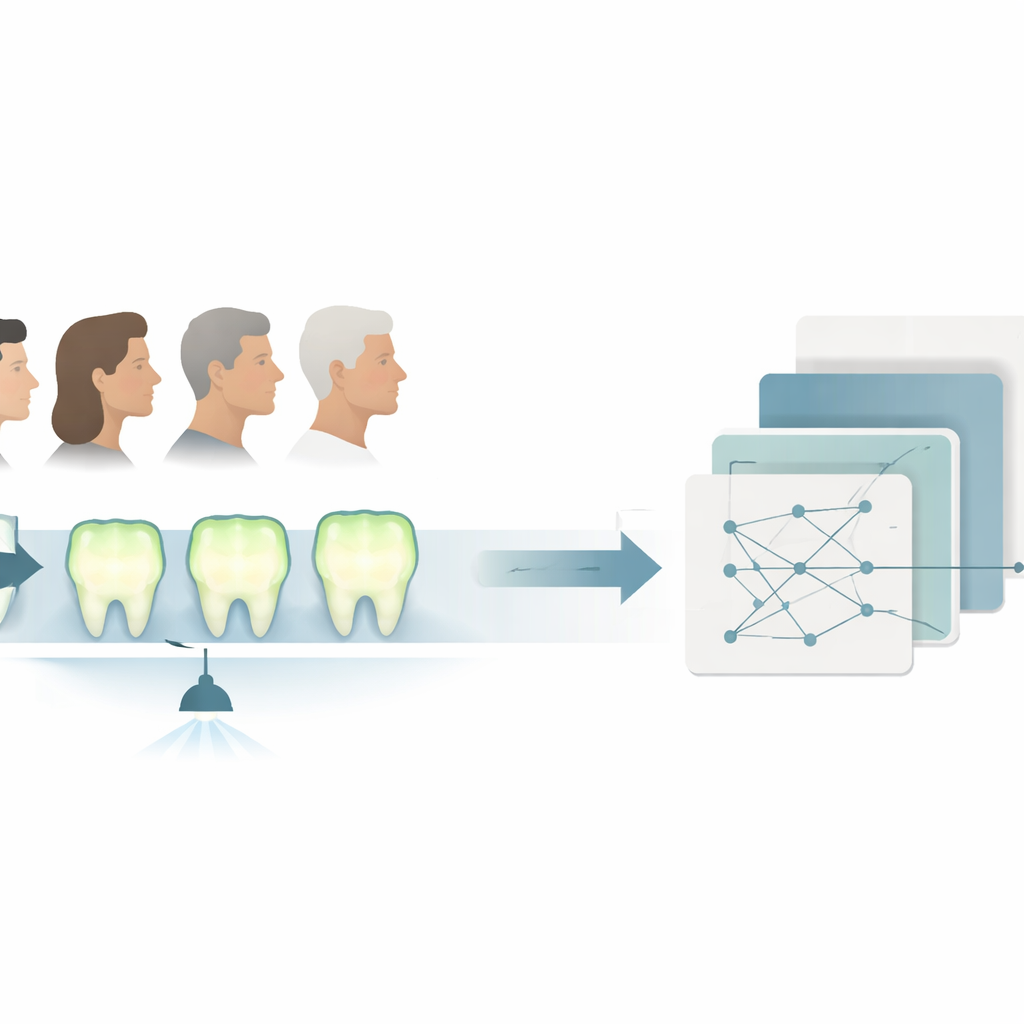
Teeth do not just reflect ordinary light; they also glow faintly when illuminated with certain colors. The researchers used a technique called quantitative light-induced fluorescence, which bathes teeth in violet-blue light and records the greenish glow that comes back. Normal enamel and worn areas glow differently, creating a measurable signal related to how much a tooth has been ground down over time. From these images, the team calculated a number, called a wear score, for the most worn area on each tooth, turning a fuzzy visual impression of wear into a precise measurement.
From Tooth Brightness to Age Numbers
The study analyzed more than 2,700 teeth from 104 adults aged 20 to 69. The scientists first checked whether their wear scores were trustworthy when measured twice, and they were highly consistent. They then looked at how the average wear score across all teeth related to a person’s actual age. The result was a strong upward trend: older people generally had higher scores, meaning more pronounced wear. This confirmed that the fluorescence-based measure was not just a technical curiosity but genuinely tracked age-related change in tooth surfaces.
Training an AI to Read Dental Time Stamps
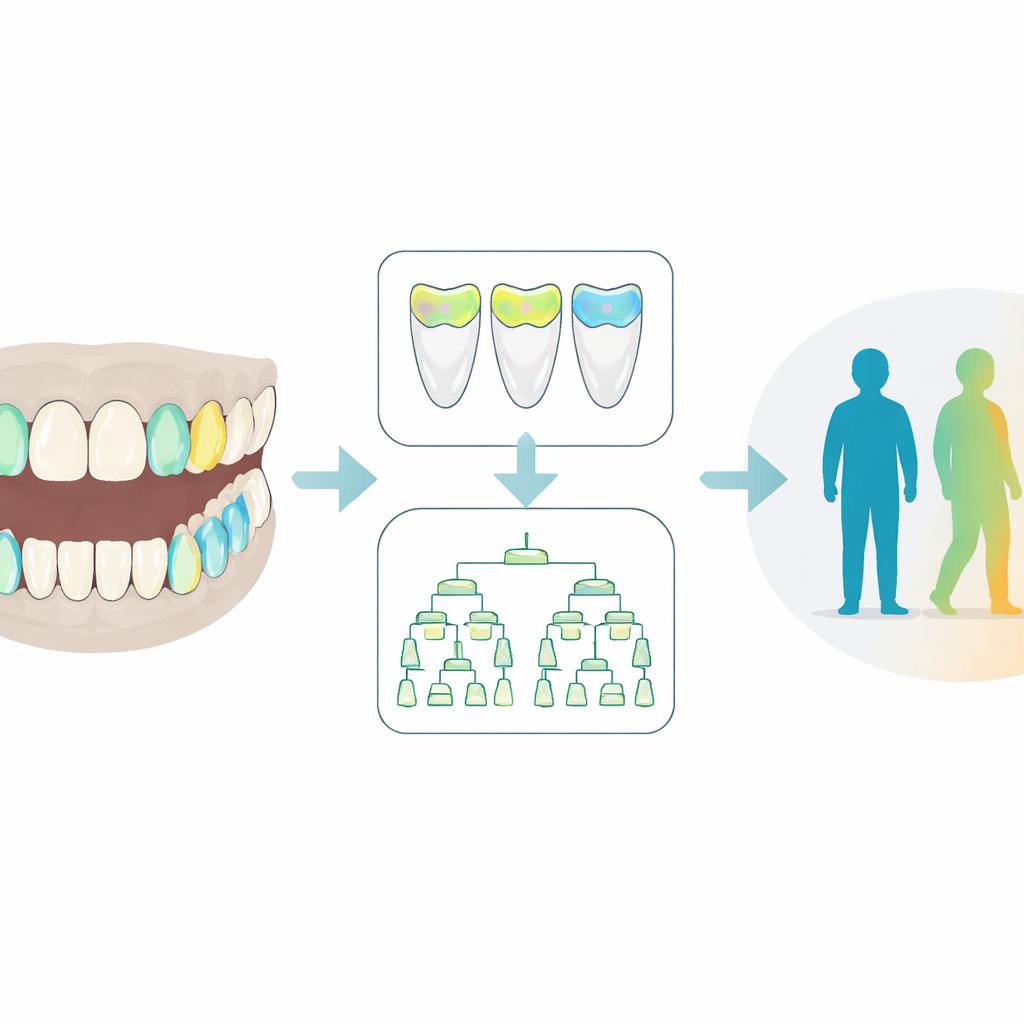
Next, the team asked whether a machine-learning model could combine the wear scores from many teeth to predict someone’s age. They used a method called a random forest, which blends the decisions of many simple decision trees to produce a single estimate. The data were carefully split so that the model learned from one group of people and was then tested on completely different individuals, avoiding overoptimistic results. After tuning the model’s settings, its typical error on unseen cases was about seven to eight years, comparable to many existing dental age methods that rely on X-rays or invasive sampling.
Finding the Few Teeth That Matter Most
Checking every tooth in the mouth can be slow and is not always possible, especially when teeth are missing or heavily restored. To make the system more practical, the researchers used an algorithm that systematically tried out different tooth combinations and kept those that preserved most of the predictive power. Surprisingly, they found that just seven strategically placed teeth—front and back, upper and lower—performed nearly as well as using the full set of 28 teeth. In fact, these seven teeth showed a slightly stronger link with age than the full mouth, suggesting that some teeth mostly add noise rather than helpful information.
What This Could Mean in Everyday Life
For non-experts, the takeaway is that our bite surfaces act a bit like a biological calendar, and that calendar can now be read by a camera and an interpretable AI model instead of by eye alone. The method is non-invasive, avoids radiation, and points toward portable systems that could estimate age in clinics, field studies, and forensic settings with only a handful of key teeth. The current work is an early proof-of-concept based on a modest number of participants, so larger and more diverse studies are needed. Still, it demonstrates that glowing patterns on worn teeth, filtered through transparent AI, can offer a practical new way to estimate how many years a person has lived.
Citation: Kim, SK., Lee, ES. & Kim, BI. AI-assisted age estimation from occlusal tooth wear using biofluorescence imaging. Sci Rep 16, 13145 (2026). https://doi.org/10.1038/s41598-026-42573-1
Keywords: forensic age estimation, tooth wear, biofluorescence imaging, dental AI, quantitative light-induced fluorescence