Clear Sky Science · en
Meta-analysis, WGCNA, and machine learning converge on a four-gene biomarker panel for heat stress tolerance in Solanum lycopersicum
Why hot weather is a problem for tomatoes
Tomatoes are a staple of kitchens and farms around the world, but they are surprisingly sensitive to heat. When temperatures climb above the mid‑30s Celsius, tomato plants grow poorly, flowers fail, and yields drop. As climate change makes heat waves more frequent, breeders urgently need simple ways to tell which plants can cope with high temperatures. This study looks inside tomato cells to find a tiny set of genes whose activity reliably signals whether a plant is under dangerous heat stress and how well it is responding.
Looking for a common heat signal in many experiments
Rather than running just one experiment, the researcher gathered raw RNA sequencing data from four independent tomato studies, covering 30 samples grown under normal and heat conditions. RNA sequencing measures which genes are switched on or off, and by how much, across the whole genome. By combining these datasets in a careful meta-analysis, the study boosts statistical power and filters out noise specific to any single experiment. After correcting for technical differences between studies, the analysis uncovered 526 genes whose activity consistently changed under heat: 225 became more active, while 301 became less active across the different experiments.
What tomato cells do when they overheat
The genes that ramped up under heat were strongly linked to protecting proteins from damage. They included many helpers that fold, refold, or stabilize other proteins and that help cells deal with harmful by-products like reactive oxygen molecules. In other words, when tomatoes overheat, they quickly redirect energy to basic survival: keeping essential proteins in working shape and limiting oxidative harm. The genes that quieted down told the other half of the story. Many were involved in plant hormones, secondary chemicals, and growth-related processes such as building cell walls and regulating development. Turning these down appears to be a deliberate strategy to conserve resources, pausing growth and some metabolic activities so that the plant can focus on surviving the heat.
Finding key groups of genes that act together
To go beyond single genes, the study used a network approach called co-expression analysis to see which genes tended to rise and fall together. This revealed three clusters, or modules, that were tightly linked to heat stress. One cluster mirrored the classic heat-shock response, rich in protein-protecting functions, while two others contained genes tied to growth, metabolism, and signaling that were suppressed in hot conditions. By intersecting these network hubs with the 526 heat-responsive genes, the researcher distilled the list down to 139 high-confidence candidates that are both strongly changed by heat and sit in the middle of important regulatory neighborhoods. These 139 genes became the starting point for a more focused search for a practical biomarker panel.
Using machine learning to narrow the field
From this shortlist, two different machine learning methods were applied to ask which genes best separate heat-stressed samples from normal ones. One method, a support vector machine with recursive feature elimination, repeatedly removed the least useful genes until it found a compact set that still classified samples with very high accuracy. The second, a technique called LASSO regression, favored a small group of genes with the strongest predictive power. Despite using different mathematical strategies, both approaches converged on the same four genes. Together, this four-gene signature could distinguish heat-stressed from control samples with about 98.5% accuracy, and each gene alone showed strong predictive performance when tested one by one. 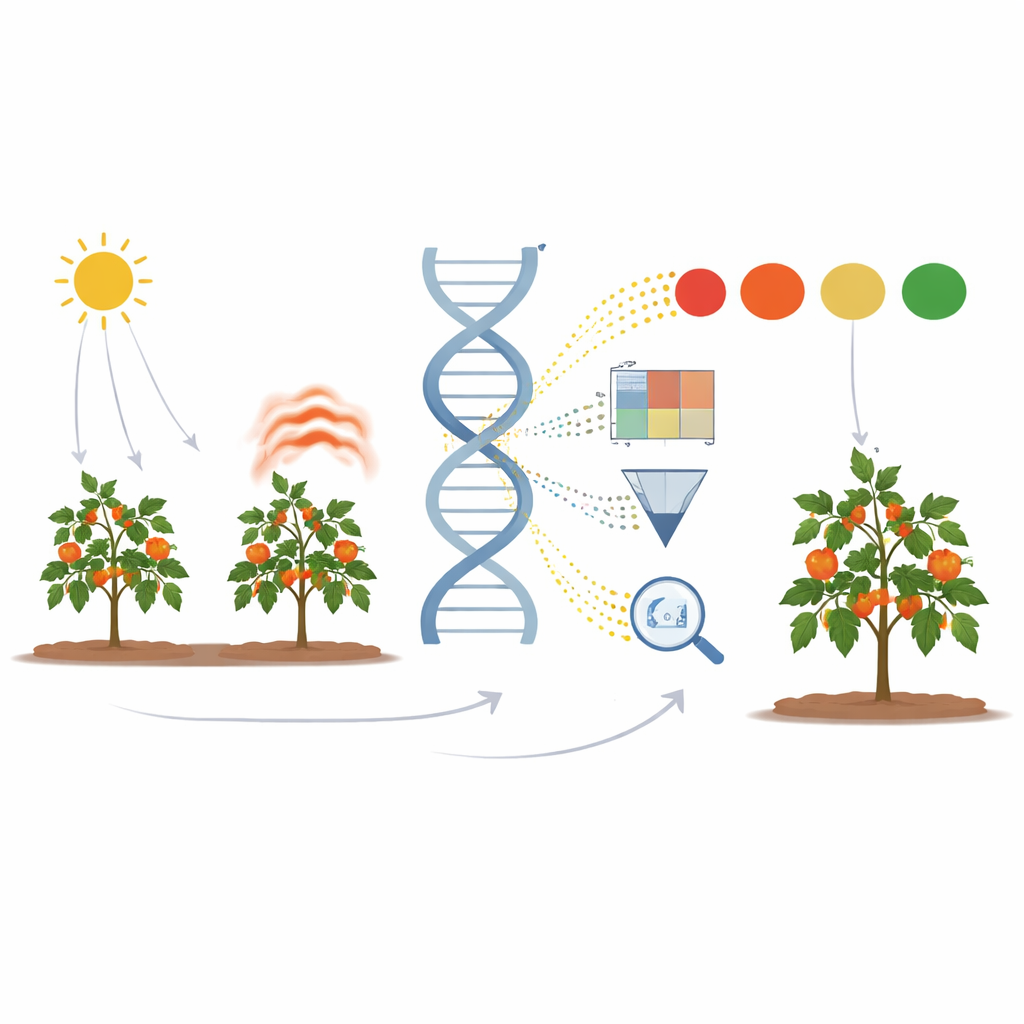
What the four genes reveal about heat-tolerant tomatoes
The four genes capture two complementary sides of the plant’s response. One encodes a small heat shock protein, a molecular “bodyguard” that helps keep other proteins from clumping or breaking down during heat waves. A second, ACS3, is a key enzyme in the production of ethylene, a hormone that influences flower and fruit development and can shape how reproductive organs tolerate high temperatures. The remaining two genes mark regulatory switches: one linked to a family of stress-responsive factors that can turn protective programs on, and another connected to hormone and growth control that tends to be dialed down when heat strikes. Across the combined datasets, a simple pattern emerges: protective chaperone genes rise, while growth- and ethylene-related genes drop, in plants under heat. 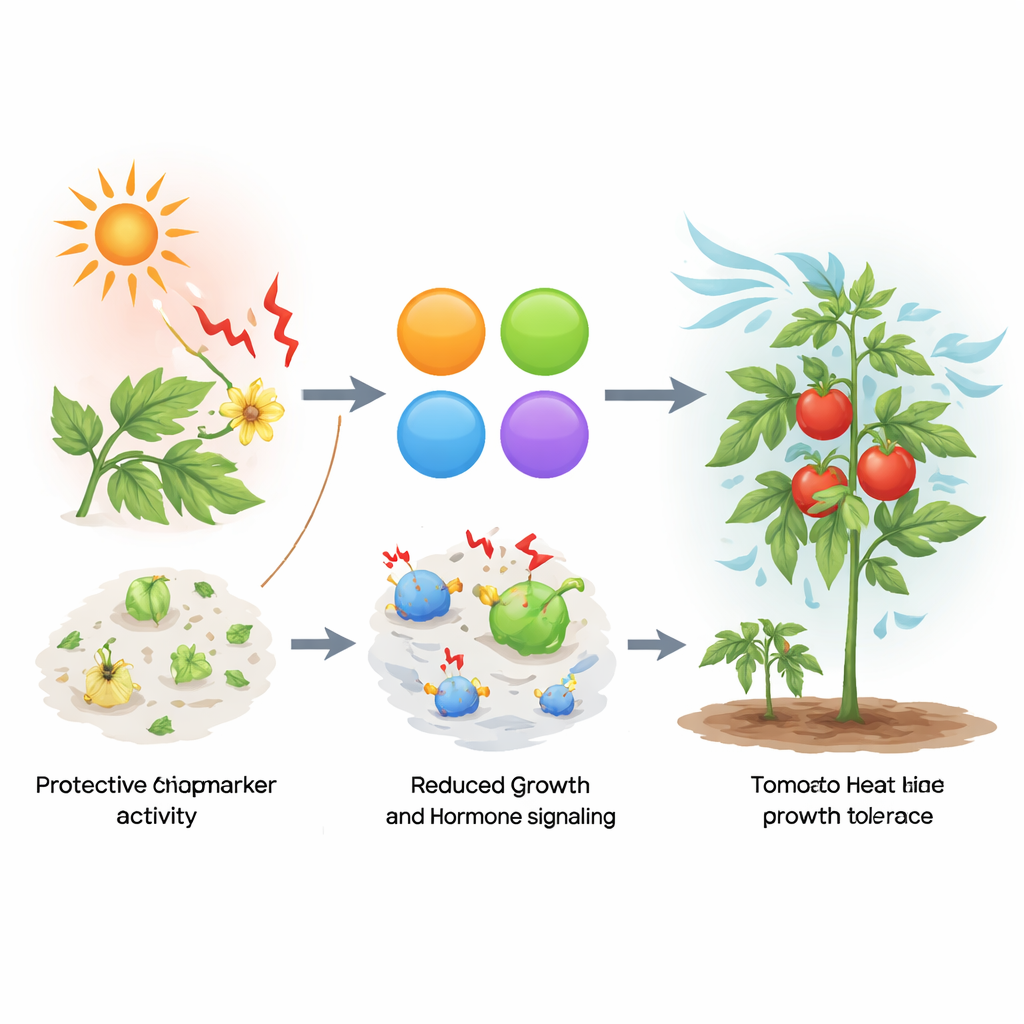
What this means for future tomato breeding
For non-specialists, the key message is that tomato heat tolerance may be tracked—and eventually improved—by watching just a handful of genes. This four-gene panel is not yet a ready-made test for farmers, but it offers breeders and plant scientists a powerful starting point. By measuring these genes in different varieties and conditions, researchers can more quickly spot promising heat-tolerant lines and design targeted follow-up experiments. In a warming world where securing stable harvests is increasingly difficult, such compact genetic markers could help speed the development of tomato plants that keep producing reliably, even when the weather turns extreme.
Citation: Karimi-Fard, A. Meta-analysis, WGCNA, and machine learning converge on a four-gene biomarker panel for heat stress tolerance in Solanum lycopersicum. Sci Rep 16, 14312 (2026). https://doi.org/10.1038/s41598-026-42561-5
Keywords: tomato heat stress, crop climate resilience, plant stress genes, molecular breeding, machine learning in genomics