Clear Sky Science · en
Contrasting effects of biochar and compost on greenhouse gas emissions and the global warming potential of semi-arid cropping systems
Why dryland farms matter for the climate
Vast stretches of the American West are farmed under hot, dry conditions where soils are easily damaged and harvests depend on every drop of water. These semi‑arid fields also quietly breathe out greenhouse gases, adding to global warming. This study asks a simple but urgent question: if we add different kinds of organic matter to worn‑out soils—specifically compost or biochar—can we both rebuild the soil and dial down its climate impact?
Two very different ways to feed the soil
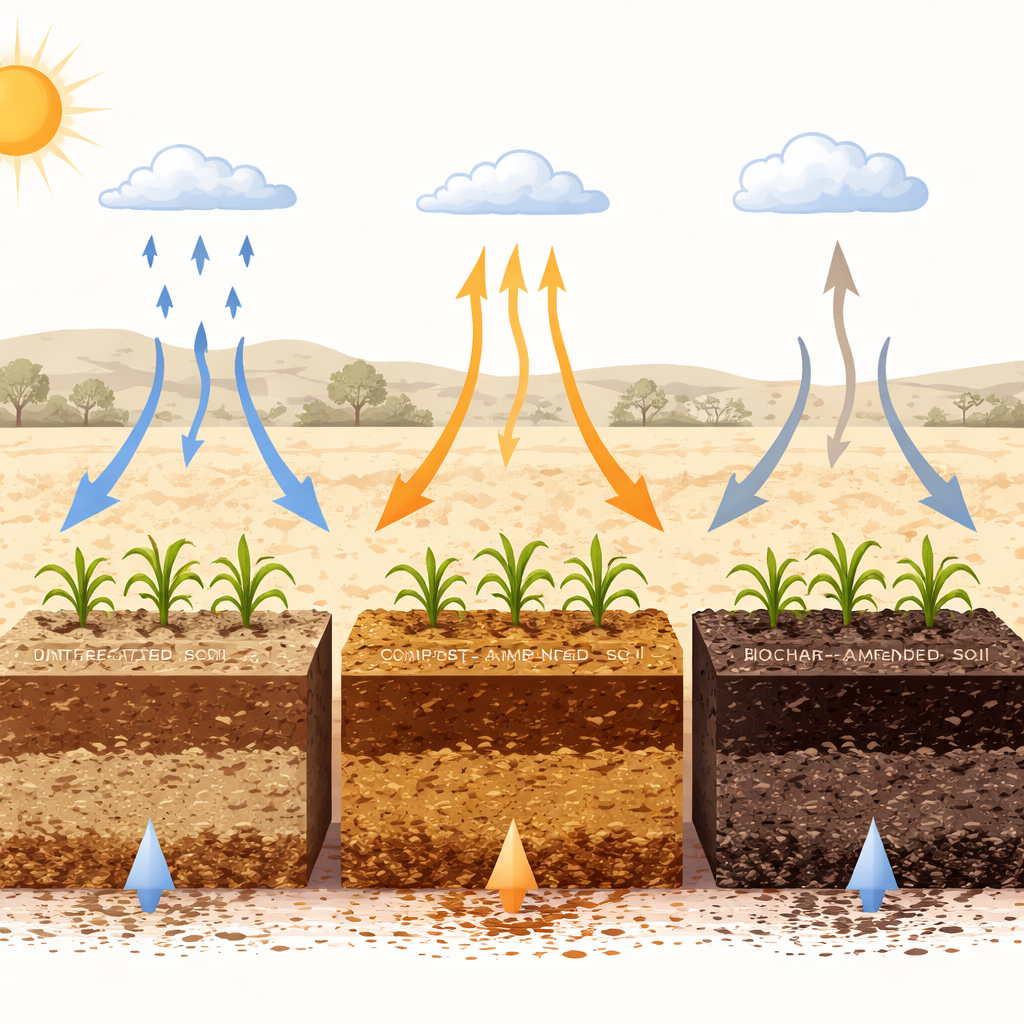
The researchers worked on a sorghum field in eastern New Mexico, where rainfall is low and temperatures swing widely through the year. They compared four plots: one left untreated, one given dairy compost, one given wood‑based biochar (a charcoal‑like material made by heating plant matter with little oxygen), and one receiving both compost and biochar. All plots were fertilized and irrigated in the same way. The key gases monitored were carbon dioxide (from soil and root respiration), nitrous oxide (a powerful greenhouse gas linked to nitrogen fertilizers), and methane (which soils can either emit or absorb).
Watching the soil breathe around the clock
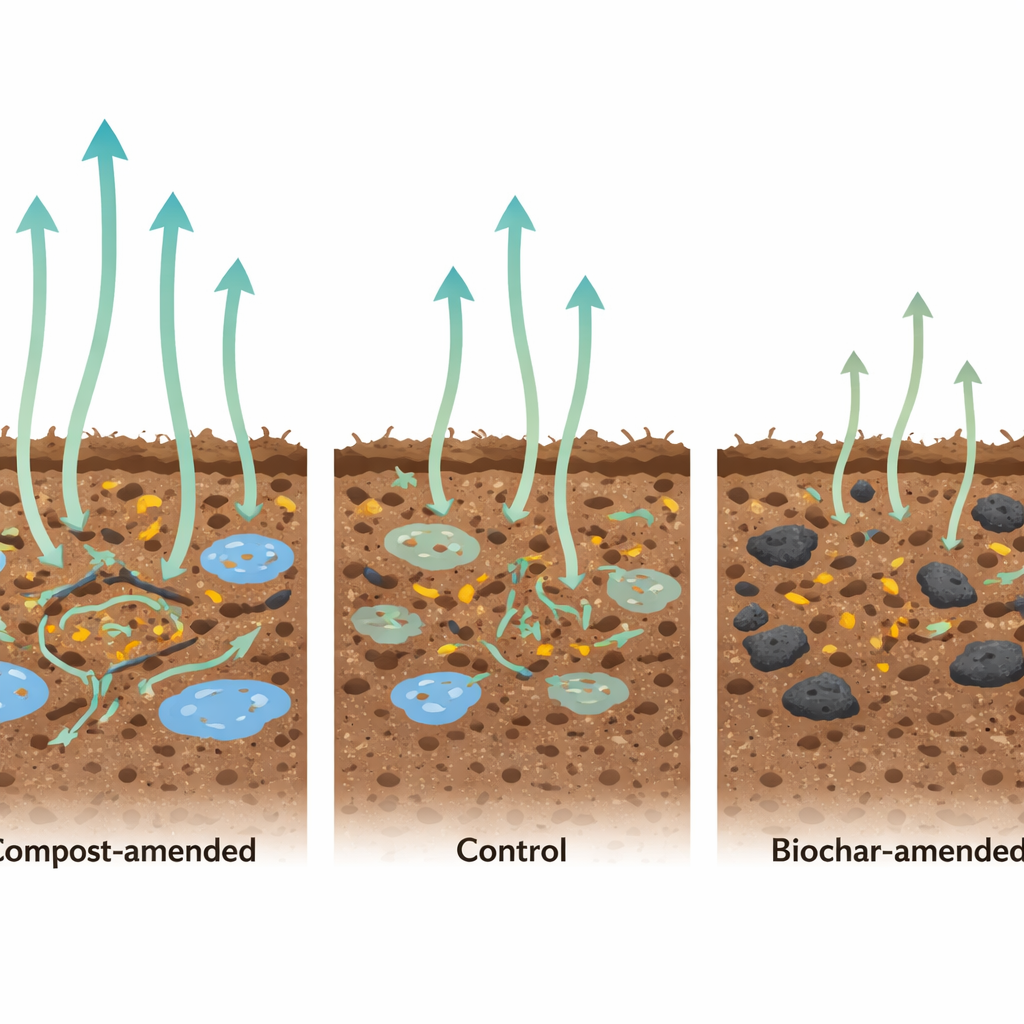
Instead of taking only occasional measurements, the team used automated chambers that sampled gases every two hours from April through October. This high‑frequency monitoring captured daily cycles, brief bursts after storms or irrigation, and longer seasonal shifts. Emissions rose and fell with soil moisture and temperature: nitrous oxide spiked after wetting events when microbes had both nitrogen and water to work with, while carbon dioxide climbed on warm afternoons as soil life and plant roots respired more intensely. Methane behaved differently—these dryland soils were mostly a net sink, drawing methane from the air rather than releasing it.
Biochar cuts key greenhouse gases
The contrasting soil amendments produced clearly different climate footprints. Compost‑amended plots showed strong nitrous oxide surges, especially in early summer, when warm, moist conditions allowed microbes to feast on readily available nitrogen and carbon. By contrast, biochar‑treated soils released 52% less nitrous oxide and 16% less methane than the control, while remaining strong methane sinks. Biochar’s porous structure adsorbs nitrate and improves aeration, which appears to slow the microbial pathways that generate nitrous oxide and to favor organisms that consume methane. Biochar plots did emit slightly more carbon dioxide overall, likely because they had warmer, better‑aerated soil that stimulated microbial respiration, but this modest rise was outweighed by the large cuts in nitrous oxide and methane.
Seasons, roots, and water pulses reshape emissions
The presence of crops changed the story over time. During the sorghum growing season, average carbon dioxide emissions were about three‑quarters higher and nitrous oxide almost half again as large as in the bare‑soil period, reflecting vigorous root growth, root exudates, and faster nutrient cycling. Yet methane uptake also strengthened in the cropped months. Across treatments, the biggest nitrous oxide pulses followed irrigation and rain, when soils briefly shifted from dry and oxygen‑rich to wetter, microbe‑friendly conditions. Statistical analyses showed that soil moisture explained much of the variation in nitrous oxide, while temperature more strongly shaped methane behavior.
Weighing total warming from field to fertilizer
To estimate overall climate impact, the authors converted each gas to its carbon‑dioxide equivalent over 100 years and added emissions from farm operations, irrigation, fertilizer manufacture, and producing the amendments themselves. Compost raised net warming potential compared with the untreated control, largely because it decomposed quickly and because compost production releases substantial carbon dioxide. Biochar, despite emissions from its manufacture, delivered the lowest net warming and greenhouse gas intensity per kilogram of grain. The mixture of compost and biochar fell in between, gaining some soil‑carbon benefits but losing much of biochar’s nitrous‑oxide advantage due to extra available nitrogen.
What this means for future dryland farming
For farmers and policymakers seeking climate‑smart practices in dry regions, the message is clear: how we feed the soil matters as much as how much we feed it. In this New Mexico field, biochar stood out as a way to rebuild semi‑arid soils while substantially cutting nitrous oxide and methane emissions, even when accounting for the energy used to make it. Compost remains valuable for nutrients and organic matter but, on its own, can increase a field’s overall warming footprint. The study also shows that capturing short‑lived emission bursts with continuous monitoring is essential for honest climate accounting. Together, these findings support targeted incentives and further research into biochar as a long‑term strategy to make dryland crops both productive and kinder to the climate.
Citation: Madhuwanthi, P., Ghimire, R., Sapkota, S. et al. Contrasting effects of biochar and compost on greenhouse gas emissions and the global warming potential of semi-arid cropping systems. Sci Rep 16, 12380 (2026). https://doi.org/10.1038/s41598-026-42554-4
Keywords: biochar, compost, semi-arid agriculture, greenhouse gas emissions, soil amendments