Clear Sky Science · en
Improving multi-variable weather forecasting with spatiotemporal feature interaction and large-kernel modeling
Why better local weather forecasts matter
Weather touches nearly every part of daily life, from farming and flying to keeping the lights on and preparing for storms. Yet traditional computer-based weather prediction is costly to run and can still miss sudden local changes, especially over complex landscapes with mountains, basins, and plains. This study explores how modern artificial intelligence can learn from past weather to produce faster and more accurate forecasts for specific regions, by teaching computers to read how temperature, moisture, and winds influence one another over time and space. 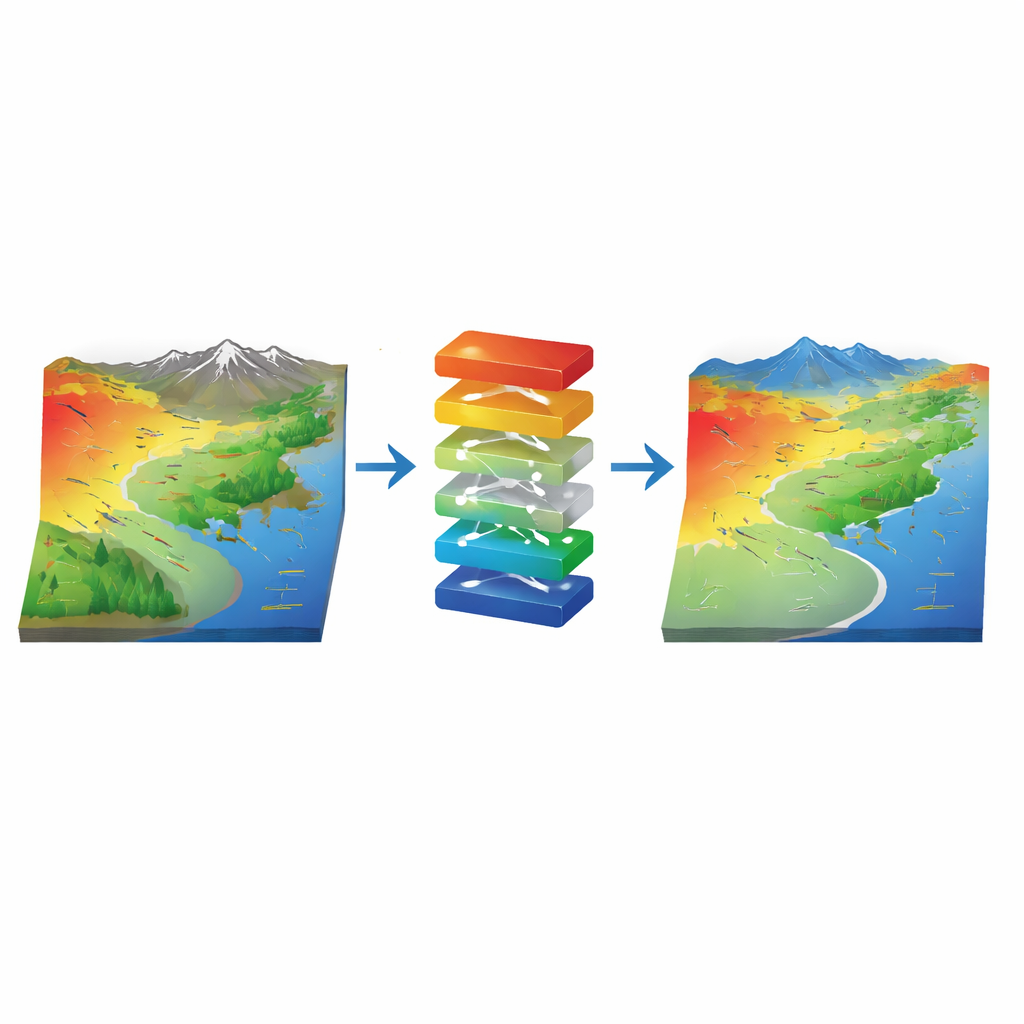
Looking beyond one weather variable at a time
Many recent AI-based weather systems treat forecasting as a problem of predicting one map at a time, such as temperature alone, and often do so step by step into the future. In reality, the atmosphere is a tightly coupled system: temperature, dew point (a measure of moisture), and winds all shift together in patterns that stretch across hundreds of kilometers and unfold over several days. The authors first analyze data over southern China, a region with rugged terrain and varied climate, and show that these variables differ strongly between valleys, plateaus, and plains, yet still display synchronized swings across distant areas. This confirms that useful forecasts must pay attention to both local differences and long-distance connections, and must treat several weather fields as a linked whole rather than isolated pieces.
Blending many weather fields into one picture
To reflect this reality, the researchers design a Multi-factor Fusion Network, a type of neural network that takes in four weather variables at once: temperature, dew point, and the two horizontal wind components. Instead of simply stacking these inputs, the network creates separate branches that specialize in each variable and a fusion branch that combines them. A cross-attention mechanism allows information to flow back and forth: patterns in temperature can highlight which wind features matter, while moisture fields can sharpen the understanding of temperature changes, and so on. This guided blending helps the model form a richer internal picture of the atmospheric state, where each variable is interpreted in the context of the others rather than in isolation.
Seeing weather patterns near and far
The second key ingredient tackles how weather patterns evolve over space and time. Many existing deep-learning models use small image filters that see only tiny neighborhoods and must be stacked many times to sense larger structures like fronts or organized wind bands. The authors replace these with a “large-kernel” design inside a recurrent unit called NLK-LSTM, which is then stacked into a full forecasting system named NLKRNN. These large filters can span much wider areas in a single step while still preserving fine details, and the recurrent design maintains two kinds of internal memory: one focused on how patterns change over time and another on how they spread across layers of the network. Together, these features allow the model to track both slow, broad shifts and quicker, localized changes in the atmosphere. 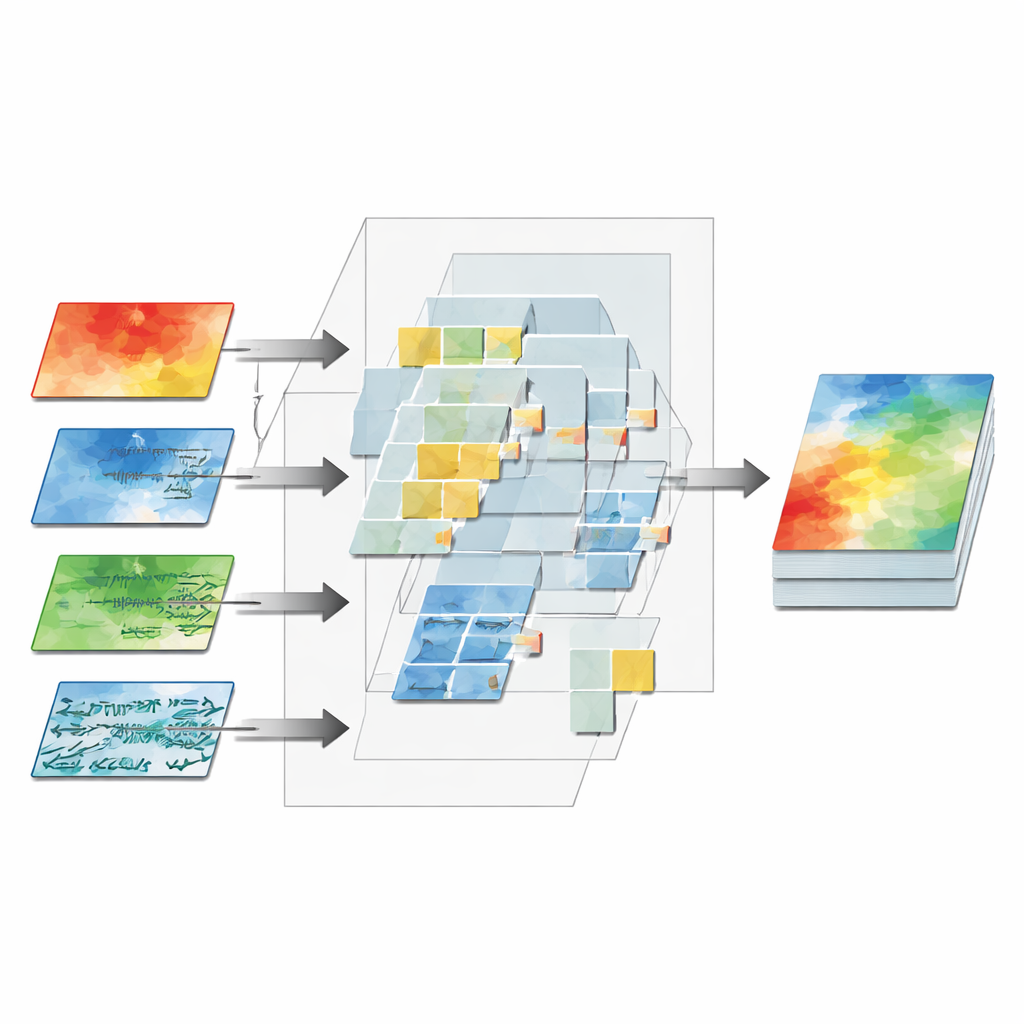
Testing the model in a real regional setting
The team trains and evaluates their system on a high‑resolution dataset covering several years of hourly weather over southern China, using about five years for training and more recent years for validation and testing. They ask the model to predict 72 hours ahead, all at once, for all four variables. Against simple baselines such as “tomorrow looks like now” or long‑term averages, and against well-known deep learning models used for spatiotemporal prediction, the new approach consistently reduces typical forecast errors. It also does a better job capturing the spatial structure of temperature and moisture fields and produces more coherent wind forecasts when both wind components are considered together. Detailed experiments show that each part of the design—the fusion network, the large-kernel module, and a loss term that keeps different memory streams from becoming redundant—contributes to these gains.
What this means for future local forecasts
In plain terms, this work shows that teaching AI models to consider how several weather variables interact, and to look at both nearby and distant regions at once, can noticeably sharpen regional forecasts. While not meant to replace global weather centers, the proposed system offers a lighter‑weight tool that can be tailored to specific areas and run with more modest computing power. Such models could help improve planning for heat waves, heavy rain, and wind‑sensitive operations at regional scales. Looking ahead, the authors suggest extending their approach to finer‑scale data, longer forecast ranges, and more practical, real‑time applications, moving toward a new generation of fast, data‑driven local weather guidance.
Citation: Ye, Y., Fei, J. & Gao, F. Improving multi-variable weather forecasting with spatiotemporal feature interaction and large-kernel modeling. Sci Rep 16, 13196 (2026). https://doi.org/10.1038/s41598-026-42553-5
Keywords: regional weather forecasting, deep learning, spatiotemporal modeling, multi-variable data, large-kernel neural networks