Clear Sky Science · en
Systemic risk mitigation in supply chains through network rewiring
Why the Health of Supply Chains Matters to Everyone
Empty shelves, soaring prices, and factory shutdowns have made supply chains a kitchen‑table topic. From pandemic lockdowns to wars that choke off food and energy, small glitches in the web of suppliers and customers can snowball into nationwide disruptions. This study asks a deceptively simple question: could we rearrange who buys from whom in an economy so that shocks spread less, without actually producing less? Using detailed data from two countries, the authors show that modest changes to existing supplier relationships could cut the risk of large‑scale breakdowns by up to half — all while keeping output essentially unchanged.
The Fragile Web Behind Everyday Products
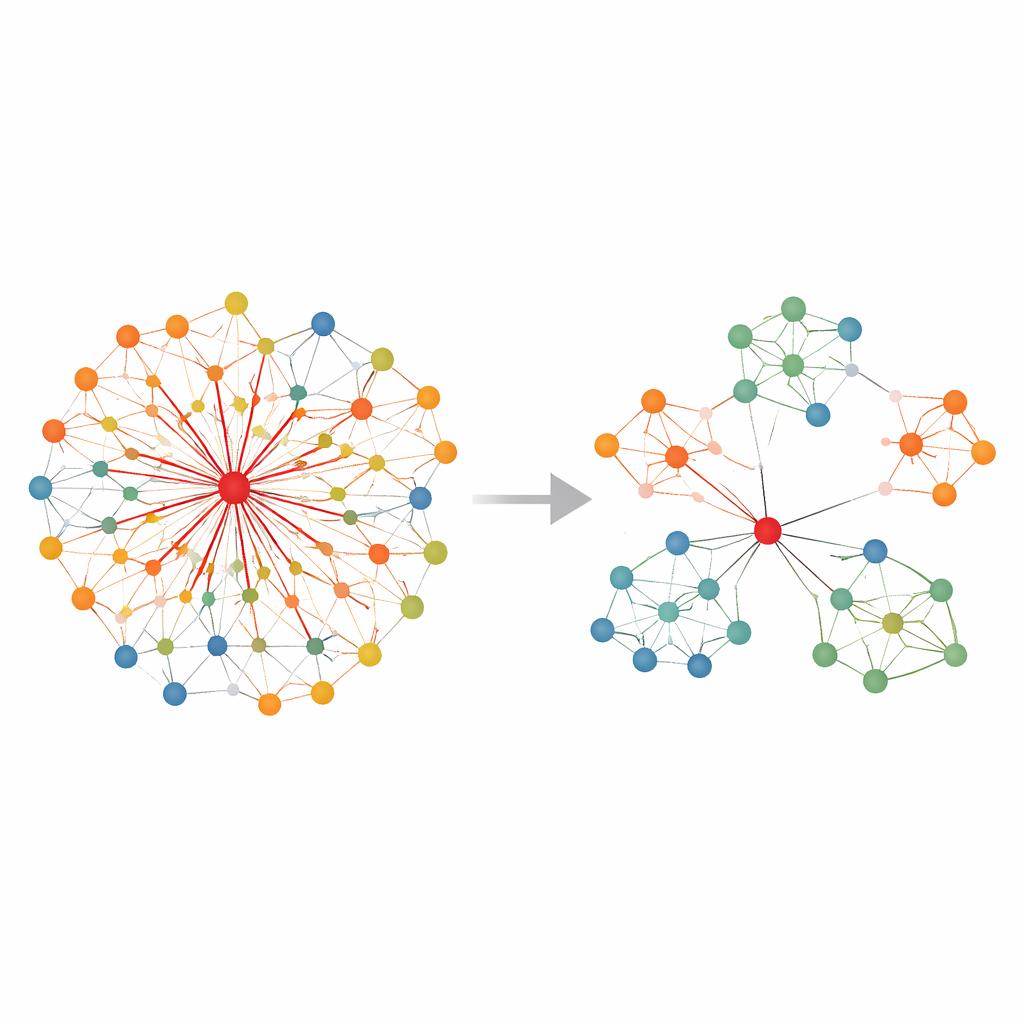
Modern economies are built from vast networks of firms that buy inputs, turn them into products, and sell them on. In this web, each company is a node and each supplier–customer relationship is a link that carries goods and services. Because these links tie firms together, the temporary failure of a single company — due to a flood, a pandemic shutdown, or a geopolitical crisis — can ripple through its customers and suppliers, causing them to cut production as well. Earlier research introduced a measure called the Economic Systemic Risk Index (ESRI), which estimates how much of a country’s total production would be affected if one firm suddenly stopped producing. It revealed that only a tiny fraction of firms carry a disproportionately large share of this systemic risk, and that their importance is not simply a matter of size or revenue.
Rewiring the Network Without Slowing Production
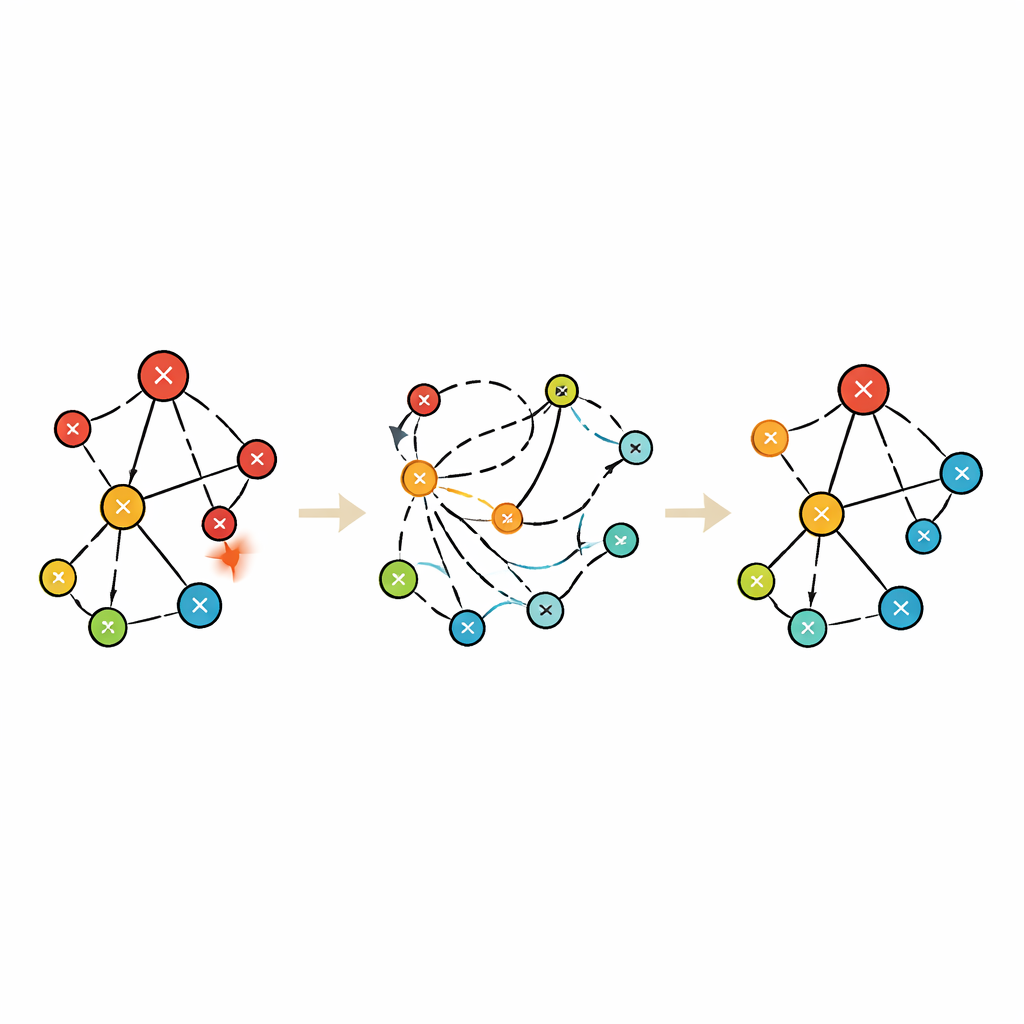
The central idea of this paper is to treat the supply chain like a rewritable network. Instead of changing what firms make or how much capacity they have, the authors consider only changes in who supplies whom. They design a link‑swapping procedure that respects several realistic constraints: each firm must keep roughly the same total output, must draw the same mix of products as inputs, and can only switch to suppliers that provide comparable goods or services. In practice, this means that a supply link between two firms can be swapped with another similar link, or split and partially exchanged, as long as these conditions remain nearly intact. A Monte Carlo search, inspired by methods from statistical physics, explores huge numbers of such rewired networks and preferentially keeps those in which the average ESRI across firms is lower, gradually homing in on safer configurations.
Real‑World Tests in Food and Car Industries
To see how much risk could realistically be removed, the authors apply their algorithm to six actual production subnetworks built from tax records in Ecuador and Hungary. These subnetworks focus on specific slices of the economy, such as processing of fish and crustaceans, soft drinks manufacturing, food production, and the automotive industry, each involving about a thousand firms and thousands of supply links. Starting from the observed real‑world configuration, they iteratively rewire links and recalculate ESRI after each step. Depending on the sector, the resulting networks show systemic risk reductions between 16% and 50%, with no reduction in firms’ production levels. Notably, similar improvements are possible even when only the pattern of connections is known, and not the volume of each transaction, underscoring that the way firms are connected can matter as much as how big those connections are.
Hidden Structures, Not Simple Statistics
One might expect that familiar network statistics — such as how many links firms have on average, how clustered the network is, or how many firms lie on tightly interconnected loops — would explain why some configurations are safer than others. Yet, when the authors compared these measures before and after rewiring, they found no simple pattern that accounted for the drop in systemic risk. While some features, like mutual two‑way trading relationships, tended to decline, this alone did not drive the improvements. Instead, the results point to the importance of subtle “meso‑scale” structures: groups of mutually connected, high‑impact firms that form a systemic risk core. Rearranging who sits in this core, and how it connects to the rest of the economy, can dramatically shrink the size of cascades triggered by a single failure.
What This Means for Policy and Business
The study concludes that actual production networks are far from optimal when it comes to preventing cascading failures. Firms naturally choose suppliers based on price, quality, reliability, or geography, but they rarely see — let alone manage — the broader systemic risk their choices create. The authors show that, at least in principle, modest, targeted supplier changes on the scale of the normal yearly “churn” in business relationships could markedly reduce the chance that a local shock turns into a nationwide crisis. Turning this potential into practice would require new data infrastructures to monitor firm‑level supply links, along with incentives or insurance schemes that reward companies for choosing less risky configurations. While many practical and fairness questions remain, the key message is clear: by paying attention not only to individual firms but to the shape of the network that connects them, societies could build supply chains that are both efficient and far more resilient.
Citation: Zelbi, G., Ialongo, L.N. & Thurner, S. Systemic risk mitigation in supply chains through network rewiring. Sci Rep 16, 12334 (2026). https://doi.org/10.1038/s41598-026-42549-1
Keywords: supply chain resilience, systemic risk, production networks, network rewiring, cascading failures