Clear Sky Science · en
Research on key technologies for privacy-preserving, regulatorily compliant, and cross-chain interoperability in heterogeneous blockchain systems
Why connecting blockchains now matters
Blockchains were meant to move value as easily as the internet moves information. In reality, today’s blockchains resemble isolated islands: money and data are trapped on separate networks that barely talk to one another. At the same time, people want strong privacy for their transactions while governments demand clear oversight against crime. This paper presents a new technical blueprint that tries to satisfy all three sides at once: open connectivity between blockchains, strong privacy for users, and tools that regulators can actually use.
The problem of isolated and exposed value
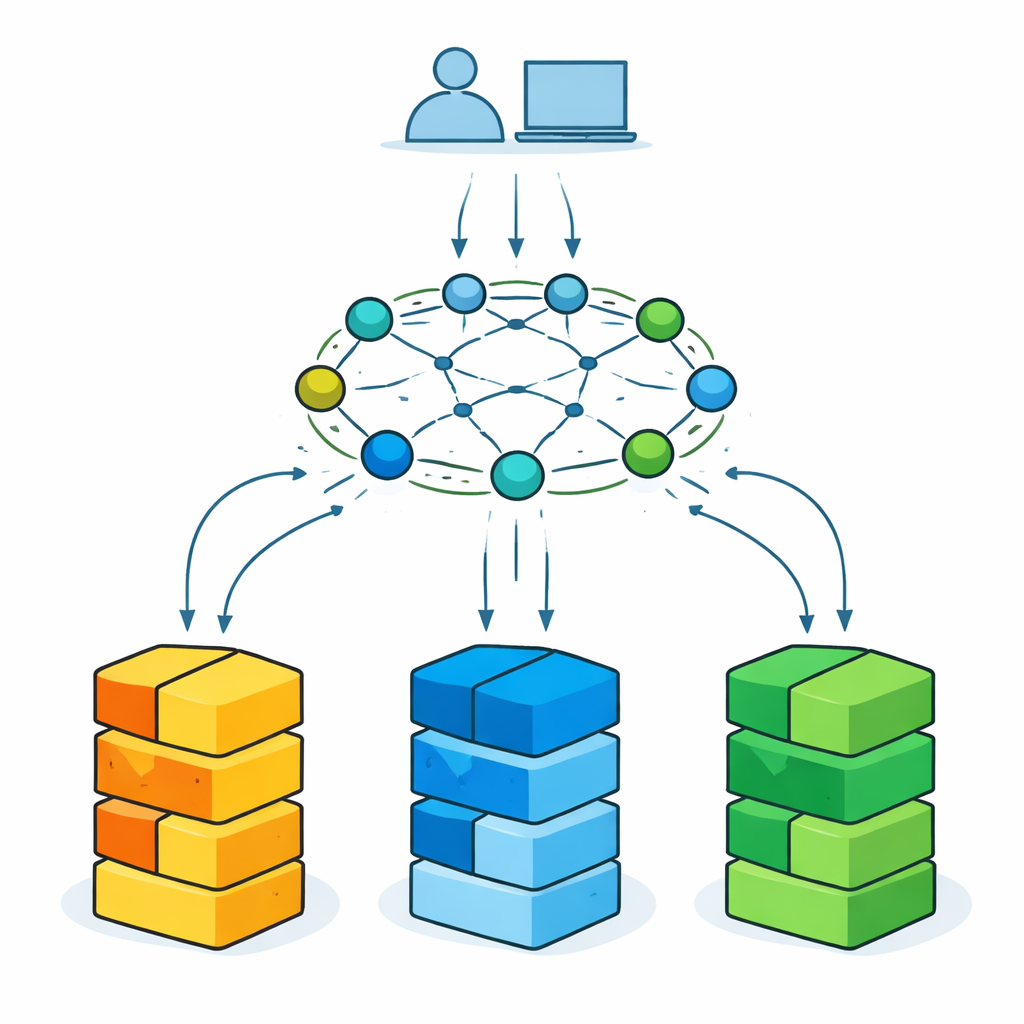
As more blockchains have appeared—public coins, consortium chains, finance platforms—they have evolved very differently under the hood. That diversity creates “value silos”: assets on one chain cannot easily move to another without going through fragile, often centralized bridges. Existing approaches force trade-offs. Some are fast but depend on a few trusted middlemen. Others are more decentralized but clumsy, support only simple swaps, or are too slow and expensive. On top of that, many cross-chain designs either leak transaction details, undermining privacy, or hide everything so completely that regulators cannot see abuse, which attracts scrutiny and limits real-world adoption.
A new three-layer blueprint
The authors propose a three-layer architecture designed to break this deadlock. At the bottom sit many different blockchains, each running its own code and rules. Above them lies a new protocol layer built around three coordinated components. First is a distributed threshold network, a group of independent nodes that collectively act as a neutral bridge. Instead of any single operator holding the keys, many nodes must cooperate to authorize cross-chain actions, greatly reducing the risk that one party can steal or censor funds. Second is a privacy-preserving verification protocol, which lets those nodes check whether a cross-chain request is valid while only seeing encrypted or split-up data. Third is a key-shared supervision protocol that brings regulators into the same privacy-preserving computations so they can judge suspicious activity without seeing everyone’s raw transactions.
How private checks and shared oversight work
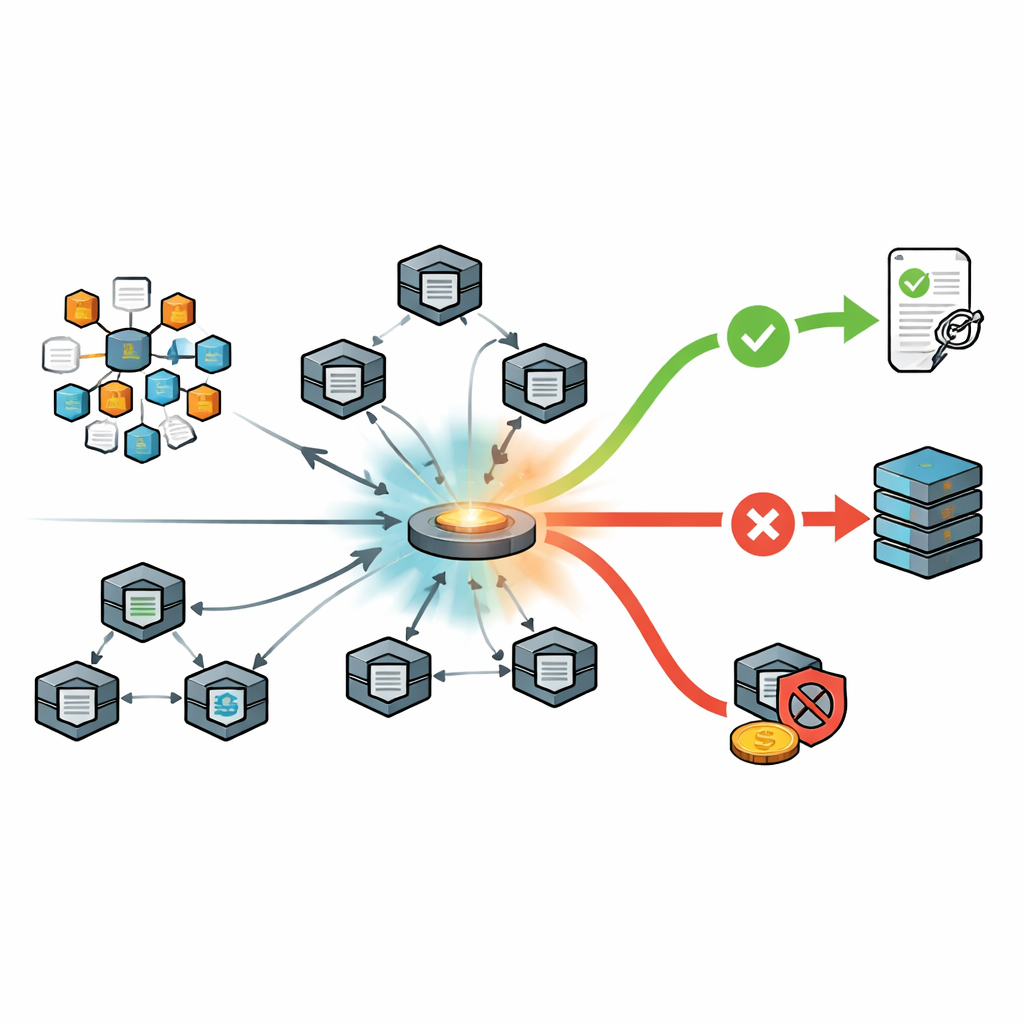
Under the hood, the system uses advanced cryptographic techniques, but its behavior can be understood in simple steps. When a user starts a cross-chain transfer, a smart contract on the source chain locks the assets and emits a signal. Nodes in the distributed network detect this event and each receive only a fragment of the sensitive information. Working together, they run a secure joint computation that checks basic rules—such as whether the amount and format are acceptable—without reconstructing the full transaction in any one place. If the request passes, the nodes collectively produce a single compact signature that the destination chain can verify, proving that the group agrees without revealing who signed or what they saw. If preset regulatory triggers are met—such as unusually large transfers or links to high-risk addresses—regulatory participants join a second secure computation that outputs only a yes/no decision about whether the transfer should proceed, be refunded, or be frozen.
Evidence that it is both safe and practical
To support this design, the authors formally analyze how the protocols behave in the presence of powerful attackers who can eavesdrop, tamper with messages, or corrupt some of the bridge nodes. They show that, assuming standard mathematical hardness assumptions hold, attackers cannot forge cross-chain approvals, cannot reconstruct hidden transaction details from the partial data they see, and cannot force regulators to approve or block transfers incorrectly. The team then builds a prototype that connects different styles of blockchains and subjects it to extensive testing. In realistic network environments, their system reaches more than 1,250 transactions per second with delays under 400 milliseconds, clearly outperforming traditional multi-signature bridges, and only moderately slower than high-speed but non-private solutions. On-chain verification costs remain modest because the complex work happens off-chain, and each cross-chain action appears on the target chain as a single, easy-to-verify signature.
What this means for the future of digital value
In plain terms, this research shows that it is technically possible to move assets between very different blockchains while keeping user details hidden by default and still giving regulators a controlled window into risky activity. Instead of choosing between total anonymity and total surveillance, the proposed framework lets rules be enforced through algorithms that see only what they must and reveal only a simple outcome. Although challenges remain—in particular, making the heavy cryptography faster and easier to deploy at very large scales—the work outlines a concrete path toward an “internet of value” that is not only open and efficient, but also private and accountable.
Citation: Chen, Z., Liu, H., Zhang, L. et al. Research on key technologies for privacy-preserving, regulatorily compliant, and cross-chain interoperability in heterogeneous blockchain systems. Sci Rep 16, 12817 (2026). https://doi.org/10.1038/s41598-026-42543-7
Keywords: blockchain interoperability, cross-chain bridges, privacy-preserving transactions, regulatory compliance, secure multi-party computation