Clear Sky Science · en
A causal multimodal framework for privacy-preserving early-stage cancer detection and adaptive testing
Why catching cancer early matters to everyone
Cancer is far easier to treat when it is found early, but today’s tests often miss small tumors or mistakenly flag healthy people. This paper introduces a new way to combine several simple, mostly non‑invasive checks—like blood, breath, and medical scans—into a smarter system that can spot early cancers more reliably while avoiding unnecessary, stressful testing. It also keeps patients’ data private as hospitals work together to improve the technology.
Bringing many weak signals together
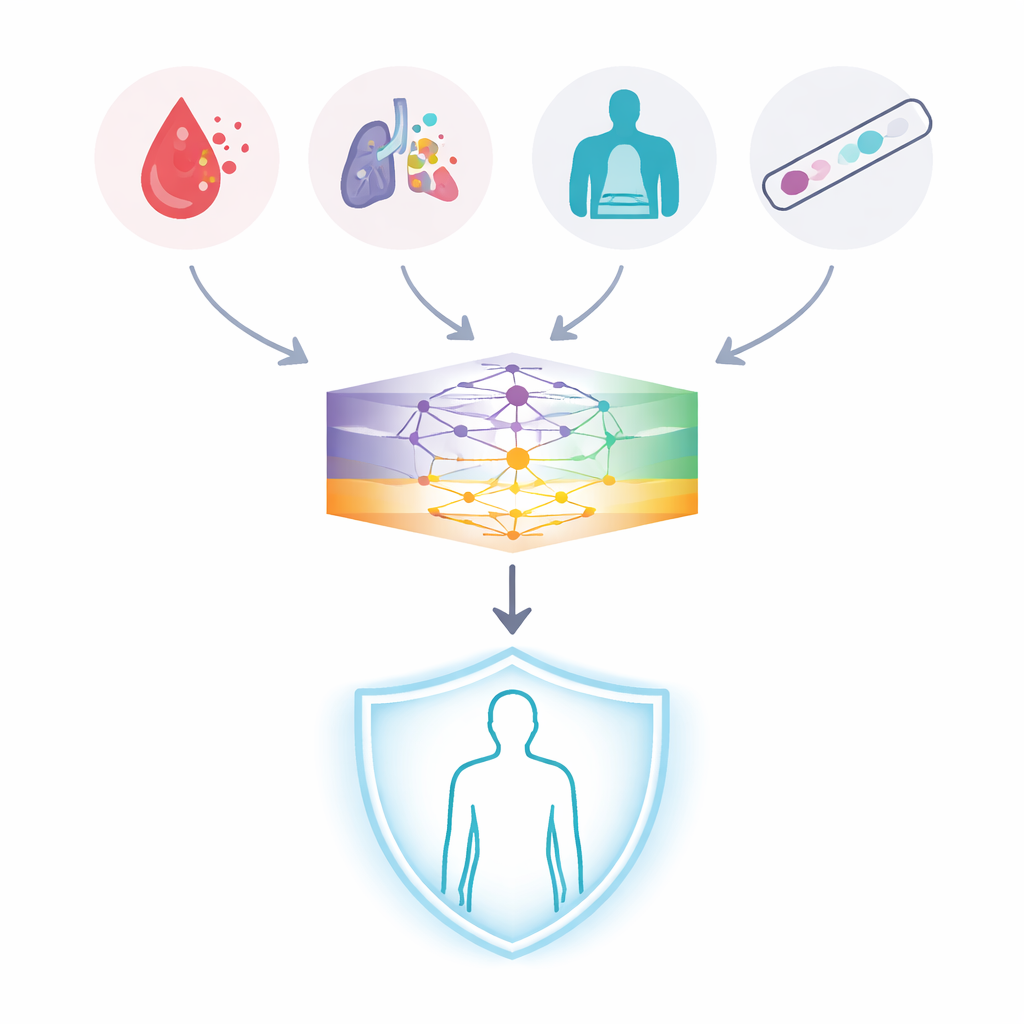
Each modern cancer test sees the disease from a different angle. Tiny DNA fragments in blood can hint at tumors, images from CT scans reveal subtle changes in organs, exhaled breath carries traces of altered metabolism, and digital slides of tissue show changes in cells. Used alone, each method has blind spots and can be thrown off by everyday factors such as smoking habits, diet, or differences between hospital scanners. The authors build a framework called CausaLMED that treats these sources as complementary parts of a single puzzle, combining them so that weaknesses in one are balanced by strengths in the others.
Focusing on true causes, not noisy coincidences
Most computer systems that fuse medical data simply stack information and search for patterns, which can accidentally latch onto coincidences—for example, a certain hospital’s scanner settings rather than the cancer itself. CausaLMED takes a different route. It represents the relationships between the different data sources and the disease as a directed network of causes and effects. By explicitly modeling possible troublemakers such as lifestyle, demographics, and machine settings, the system can "subtract" their influence and concentrate on signals that genuinely stem from early tumors. This helps the combined model stay accurate even when used on new patient groups or in new clinics.
Asking for the right next test
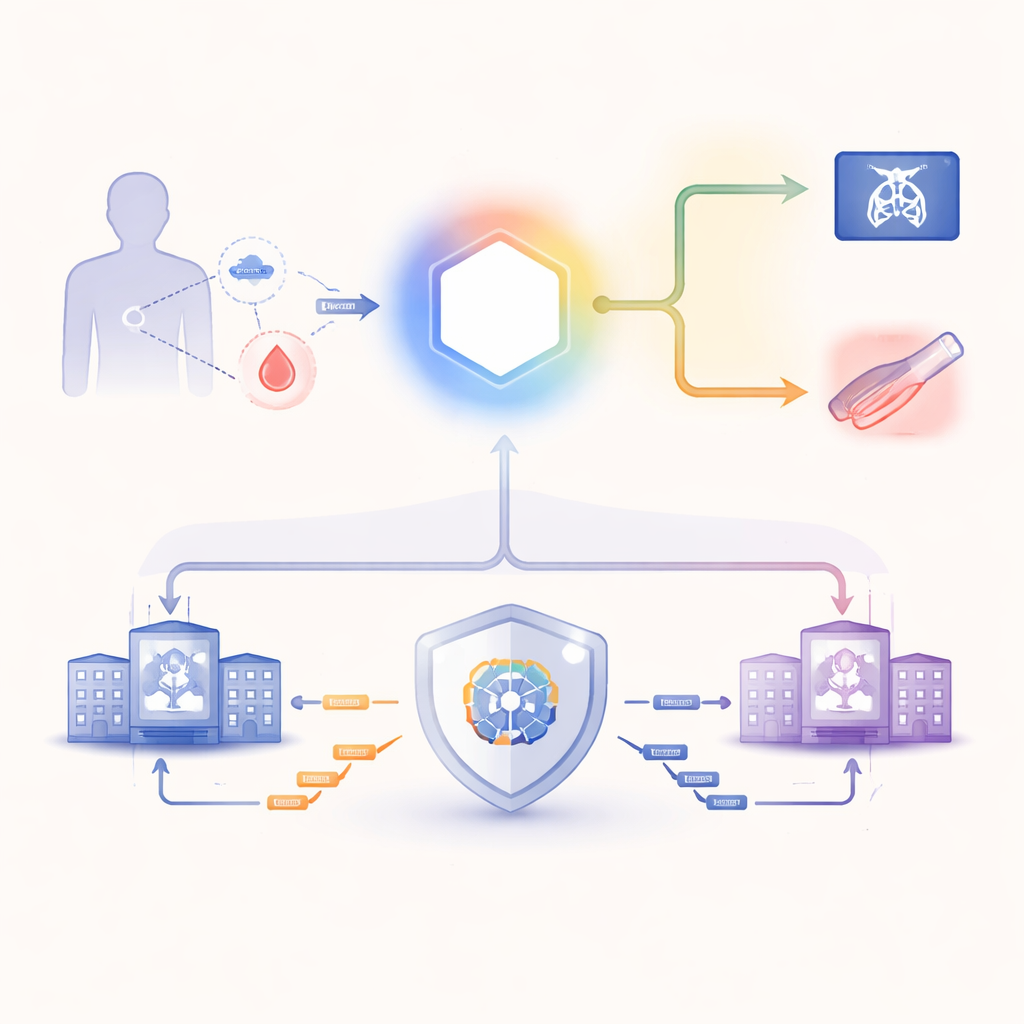
A key challenge in screening is deciding how many tests a person really needs. Instead of sending everyone through the same fixed sequence, CausaLMED uses an adaptive testing strategy inspired by decision‑making under uncertainty. It starts with simpler, low‑burden checks like breath or blood analysis. Based on how confident the system is after each result, it chooses whether to stop, repeat a low‑cost test, or move on to more involved steps such as imaging or tissue analysis. This process is mathematically framed so that each added test must meaningfully reduce uncertainty or it is skipped. In trials on existing datasets, this strategy cut unnecessary imaging referrals by nearly a quarter while maintaining high accuracy.
Learning together without sharing raw data
Powerful cancer detectors usually require data from many hospitals, but that raises serious privacy concerns. CausaLMED addresses this using federated learning: each hospital trains the model locally on its own patients, then sends only abstract parameter updates—not raw scans or records—to a central server. Extra layers of protection are applied by adding carefully calibrated noise to these updates and aggregating them in encrypted form. This means that even if someone intercepted the communication, they could not reconstruct individual patient information, yet the shared model still benefits from the diversity of all participating sites.
How well the system works in practice
The researchers tested CausaLMED on a mix of public blood, imaging, breath, and tissue datasets, mimicking deployment across different institutions. Compared with the best conventional approaches, their framework achieved 96.7% overall accuracy and, crucially, detected stage I cancers with 94.2% sensitivity while keeping specificity at 99.1%. In simpler terms, it was much better at finding very early tumors without greatly increasing false alarms. When parts of the system were disabled in an ablation study—such as replacing causal fusion with simple stacking, removing adaptive testing, or dropping the privacy‑preserving setup—performance, efficiency, or real‑world readiness noticeably suffered, underscoring the value of each component.
What this means for patients and clinics
To a layperson, the promise of CausaLMED is a future in which early cancer checks are more accurate, less invasive, and more fairly available across hospitals. By thoughtfully blending multiple gentle tests, asking for extra procedures only when they truly help, and protecting sensitive records as centers collaborate, this framework outlines a path toward screening programs that save more lives with fewer needless scares. While further prospective trials and integration into real‑world workflows are still needed, the study suggests that carefully designed, privacy‑aware artificial intelligence could become a trusted partner in catching cancer when it is most curable.
Citation: Sivaprakash, S., Baskaran, P. A causal multimodal framework for privacy-preserving early-stage cancer detection and adaptive testing. Sci Rep 16, 13080 (2026). https://doi.org/10.1038/s41598-026-42537-5
Keywords: early cancer detection, multimodal diagnostics, medical AI, privacy-preserving learning, adaptive testing