Clear Sky Science · en
Multi-scale studies of oil–water imbibition mechanism on complex pore structures and mixed-wettability: a recent 10-year review
Why tiny rock pores matter for future energy
Much of the world’s remaining oil is trapped in rocks so tight that fluids can barely move through them. Yet inside these rocks, water can sometimes creep into microscopic pores on its own and push oil out, thanks to capillary forces—much like water soaking into a paper towel. This review article looks back over ten years of research to understand how the shapes of those tiny pores and the way their surfaces prefer oil or water together control this “self-driven” oil recovery, and how new imaging, theory, and computer models might help squeeze more energy from existing fields with less environmental impact.
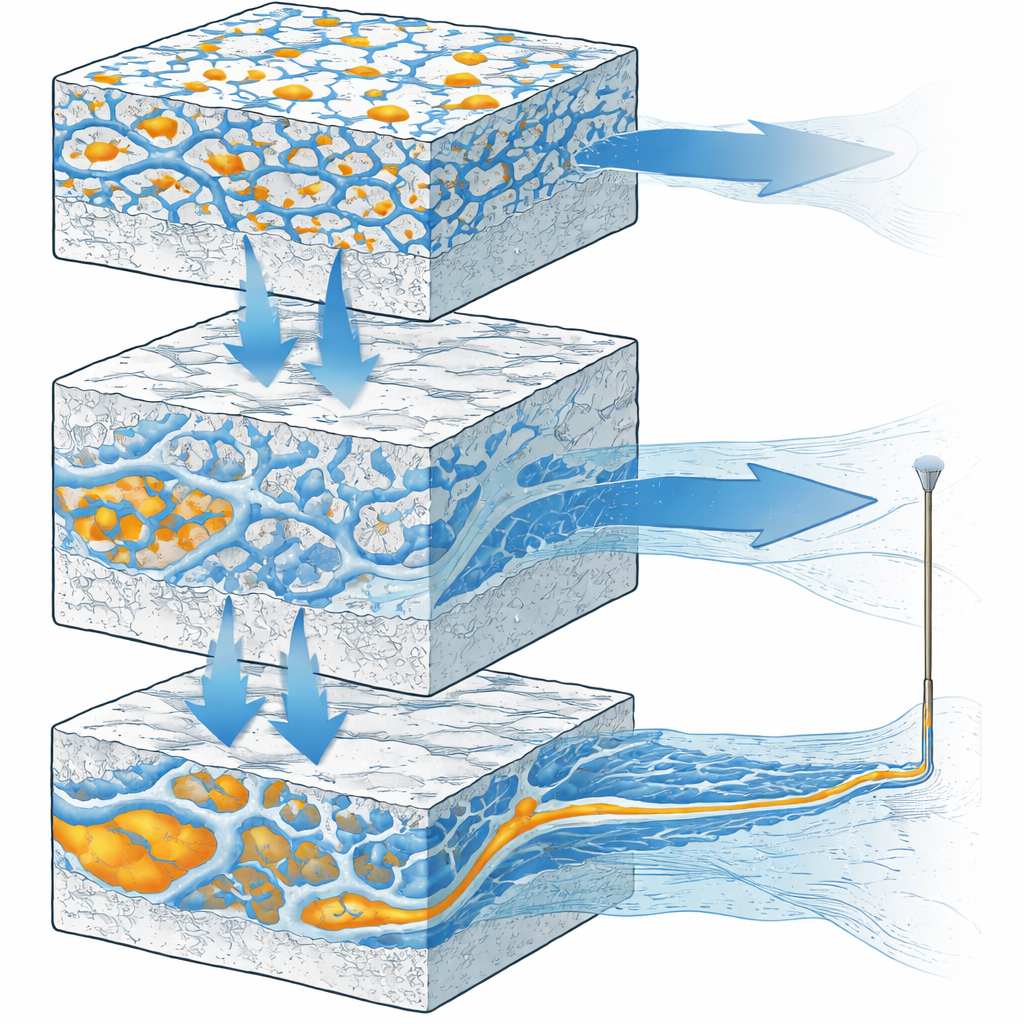
How water sneaks into tight rocks
In low‑permeability reservoirs, the rock matrix resembles a maze of irregular channels and cavities. When water is injected into surrounding fractures, it can be drawn into this matrix, displacing oil toward the fractures and ultimately to production wells—a process known as imbibition. The authors show that two elements dominate this behavior: pore structure and wettability. Pore structure describes how big the pores are, how well they connect, and how tortuous the flow paths become. Wettability describes whether the rock surface “likes” water or oil. Water‑loving (water‑wet) walls strengthen the capillary pull that drives imbibition, whereas oil‑loving (oil‑wet) walls can almost shut it down. Because real rocks have mixed regions that prefer different fluids, understanding this subtle balance is central to predicting how much oil can still be recovered.
Peering inside rocks across many size scales
Over the past decade, researchers have used a suite of experimental tools to watch imbibition in action from pore scale to field scale. X‑ray micro‑CT scanners can reconstruct three‑dimensional images of the pore network and track how oil and water rearrange during imbibition without destroying the sample. These studies reveal that imbibition mainly occurs through connected pore networks within certain size ranges, and that tiny throats and dead‑end pores often trap residual oil. At the centimeter “core” scale, laboratory tests show how overall rock permeability, fractures, external pressure, and fluid chemistry influence how quickly and how far water can imbibe. At the meter‑to‑kilometer scale, large physical models and field pilots demonstrate that fracture networks can dramatically increase oil recovery—but if they are too open, they also create channels where water bypasses much of the rock.
From simple formulas to complex computer models
The review traces how theory has evolved from idealized glass‑tube analogies to sophisticated mathematical descriptions of real rocks. Early models treated a single smooth capillary to relate pore size, surface preference, and capillary pressure. Newer formulations include tortuous pathways, irregular cross‑sections, rough walls, and a statistical “fractal” view of the pore network to better capture complexity. At intermediate scales, models link threshold pressure and flow resistance to measures of pore irregularity, while field‑scale equations couple imbibition with well shut‑in time, injection volume, and fracture geometry for production forecasting. Alongside this theory, numerical tools such as pore‑network models, lattice Boltzmann simulations, and phase‑field methods simulate how oil and water weave through complex geometries and how changes in wettability—often induced by surfactants or low‑salinity water—alter recovery.
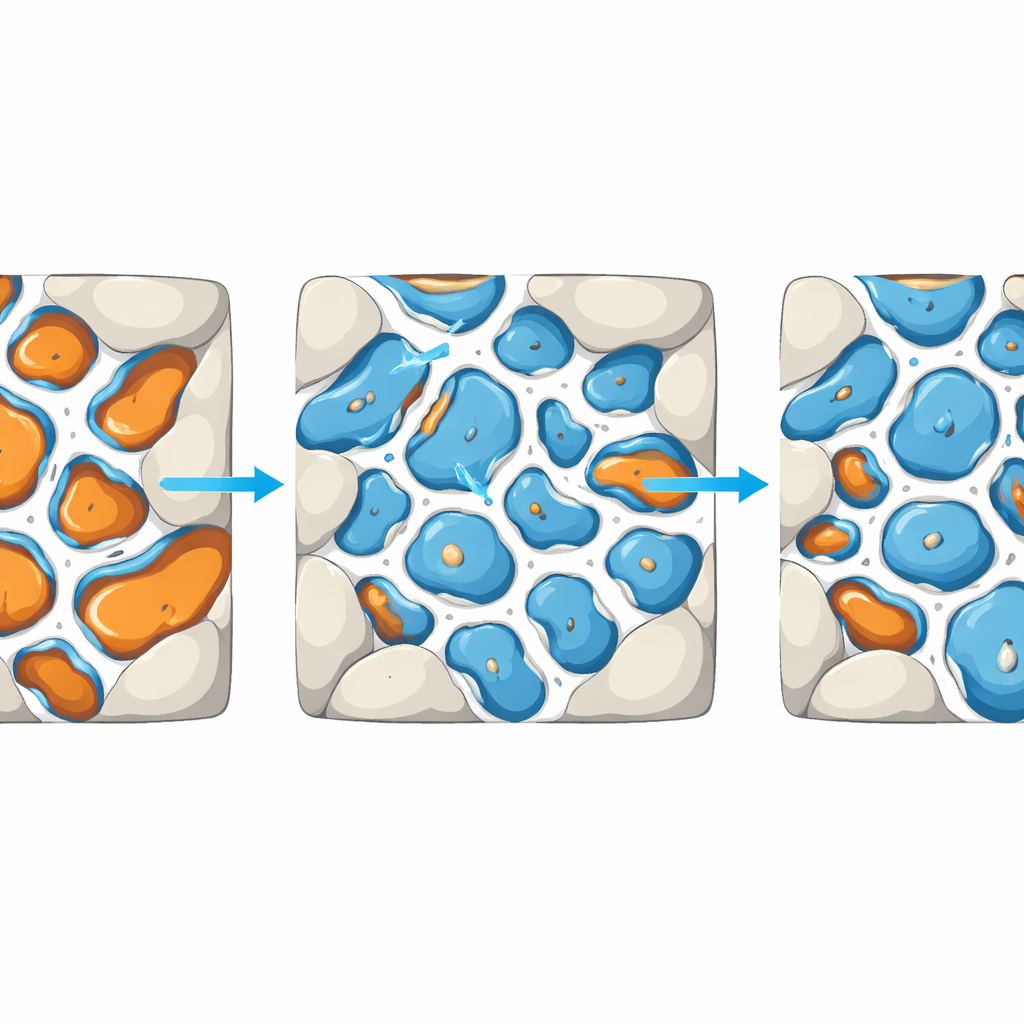
Tuning rock surfaces to coax out more oil
A major theme is the deliberate manipulation of wettability to boost imbibition. Laboratory and field studies show that chemical additives like surfactants and specially designed low‑salinity brines can shift rock surfaces from oil‑wet toward water‑wet, allowing capillary forces to pull water deeper into the matrix and push more oil out. However, the same treatments often reduce the tension between oil and water, which can weaken the very capillary forces that drive imbibition. Numerical and theoretical work indicates that optimal recovery requires a careful balance: making surfaces water‑loving enough to trigger flow without lowering interfacial tension so much that capillary pull disappears. Mixed‑wettability—patches of oil‑wet and water‑wet surfaces within the same pore—emerges as a particularly important and challenging state to characterize and model.
Linking tiny pores to big energy decisions
The article concludes that improving oil recovery from tight reservoirs depends on mastering both the geometry of pore networks and the patchwork of surface preferences across scales. Future priorities include building realistic three‑dimensional digital rocks with complex mixed‑wettability, using real‑time four‑dimensional CT imaging to follow fluid motion, and combining artificial intelligence with microfluidic chips to infer and control wettability patterns. By connecting pore‑scale physics to reservoir‑scale performance, this multiscale approach could guide safer, more efficient, and lower‑carbon use of existing oilfields, delaying the need for new drilling while the global energy system transitions.
Citation: Liu, Q., Wang, Q., Liang, B. et al. Multi-scale studies of oil–water imbibition mechanism on complex pore structures and mixed-wettability: a recent 10-year review. Sci Rep 16, 11979 (2026). https://doi.org/10.1038/s41598-026-42527-7
Keywords: spontaneous imbibition, low-permeability reservoirs, pore structure, wettability alteration, fractured reservoirs