Clear Sky Science · en
Simulation of icing calculation based on VOF model for wheel spray and landing gear water accumulation
Why wet runways in winter matter
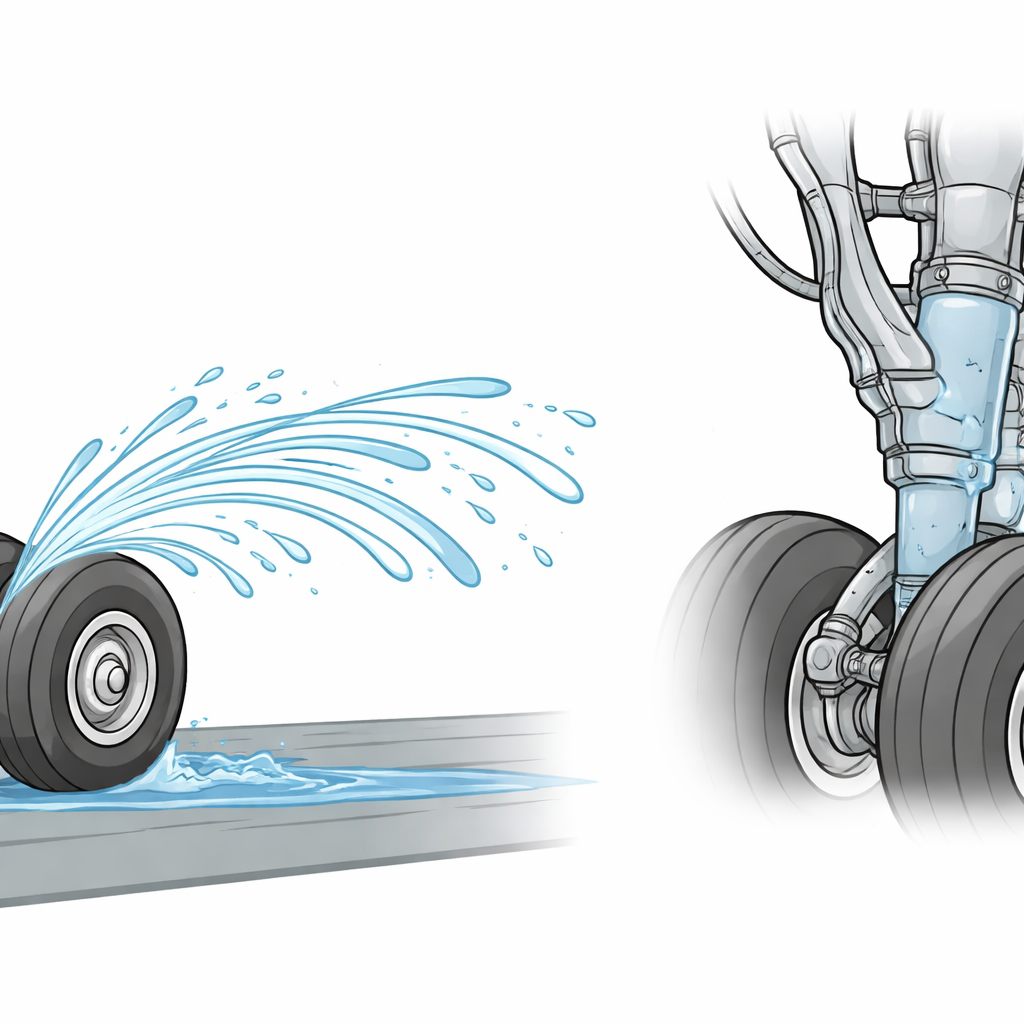
Every commercial flight relies on sturdy landing gear to roll, steer, and support the aircraft during takeoff and landing. On wet or slushy runways in cold weather, spinning wheels can throw sheets of water onto the nearby landing gear. If that water freezes, it could, in principle, jam moving parts or affect how the gear retracts—raising obvious safety concerns. This study uses computer simulations to ask a very practical question: under realistic worst-case conditions, can such wheel‑thrown water build up enough ice on the landing gear to threaten flight safety?
From puddles to spray to frozen coatings
The authors start by describing how water builds up on runways. During rain or melting snow, water can form a thin film across the surface, or collect in shallow pools where the pavement is slightly uneven. As an aircraft taxis for takeoff through this water, its wheels act like fast‑spinning paddles, hurling droplets into the air. Earlier research mostly treated this as a simple interaction between the wheel and the water, but in reality, air flow around the aircraft also bends and slows these droplets. Because large‑scale tests with real airplanes are extremely expensive and hard to measure accurately, the team turns to detailed fluid simulations to trace what happens from the runway surface to the landing gear.
Building a digital wind tunnel for water and ice
To recreate this process on a computer, the researchers construct a three‑dimensional model that includes the runway, a rotating wheel, and a simplified landing gear strut. They use a method called Volume of Fluid, which tracks how water and air share each tiny cell of the simulated space, allowing the computer to follow splashing, spreading, and merging of water films on the metal surfaces. A special “sliding mesh” technique lets the wheel spin rapidly through the stationary fluid while still exchanging information with the surrounding air and water. The team calibrates this approach by reproducing a separate experiment in which a rotating disc flings out a thin layer of oil; their simulation captures the observed patterns, giving confidence that it can also represent water thrown by aircraft wheels.
Turning thin water layers into possible ice
Once they know how thick the water film becomes on different parts of the landing gear, the authors ask how much of that water could freeze in cold air. They consider takeoff on a water‑covered runway for a typical civil airliner, using conservative choices: relatively high ground water depths up to the regulatory limit, low ambient temperatures, and a full 12‑second taxi run. A simple heat‑balance model then estimates how quickly heat can be drawn out of the water through the metal wall and into the surrounding air. Importantly, they assume that all available cooling goes into freezing, not just chilling the water. They also ignore water running off, partial freezing, or melting—assumptions that all push the results toward over‑predicting ice thickness rather than under‑predicting it.
Where the water and ice actually collect
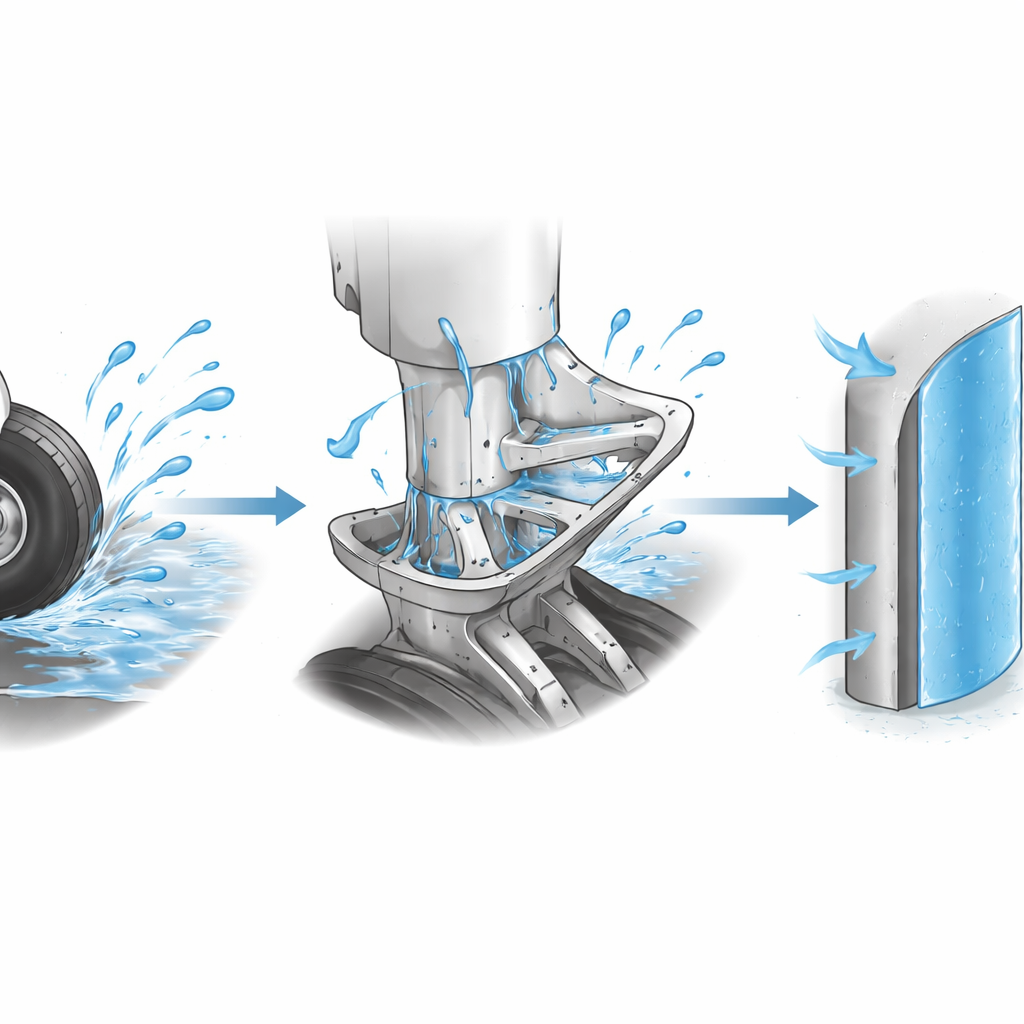
The simulations reveal that wheel‑thrown water does not coat the entire landing gear uniformly. Instead, it concentrates on the lower half of the main strut, especially near corners, brackets, and small recesses where flowing water tends to slow down and pool. There, the water film can briefly become thicker before air flow strips some of it away, producing a spiky, time‑varying pattern. Even under the most water‑laden cases, the resulting ice layer is always thinner than the liquid water layer that produced it, showing that not all captured water has time to freeze. When the team stacks up the contribution from every moment of the 12‑second run—again using their deliberately pessimistic assumptions—they find that the ice remains a localized coating, rather than a solid casing around the entire gear.
What this means for flight safety
For regulators and aircraft designers, the key outcome is not the exact shape of every droplet but the maximum ice thickness that might realistically form. The study finds that even under severe cold and deep water films, the resulting ice on critical parts of the landing gear is thin—on the order of a few millimeters at most, and typically much less. The authors’ fully conservative estimate still stays below levels that would be expected to jam mechanisms or endanger gear deployment; in practice, real ice thickness is likely significantly smaller. In plain terms, their work suggests that for modern airliners operating within existing limits on runway water depth, wheel‑generated spray during takeoff in freezing weather is unlikely, by itself, to build up enough ice on the landing gear to compromise safe retraction or extension.
Citation: Dai, J., Zhang, L., Chen, Q. et al. Simulation of icing calculation based on VOF model for wheel spray and landing gear water accumulation. Sci Rep 16, 12174 (2026). https://doi.org/10.1038/s41598-026-42513-z
Keywords: aircraft icing, landing gear, wet runway, wheel spray, flight safety