Clear Sky Science · en
Étendue and radiance conservation in transformation optics establish strict analytical bounds on field enhancement
Why squeezing light matters
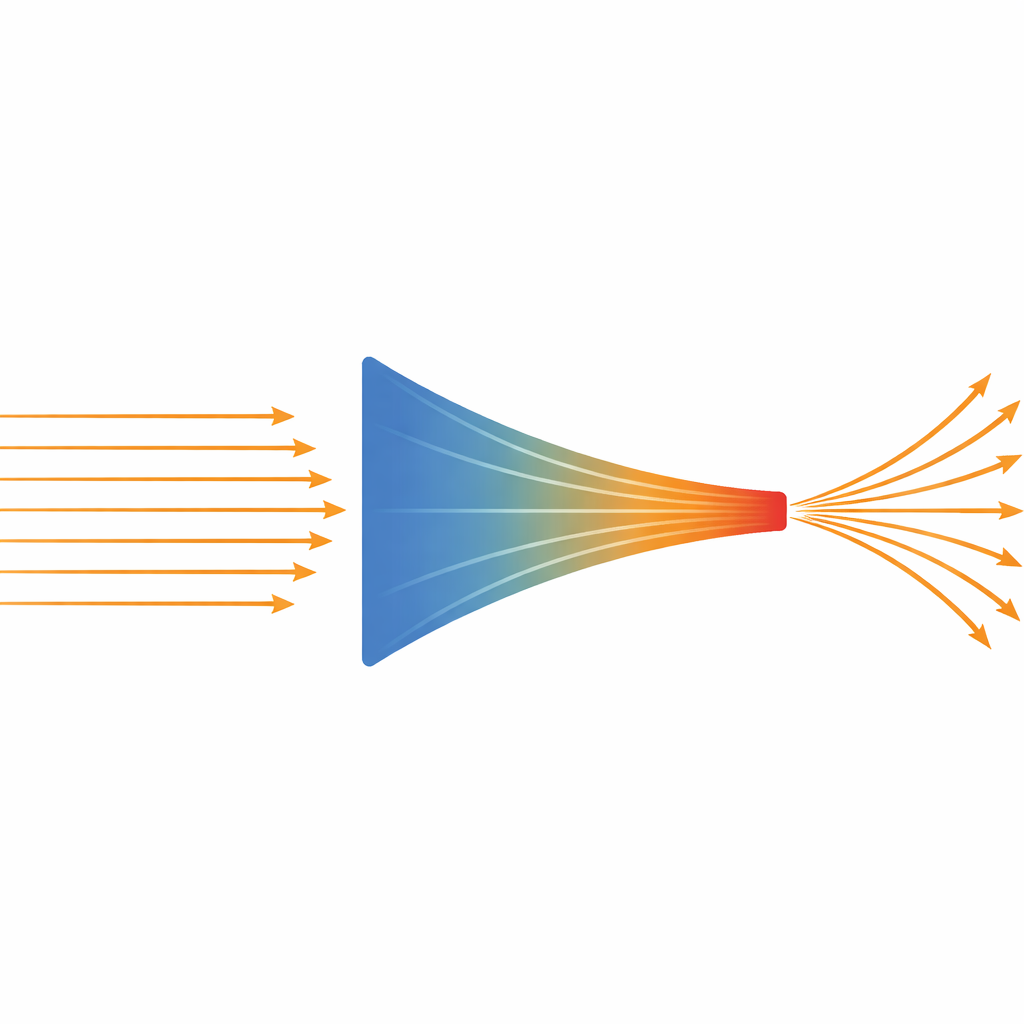
Modern optical devices—from microscopes to solar cells—often promise to squeeze light into tiny regions and boost its strength dramatically. Transformation optics, a design method that treats materials as if they bend space for light, seems to offer almost magical ways to do this. At first glance, it looks as though we could concentrate light without limit simply by mapping a large region of space into a very small one. This paper asks a basic, practical question: can such devices really beat the age‑old limits on how bright light can be made in passive systems, or are they still constrained by the same rules that govern lenses and mirrors?
Old rules for brightness
Classical optics has long established two quiet but powerful ideas: radiance and étendue. Radiance is essentially brightness—how much power passes through a given area in a given range of directions. Étendue measures how “spread out” a beam is when you consider both its size and its range of angles. In any passive, lossless optical system, radiance cannot increase and étendue cannot decrease; you can shuffle light around in space and angle, but you cannot make it intrinsically brighter without adding energy. These results are tied to Liouville’s theorem from Hamiltonian mechanics, which says that the volume occupied by a set of light rays in position–direction space must remain constant as they move through an ideal system.
How transformation optics reshapes space
Transformation optics provides a recipe for designing complex materials by starting from a simple “virtual” space where light is easy to describe and then applying a smooth coordinate transformation. This mapping tells you how to engineer an anisotropic material—one whose properties depend on direction—so that light in the real device behaves as if space itself had been stretched, squeezed, or twisted. Devices such as cloaks, concentrators, and illusion media all arise from this idea. Extreme-index platforms, like zero-index and optical-null media, are particularly striking because they can confine fields very strongly, tempting designers to believe that brightness might be pushed beyond classical limits.
The hidden phase-space structure
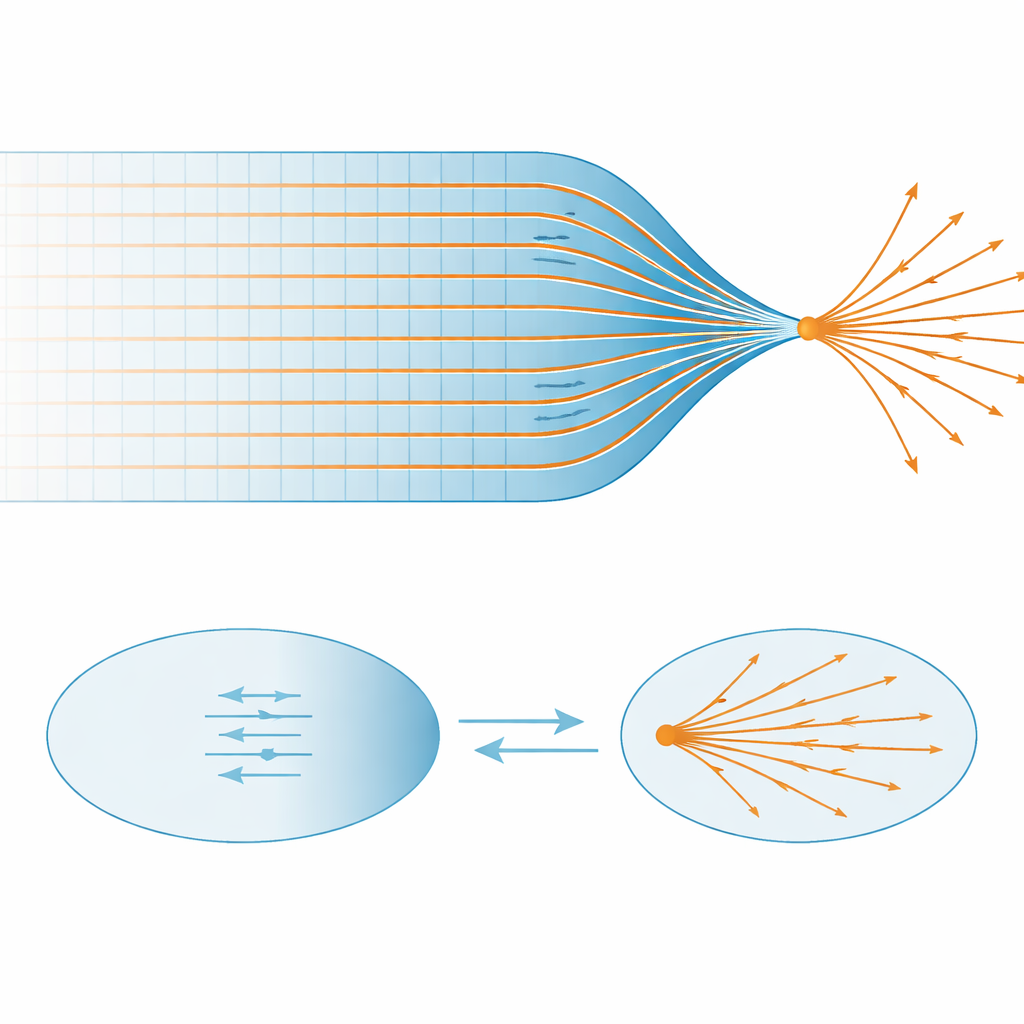
The authors show that, under reasonable conditions (smooth, passive, impedance-matched materials in the geometric-optics regime), every transformation-optics mapping acts as a special kind of transformation in phase space—one that is canonical, or symplectic, in mathematical language. In simple terms, this means that when the mapping squeezes space in one region, it must expand the range of directions in which rays travel, and vice versa, in just the right way so that the total volume in position–direction space stays unchanged. Radiance is carried along each ray without increase, and the combined “volume”—the étendue—remains exactly conserved as light passes through the device. This links the abstract geometry of transformation optics directly to the familiar brightness theorems of nonimaging optics.
Sharp limits on how much you can concentrate
With this phase-space picture in hand, the authors derive strict analytical bounds on how much a transformation-optics device can boost intensity. For an ideal concentrator that maps a larger input area onto a smaller core, the maximum average intensity in the core cannot exceed the input intensity multiplied by the simple geometric area-compression ratio (input area divided by core area). Any apparent extra gain must come from narrowing the range of allowed directions, not from increasing brightness itself. Numerical evaluations for a radially symmetric concentrator confirm that this bound is exactly met in the geometric-optics limit. The same reasoning applies to zero-index and optical-null media and to illusion devices: they can dramatically redistribute where light goes and how it is angled, but they cannot create brightness beyond that of the source in a passive setting.
What this means for advanced optical designs
The work clarifies both the power and the limits of transformation optics. On the one hand, it shows that very large local fields seen in simulations of extreme-index or illusion-based designs are not signs of forbidden “super-brightness,” but rather of lawful intensity redistribution controlled by conserved étendue. On the other hand, it spells out when the bounds might not apply: for example, when the device operates outside the geometric-optics regime, includes gain or active modulation, or relies on near-field and strongly wave-based effects. Within its domain—passive, linear, smooth transformation-optics media—this phase-space view provides a unified and rigorous framework for judging any proposed concentrator or illusion device against hard limits set by fundamental physics.
Citation: Sadeghi, M.M., Sarısaman, M. Étendue and radiance conservation in transformation optics establish strict analytical bounds on field enhancement. Sci Rep 16, 13875 (2026). https://doi.org/10.1038/s41598-026-42509-9
Keywords: transformation optics, light concentration, radiance conservation, étendue, metamaterials