Clear Sky Science · en
A manta ray-bayesian optimization approach for hyperparameter-tuned convolutional neural networks in lung cancer classification
Why this matters for patients and doctors
Lung cancer is one of the deadliest cancers, and catching it early on CT scans can save lives. But teaching computers to read these scans accurately is tricky, because even strong artificial intelligence systems can stumble if they are not tuned just right. This study introduces a smarter way to fine tune a compact image analysis network so it can spot lung cancer more accurately and efficiently, which could one day help radiologists make quicker and more reliable decisions.
A smarter way to teach computers
Modern image based diagnosis often relies on deep learning, where computer networks learn patterns directly from medical images. These systems have already shown they can distinguish between healthy lungs and cancerous nodules, sometimes rivaling traditional methods. However, their success depends heavily on hidden settings such as how fast the model learns, how many filters it uses to scan an image, and how much regularization is applied to avoid overfitting. Traditionally, researchers adjust these settings by trial and error or by brute force search, which is slow, costly, and may still miss better combinations. The authors argue that for lung cancer imaging, we need tuning strategies that are both more intelligent and more practical.
Combining two search strategies
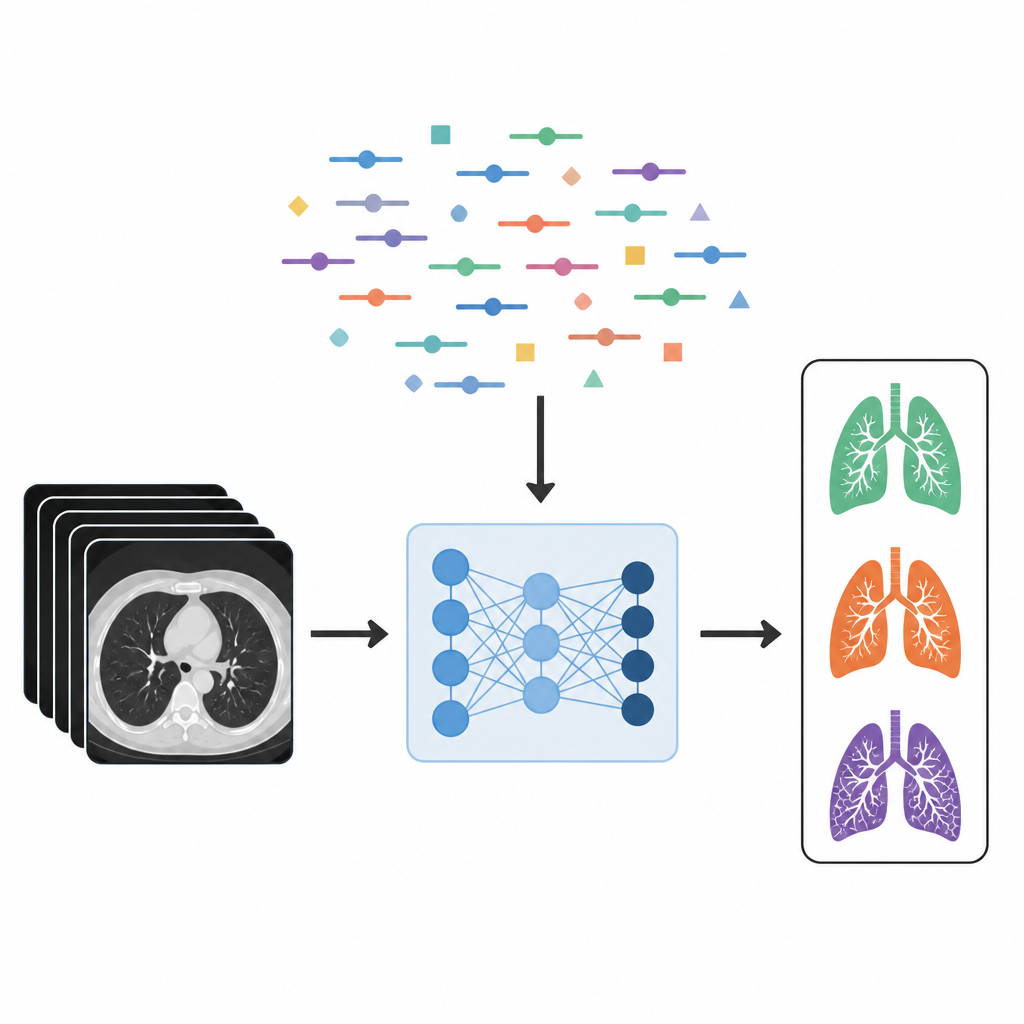
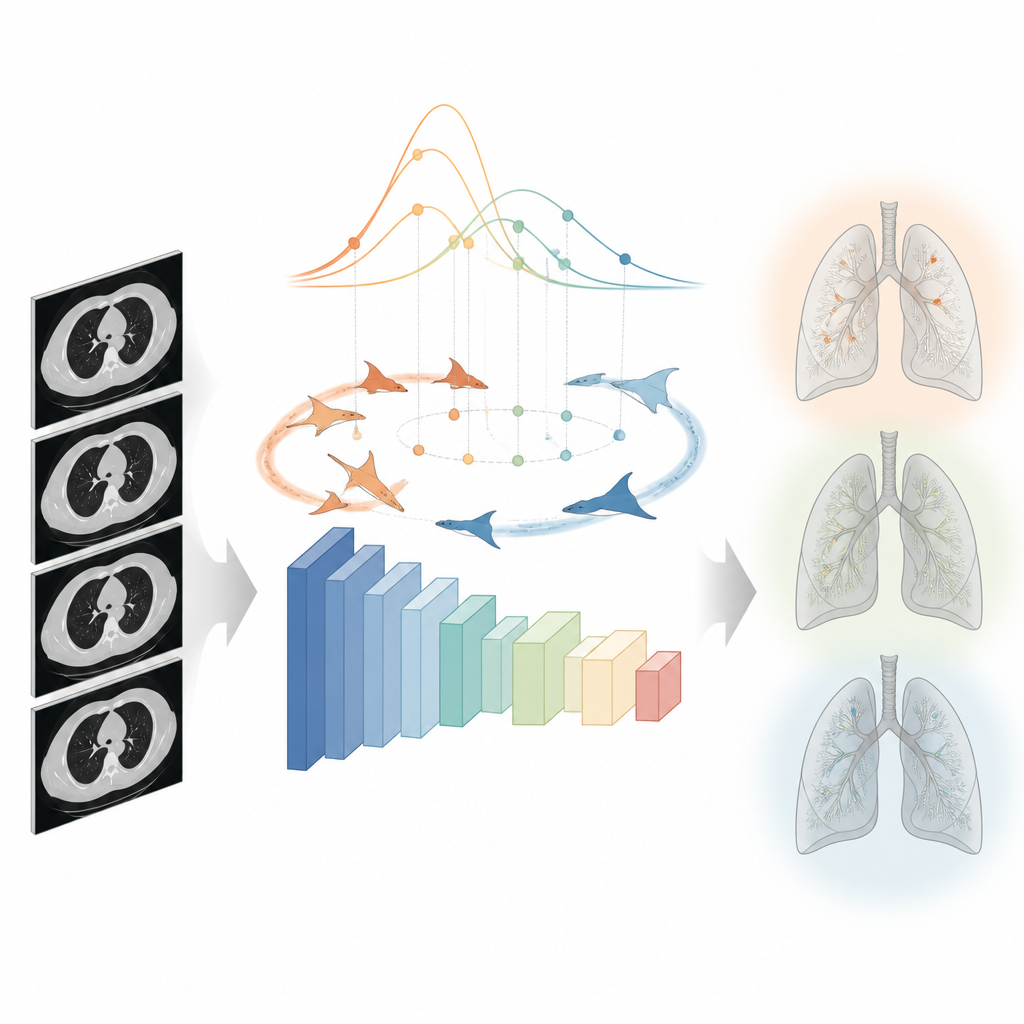
The team proposes a two step search procedure that treats model tuning like exploring an unknown landscape. First, a probabilistic method called Bayesian optimization looks at previous model results and suggests the most promising new settings to try next, rather than checking every option blindly. It uses a mathematical surrogate of performance to guide this exploration across the space of learning rate, number of convolution filters, number of dense units, and dropout rate. Once this global step has narrowed down a good region, a second method inspired by how manta rays forage in the ocean takes over. This swarm based procedure gently perturbs candidate settings through chain like movement, swirling patterns, and sudden "somersault" jumps to refine them locally and escape small traps in the performance landscape.
A lean network built for scans
To take advantage of this tuning strategy, the authors design a lightweight convolutional network tailored to lung CT images. Instead of heavy, multi million parameter models, their design borrows ideas from compact mobile vision architectures. It uses depthwise separable convolutions and pointwise layers to reduce the number of calculations while preserving important visual detail, then fuses features from different depths and feeds them into a final classification layer that distinguishes multiple lung categories. Careful image preprocessing further helps the model by denoising scans, enhancing contrast, emphasizing edges, and balancing the dataset through augmentation so that rare or subtle cases are not overlooked.
How well the approach works
The researchers test their tuned network on several public lung cancer CT datasets, including a clinically realistic collection where malignant cases are more common than normal ones. Compared with widely used architectures such as MobileNet, ResNet, DenseNet, and transformer based models, their compact network attains similar or higher accuracy with far fewer parameters and lower computation time. With the combined Bayesian and manta ray tuning process, the model reaches around 98 percent test accuracy on one benchmark and maintains strong precision and recall for benign, malignant, and normal classes. Cross validation and statistical tests suggest that this hybrid search strategy yields more consistent and significantly better results than other optimization schemes such as particle swarms and genetic algorithms.
What this could mean in practice
For non specialists, the key message is that tuning how an AI model learns can matter as much as the model design itself. By pairing a global probabilistic search with a local, nature inspired refinement step, this study shows that a relatively small network can learn to read lung CT scans accurately, while using modest computing resources. Although more comparisons with alternative tuning methods and large scale clinical trials are still needed, the work points toward AI tools that might fit into everyday hospital equipment, supporting radiologists with fast second opinions and potentially helping to catch lung cancer earlier and more reliably.
Citation: Samal, S., Sunder, S., Gadekellu, T. et al. A manta ray-bayesian optimization approach for hyperparameter-tuned convolutional neural networks in lung cancer classification. Sci Rep 16, 14794 (2026). https://doi.org/10.1038/s41598-026-42506-y
Keywords: lung cancer, CT scan, deep learning, hyperparameter tuning, medical imaging