Clear Sky Science · en
Dual-branch spatio-temporal graph network for bearing fault diagnosis
Watching the Health of Spinning Machines
From wind turbines to factory conveyors, countless machines rely on spinning shafts supported by tiny metal components called bearings. When a bearing starts to fail, it can quietly damage equipment, cut productivity, and even cause accidents. This paper presents a new way to listen to the subtle vibrations of bearings and spot trouble early and reliably, even when the signals are noisy and the operating conditions keep changing.
Why Bearings Are Hard to Diagnose
Modern industry depends on rotating machinery that often runs for long hours in harsh environments. Bearings live at the heart of these systems, and their breakdowns are a major cause of unplanned shutdowns. Engineers have long tried to read bearing health from vibration signals, first using human senses and simple tools, then more advanced signal processing, and more recently machine learning and deep learning. Yet these approaches still struggle when speed varies, noise is strong, or only a few examples of faults are available. One problem is that many methods treat vibration data as either plain time series or images, ignoring the rich relationships between different points in time and frequency that can reveal faint signs of damage.
Turning Vibrations into Connected Patterns
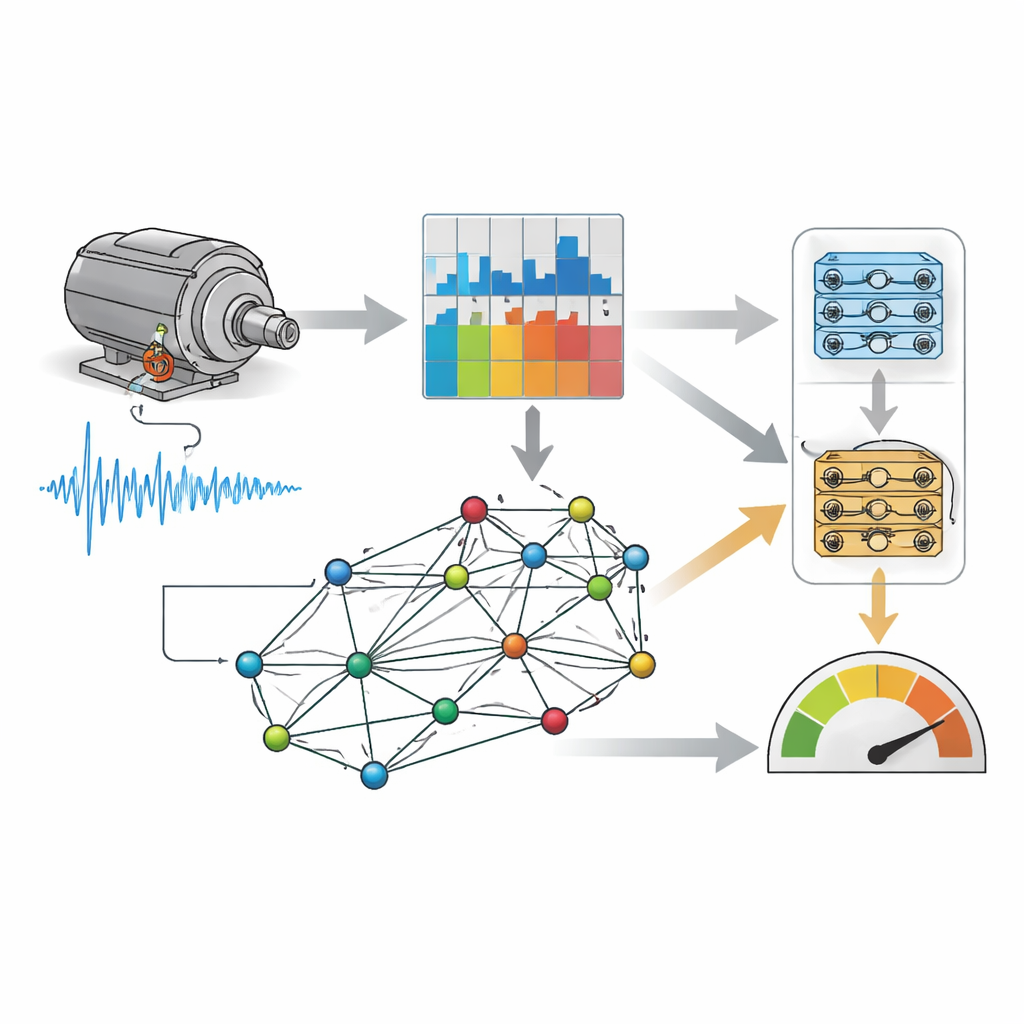
The authors propose a fresh perspective: instead of viewing vibration as a flat signal, they treat it as a network of connected points evolving over time and frequency. First, they cut the raw vibration into short segments and apply a short-time Fourier transform, which spreads each segment into a map of how energy is distributed over both time and frequency. They then convert these maps into power spectra that highlight where fault-related energy peaks stand out from normal behavior. Each processed sample becomes a node in a "spatio-temporal" network, and links are drawn between nodes whose spectral patterns are similar. This fully connected structure preserves subtle relationships between frequencies and moments in time that might signal early or rare faults.
Learning from Two Views at Once
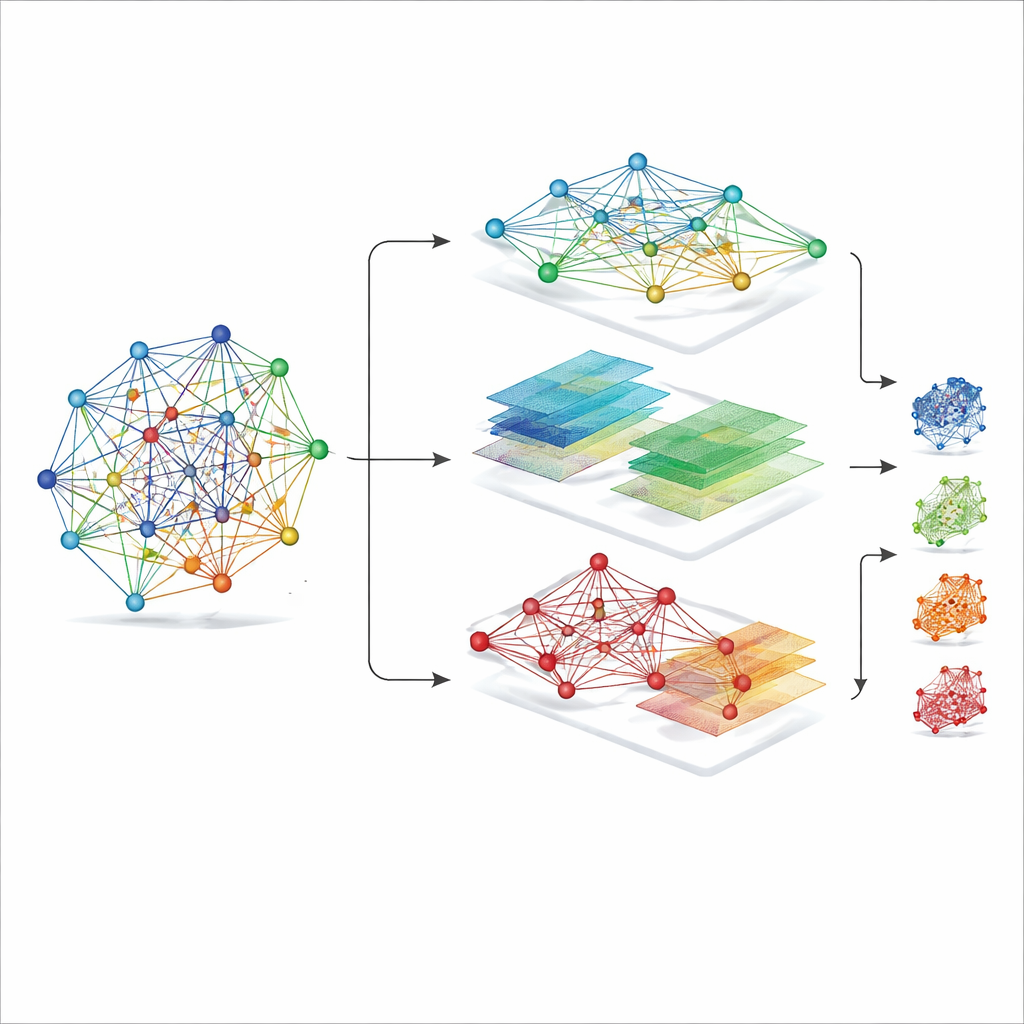
To analyze this network, the researchers build a dual-branch spatio-temporal graph network (DBSGN). At its core is a type of neural network designed for graph data, which can pass messages along links and combine information from neighboring nodes. The team uses a mathematically efficient flavor of graph convolution that relies on Chebyshev polynomials and the Laplacian matrix of the graph, allowing them to capture multi-step neighborhood patterns without overwhelming computation. Crucially, they split the learning into two separate branches: one trained on all samples, capturing broad patterns of normal and faulty behavior, and another trained only on fault samples, specializing in the more delicate features that distinguish different types and severities of damage.
Letting the Model Decide Which Branch to Trust
Because normal and faulty conditions place very different demands on the model, simply averaging the two branches would be suboptimal. Instead, the authors introduce a learned attention mechanism that looks at the outputs of both branches for each sample and assigns adaptive weights to them. For clearly healthy signals, the fusion leans more on the branch trained on all data; for obvious faults, it emphasizes the fault-focused branch; for borderline or minor faults, it balances the two. This fusion is trained together with both branches using a carefully designed combined loss function so that the entire system cooperates to improve recognition of every class, from healthy to severely damaged.
Proving the Method in Real Testbeds
The team evaluates DBSGN on three widely used bearing datasets from Case Western Reserve University, Paderborn University, and the University of Ottawa. These testbeds cover different machines, sensors, loads, speeds, and types of defects, including time-varying rotation speeds. Across six standard performance measures—accuracy, precision, recall, F1-score, area under the ROC curve, and Matthews correlation coefficient—the proposed method matches or surpasses a range of strong competitors, including conventional machine-learning pipelines, convolutional neural networks, transformers for time series, and earlier graph-based approaches. On one dataset, DBSGN even achieves perfect scores, correctly identifying every sample. Visualization of the learned features shows that, after fusion, different bearing conditions form well-separated clusters, indicating that the model has discovered clear internal structure in the data.
What This Means for Everyday Machines
In simple terms, this study shows that treating vibration data as a living network of related events—and letting two specialized models debate and fuse their opinions—can make fault diagnosis both more accurate and more stable. For plant operators and maintenance teams, such a system promises earlier and more reliable warnings of bearing trouble, fewer surprise breakdowns, and safer operation of critical machinery. The authors note that their current graph construction and spectral features still rely on some hand-tuned choices, and future work may automate and enrich these steps. Even so, the dual-branch spatio-temporal graph approach marks a promising step toward smarter, more resilient monitoring of the spinning hardware that powers modern industry.
Citation: Wang, Y., Li, Y., Li, C. et al. Dual-branch spatio-temporal graph network for bearing fault diagnosis. Sci Rep 16, 13184 (2026). https://doi.org/10.1038/s41598-026-42504-0
Keywords: bearing fault diagnosis, rotating machinery, graph neural networks, vibration analysis, predictive maintenance