Clear Sky Science · en
Impact of contact parameters on lesion dimensions during circular Pulsed-Field ablation in ex vivo and in vivo models
Why this heart treatment study matters
For people living with abnormal heart rhythms, a common treatment is to scar tiny areas of heart tissue so faulty electrical signals can no longer spread. A new technique called pulsed-field ablation promises to do this more safely than traditional heat- or cold-based methods. This study explores a deceptively simple but crucial question: when using a circular pulsed-field catheter, how much does the way the catheter touches the heart wall really matter for how deep and effective those tiny scars become?
New way to burn without heat
Unlike conventional approaches that heat or freeze the heart, pulsed-field ablation uses short bursts of high voltage to punch microscopic holes in heart cells, a process called electroporation. The damaged cells then die and leave behind scar tissue that can block dangerous rhythms. Because this method does not rely on heat, it may spare nearby structures such as blood vessels or the esophagus. However, to make this therapy reliable, doctors must know how to position the catheter so the resulting lesions are just deep enough to match the heart wall, without being too shallow or excessively aggressive.
Testing contact in potato and pig hearts
To untangle the role of contact, the researchers built a stepwise experiment using both potato slices and live pig hearts. In the lab, a robot-controlled circular catheter delivered pulsed fields to potato discs under four conditions: hovering just above the surface, and pressing with low, medium, or high force. In live pigs, the same type of catheter was threaded into the ventricles, where the team compared pulses delivered with and without firm contact, and varied how many times energy was applied—once, three times, or five times. All heart tissue was collected within two hours and carefully sliced, measured, and examined under the microscope. 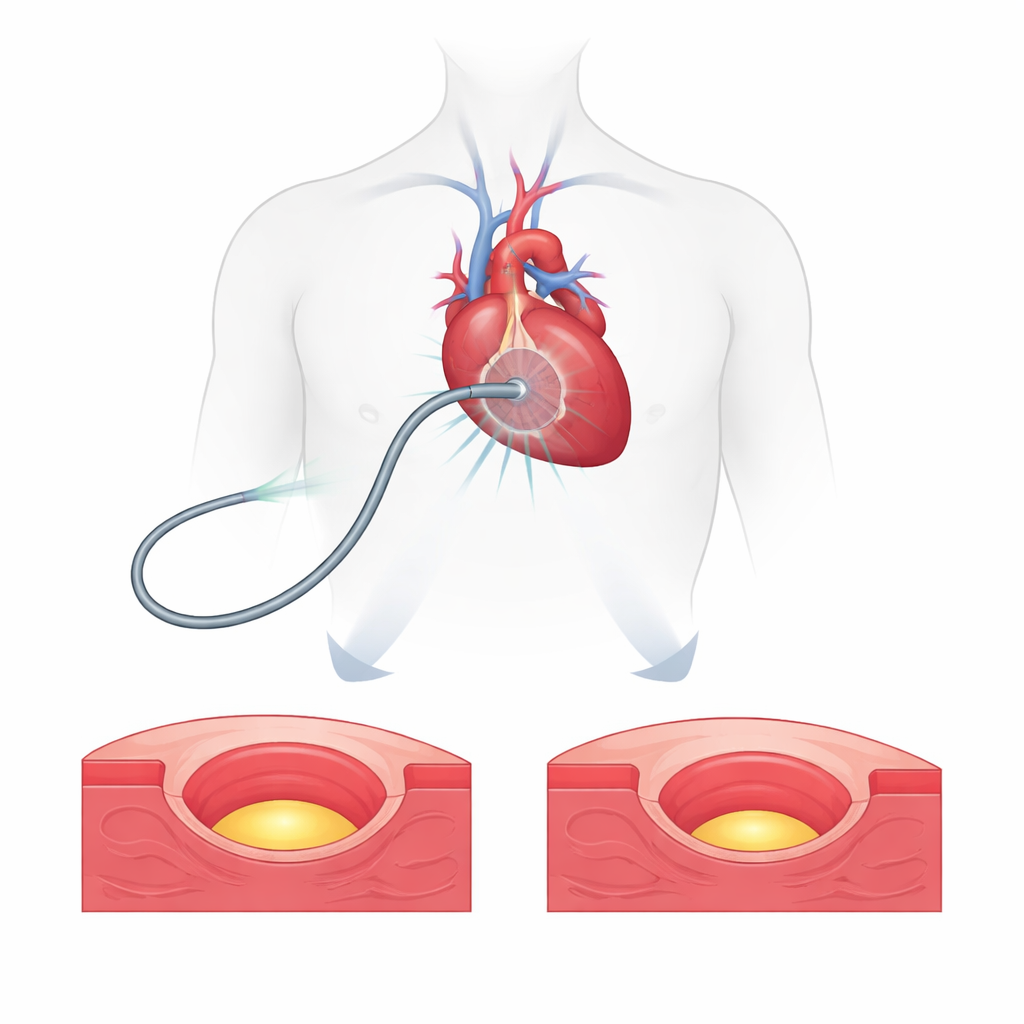
Contact changes depth, not width
The results showed a clear, intuitive pattern. In both potato and pig hearts, simply making sure the circular catheter truly touched the tissue produced notably deeper lesions than when it was slightly off the surface. However, once the catheter was in contact, pushing harder did not meaningfully increase lesion size in the phantom (potato) model: low, medium, and high forces produced similar depths and widths. In the pig hearts, the width of the lesions—their spread along the surface—remained fairly stable regardless of contact or how many times energy was delivered. What changed most was depth: contact plus repeated applications steadily carved deeper columns of injury into the wall, with the deepest lesions seen after five applications under stable contact.
What the microscope revealed
Under the microscope, both contact and non-contact pulses produced hallmark signs of acute pulsed-field injury: bands of contracted heart muscle cells, early inflammatory cells, localized swelling, and small areas of bleeding. Notably, tiny blood vessels within the damaged zones were largely preserved, fitting with the idea that pulsed fields can spare delicate structures. These changes were more intense when the catheter was in firm contact, matching the greater lesion depth seen on gross inspection. In non-contact cases, injury tended to be more superficial, with milder swelling and fewer inflammatory cells. 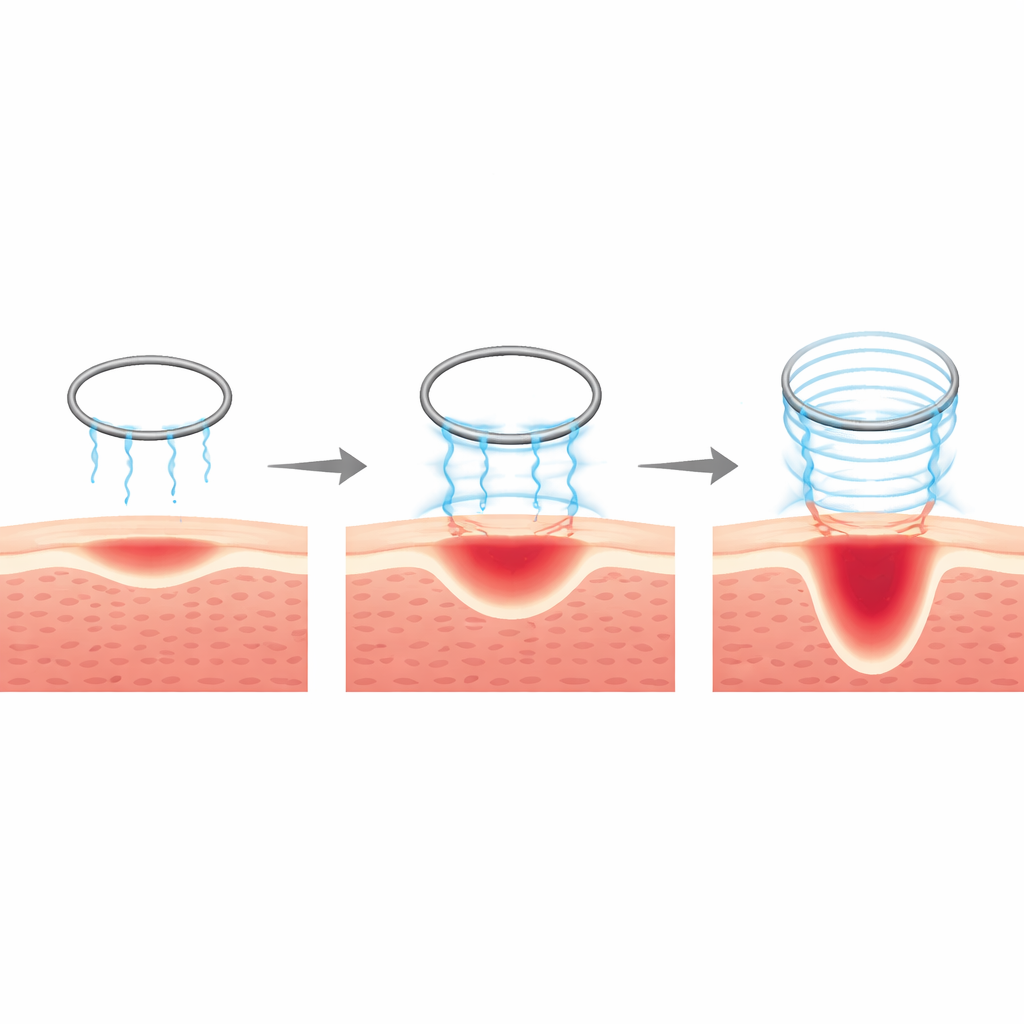
Implications for real patients
By comparing their measured lesion depths with known thicknesses of the upper heart chambers in people, the authors suggest that three well-delivered applications under stable contact could create lesions that reach through much of the typical atrial wall. This matters because gaps or incomplete lesions are linked to rhythm problems coming back after ablation. At the same time, the work hints that pressing harder with the catheter may not add much benefit for this pulsed-field system—what truly matters is that the device sits stably against the tissue while the pulses are delivered.
Take-home message for heart rhythm care
For pulsed-field ablation using a circular catheter, this study concludes that stable contact between the device and the heart wall is essential for forming deep, effective lesions, while the exact amount of force beyond that seems less critical, at least in the tested models. Repeating the energy delivery increases lesion depth, whereas lesion width stays relatively constant. Early tissue changes suggest strong cell injury with preservation of small vessels, though longer-term safety still needs study. In plain terms, for this promising non-thermal heart procedure to work best, clinicians should focus less on pushing harder and more on keeping the catheter steadily and reliably in touch with the heart.
Citation: Hu, X., Li, W., Ren, B. et al. Impact of contact parameters on lesion dimensions during circular Pulsed-Field ablation in ex vivo and in vivo models. Sci Rep 16, 11811 (2026). https://doi.org/10.1038/s41598-026-42503-1
Keywords: pulsed-field ablation, catheter contact, cardiac arrhythmia, lesion depth, atrial fibrillation