Clear Sky Science · en
Performance and energy consumption optimization of ternary optical computers based on the M/G/1 queuing model
Why smarter light-based computers matter
Modern society depends on heavy-duty computing for everything from weather forecasts to artificial intelligence. But as traditional, electricity-hungry chips push against limits in speed and power, researchers are exploring new kinds of machines that use light instead of just electrons. This paper looks at a promising light-powered architecture called a ternary optical computer and asks a practical question: how can we keep such a machine fast enough for users while sharply cutting its energy use?

A new kind of light-powered calculator
A ternary optical computer (TOC) processes information not in the usual zeros and ones, but in three light-based states. This design lets it handle very wide data words in parallel and reconfigure its hardware for different tasks, making it attractive for demanding jobs like graph analysis, signal processing, and optimization. Over the past two decades, researchers have built prototypes and demonstrated fast arithmetic, matrix operations, and advanced algorithms on TOC platforms. However, as with any high-performance machine, there remains a tension between raw speed and the cost of keeping powerful optical processors running continuously.
Breaking work into three simple stages
The authors propose to understand and improve a TOC by viewing it as a three-stage service line. In the first stage, a front-end module simply receives incoming computation requests and queues them up. In the second stage, data are reshaped into the special ternary format the optical hardware needs. Only in the third stage does the heavy lifting occur, as an optical processor executes the computations. By separating the system this way, the team can use mathematical tools from queuing theory to estimate how many tasks are waiting, how long they stay in the system, and how often the processor is actually busy.
Letting the processor “take vacations”
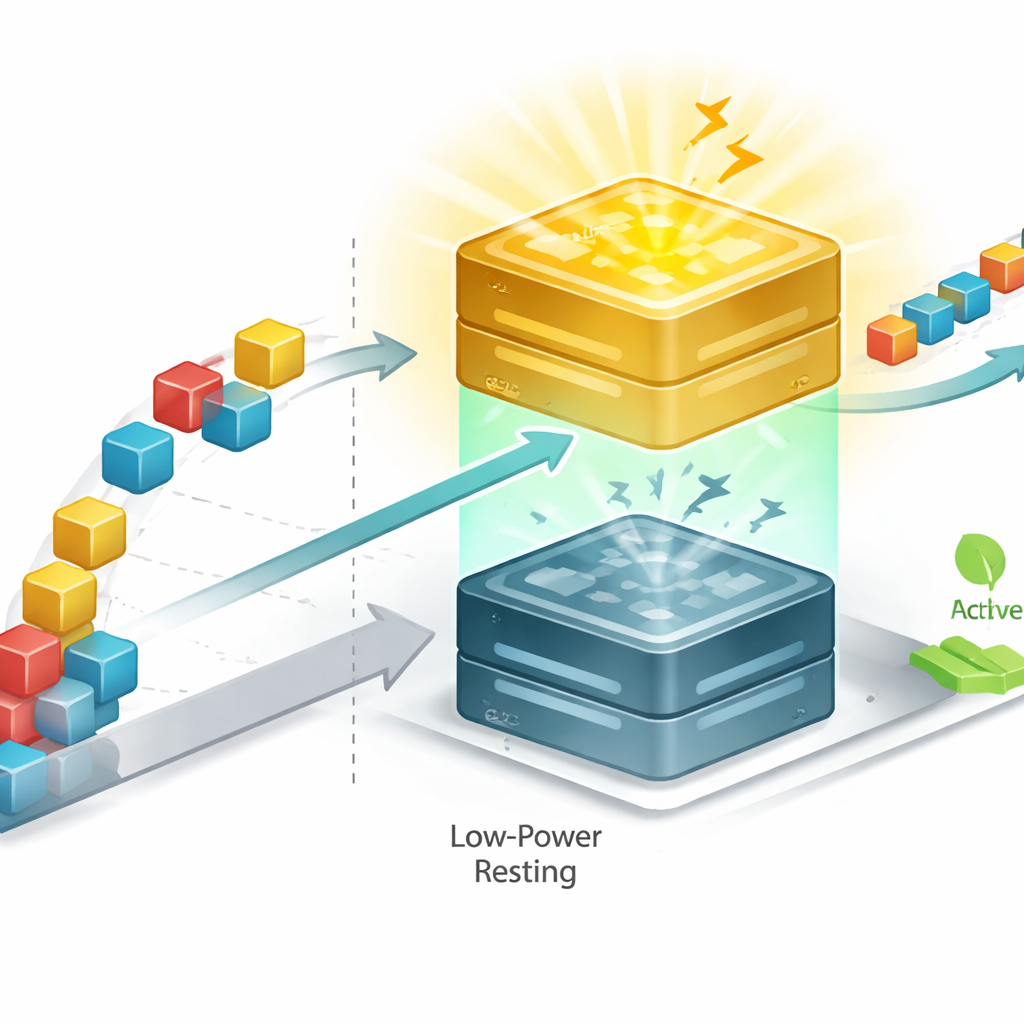
The key idea is to avoid running the optical processor at full readiness when there is little or no work to do. The authors introduce two control ideas commonly studied in operations research. First, an “N-policy” says that the processor only wakes up to work when at least N tasks have accumulated in the queue; this avoids turning the machine on and off for every tiny request. Second, a “multiple vacation” mechanism allows the processor to enter a low-power state whenever the queue is empty, and to stay in that resting mode through repeated “vacations” until enough new tasks arrive to justify waking up. Together, these rules create an automatic balance: the more traffic there is, the more time the processor spends working; during quiet periods, it mostly sleeps.
Measuring wait times and energy cost
To judge whether this strategy is worthwhile, the authors build formulas for two quantities that any user or operator cares about: how long tasks spend in the system, and how much energy the processor consumes on average. They derive an exact expression for the average queue length in the third stage, and simpler approximations for the first two stages. Using a standard relation between queue length and waiting time, they obtain the typical time a request spends inside the TOC. Then, using a mathematical tool called the renewal reward theorem, they define a cost function that represents energy consumption across repeated cycles of busy, idle, and vacation periods. By running numerical experiments with different choices of the threshold N and different patterns of “vacation” lengths, they identify operating points that keep waiting times within acceptable bounds while minimizing this energy-related cost.
What the findings mean in practice
The results show that carefully choosing when the optical processor should wake up or rest can cut its energy-related cost by more than a quarter compared with a conventional always-ready setup, while still keeping user wait times in a good range. In simple terms, the TOC behaves like an energy-smart appliance that knows when to go into sleep mode and when to spring into action, based on how many jobs are lined up. Although the analysis assumes one processor and idealized traffic, the same framework can be extended to multi-core and more complex systems. This work therefore offers both a proof of concept and a design handbook for future light-based computers that need to be not only fast, but also energy-wise.
Citation: Wenqiang, S., Weiwen, L., Heqiang, Z. et al. Performance and energy consumption optimization of ternary optical computers based on the M/G/1 queuing model. Sci Rep 16, 12271 (2026). https://doi.org/10.1038/s41598-026-42496-x
Keywords: ternary optical computer, energy-efficient computing, queueing models, performance optimization, power-aware processors