Clear Sky Science · en
Multiscale microscopic pore structure characterization and storage–flow coupling mechanisms in ultra-low permeability tight sandstone reservoirs
Why tiny spaces in rocks matter for our energy future
As easy oil and gas fields decline, energy companies increasingly turn to "tight" rocks that barely let fluids move. This study looks deep inside such rocks from the Ordos Basin in China, showing how pores thousands of times smaller than a grain of sand control both how much oil a rock can hold and how easily it can be produced. By mapping these hidden spaces across many scales, the researchers offer a clearer guide to which parts of a tight reservoir are worth developing and why.
A closer look at a tight sandstone basin
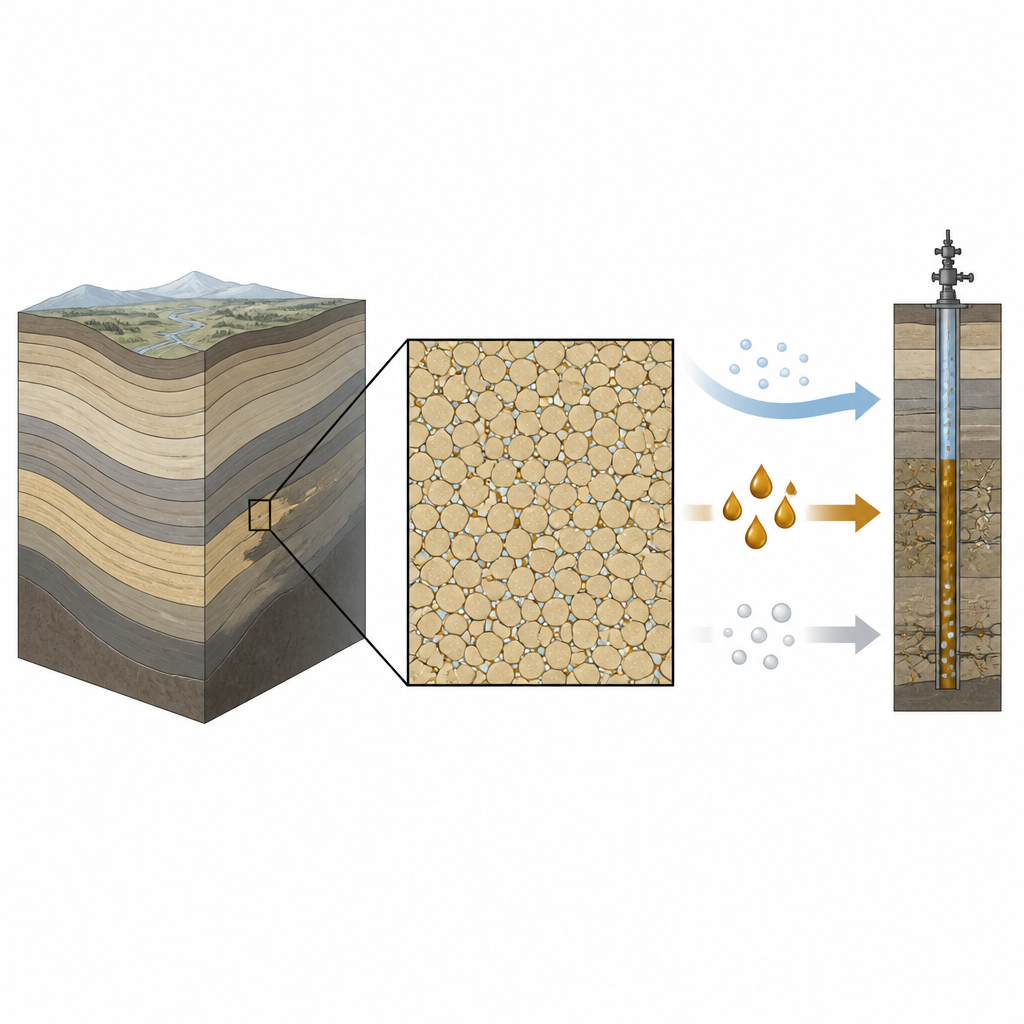
The team focuses on a set of rock layers known as the Chang 4+5 member in the Yanchang Formation, buried in the large Ordos Basin. These layers are mainly fine sandstones and siltstones with low porosity and extremely low permeability, meaning they store only modest amounts of fluid and transmit it poorly. Using core samples from five wells, the authors document a complex mix of minerals, dominated by quartz and feldspar with abundant rock fragments and clays. This mixture, combined with the basin’s calm lake and river-delta conditions during deposition, created sand bodies that vary strongly from place to place, so that even neighboring layers can behave very differently as reservoirs.
Peering into pores from micrometers to nanometers
To unravel how these rocks store and transmit fluids, the researchers combine seven laboratory techniques that each see a different size of pore. Standard thin sections and scanning electron microscopy reveal six main pore types, including leftover gaps between grains, tiny pits formed by mineral dissolution, pores between clay crystals, and microfractures. High-pressure mercury tests and nitrogen gas adsorption then measure how many pore spaces occur at each size from tens of micrometers down to a few nanometers, while micro-CT scans show how those pores connect in three dimensions. Finally, nuclear magnetic resonance (NMR) data are carefully calibrated against the gas and mercury measurements to build a single, continuous pore-size map spanning more than five orders of magnitude.
What controls storage and what controls flow
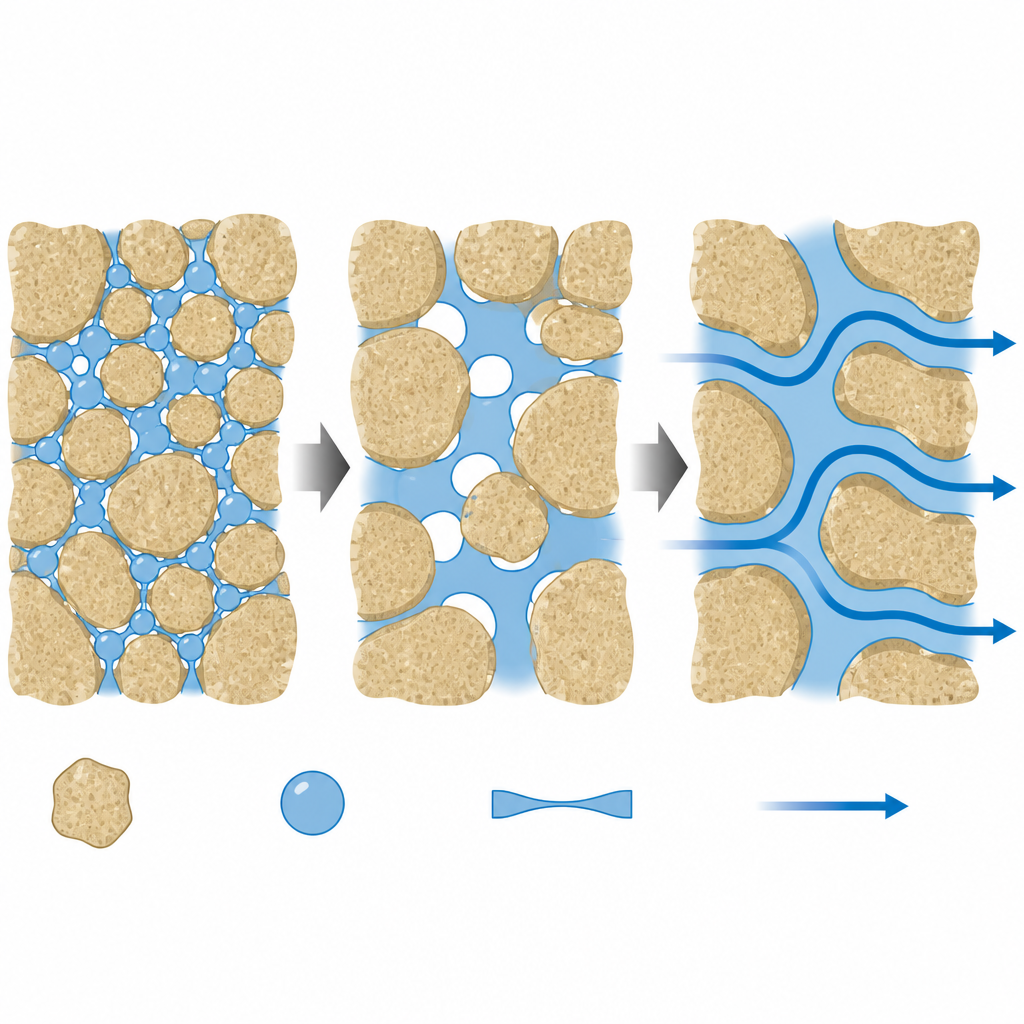
The unified picture shows that nanopores and small throats dominate the Chang 4+5 rocks, with a characteristic bimodal pattern of pore sizes: one population representing larger voids between grains and another marking the much narrower connecting throats. The study finds that overall pore volume is governed mainly by these numerous small spaces, which hold most of the fluids. However, fluid flow depends far more on the relatively rare, larger and better-connected throats. Measurements of how mercury enters and leaves the rock, and how oil and water flow together in core-flood experiments, demonstrate that a small fraction of the pore network carries most of the flow, while much of the stored fluid sits in zones that hardly contribute to movement.
How rock history reshapes tiny spaces
The way these pores formed and evolved is tied to both the original sediment and later chemical changes. Coarser, better sorted channel sandstones tend to preserve larger, simpler pore systems and have better reservoir quality than finer, muddier mouth-bar deposits. Over millions of years of burial, compaction squeezed grains closer and cement minerals such as quartz and calcite filled many of the remaining openings, cutting down both storage and flow. At the same time, the dissolution of feldspar and rock fragments carved new secondary pores and sometimes improved connectivity. Clay minerals, especially chlorite and illite, could either help by lining pores without blocking them or hurt by swelling and narrowing flow paths, depending on how and where they grew.
From microscopic structure to field development
By connecting pore-scale measurements to bulk properties like porosity, permeability, and oil–water flow curves, the authors distill a simple rule of thumb: pores dominate storage, while pore throats dominate flow. Rocks with similar porosity can have very different production behavior if their throats differ in size, number, or connectivity. This insight, backed by multiscale imaging and careful lab tests, provides a practical framework for identifying "sweet spots" within otherwise tight reservoirs and for designing development strategies that respect the limits set by the rock’s hidden architecture.
Citation: Li, CL., Su, DR., Chen, PP. et al. Multiscale microscopic pore structure characterization and storage–flow coupling mechanisms in ultra-low permeability tight sandstone reservoirs. Sci Rep 16, 14811 (2026). https://doi.org/10.1038/s41598-026-42495-y
Keywords: tight sandstone, pore structure, ultra-low permeability, Ordos Basin, oil reservoir flow