Clear Sky Science · en
Biometeorological regulation of male and female fertility traits in banana (Musa spp.) across contrasting flowering environments
Why Weather Matters for Bananas
Bananas are a daily food for hundreds of millions of people, yet many cultivated varieties are surprisingly bad at making seeds. This poor fertility makes it hard for breeders to create new, hardier types of bananas that can cope with pests, diseases, and a changing climate. The study described here asks a deceptively simple question: how do changing weather conditions at flowering time influence the basic ingredients of banana reproduction—pollen and receptive flowers—and can those patterns be predicted well enough to help breeders plan their crosses?
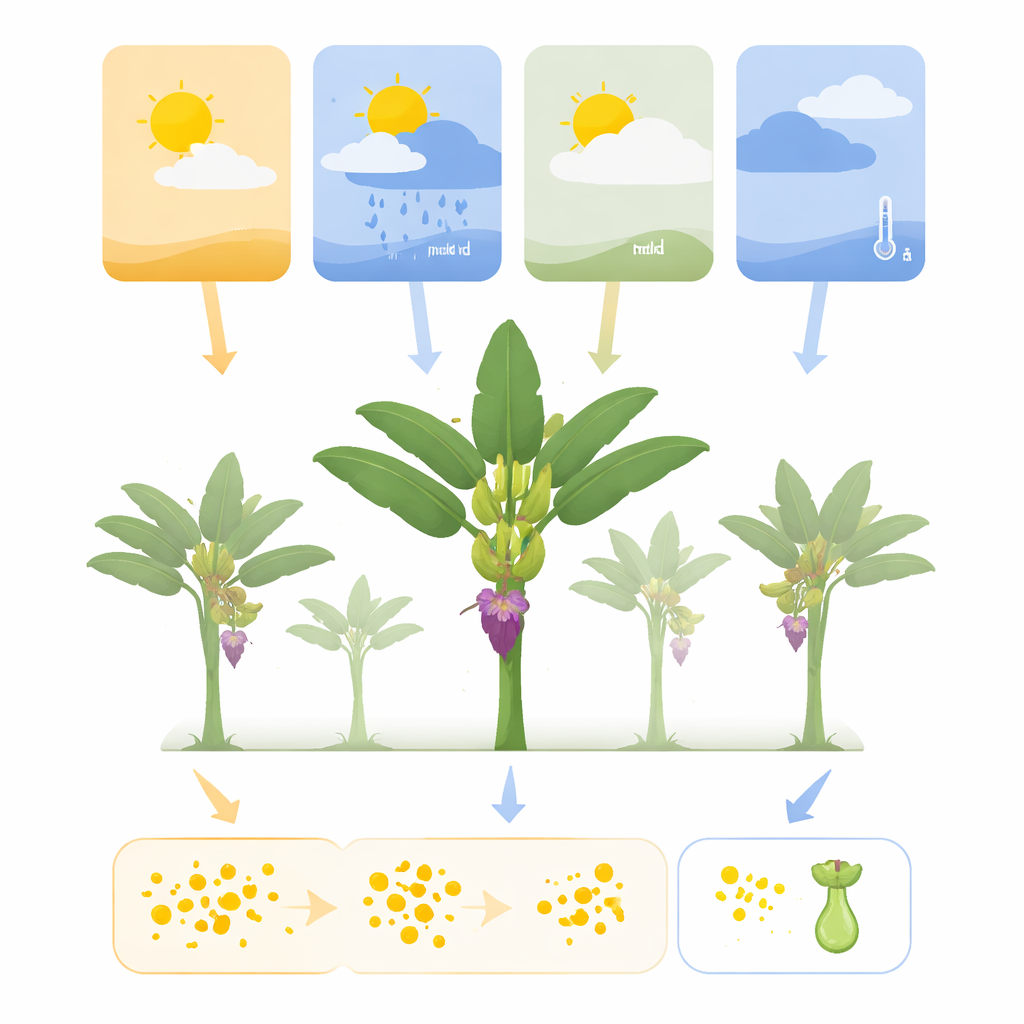
Different Bananas, Different Reproductive Strengths
The researchers examined fifteen banana types that span the genetic range used in breeding, including simpler diploid plants and more complex triploids, which are common among edible bananas. They focused on four key traits: how many pollen grains are produced, how many of those grains stay alive, how many can sprout a pollen tube to fertilize the flower, and how long the female part of the flower remains ready to receive pollen. Even before weather enters the picture, the team found strong genetic differences. A diploid wild-like banana called ‘Calcutta 4’ consistently produced abundant, vigorous pollen, while some cultivars, such as ‘Banana‑02/22’ and ‘Alpan’, made almost none at all. Another variety, ‘Grand Naine’, stood out not for pollen, but for its unusually long period of female readiness.
Flowering Seasons Shape Reproductive Success
To see how environment alters these inherent tendencies, the team tracked the same genotypes across four distinct flowering windows over a full year, from hot spring to cooler winter conditions in eastern India. The warm, bright periods of April–May and July–August turned out to be the sweet spots for male function: across genotypes, pollen numbers, survival, and germination were all highest in these phases. By contrast, during the cooler January–March phase, pollen output and performance fell sharply. Intriguingly, the female side behaved differently. Stigmas stayed receptive longest in the cooler phases, especially in winter, and for a shorter time during the warmer seasons, suggesting that male and female functions respond to climate in somewhat opposing ways.
Beyond Temperature: Cumulative Heat and Light
Rather than looking only at daily highs and lows, the researchers used three integrated weather measures that add up heat and light over the period when flowers form: growing degree days (how much warmth accumulates above a base level), photothermal units (combined warmth and day length), and heliothermal units (warmth plus bright sunshine hours). Pollen survival and germination showed the clearest links to these indices. Moderate accumulated heat and light, especially when captured by photothermal units, were associated with high pollen viability and robust germination in several diploid genotypes. When these values were low, as in the cool winter phase, pollen traits were consistently poor. Pollen quantity itself was less tightly tied to weather, reinforcing that some bananas are simply genetically good or bad at producing pollen. In contrast, stigma receptivity tended to be longer when accumulated heat and light were low, hinting that cooler, dimmer conditions slow down the aging of the female tissues.
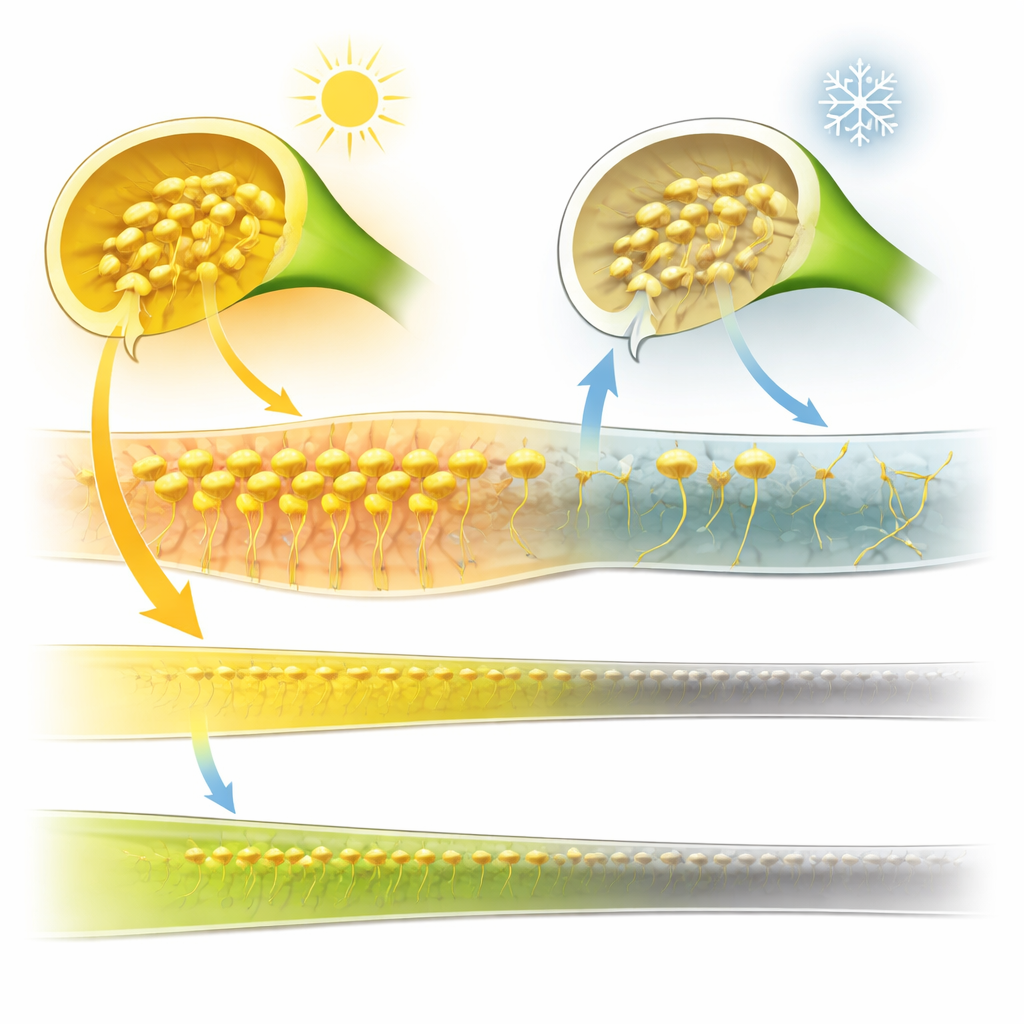
Matching Parents and Seasons for Better Crosses
By combining all traits and weather indices in multivariate analyses, the study could clearly separate high-fertility diploid bananas such as ‘Calcutta 4’ and ‘cv. Rose’ from low-fertility triploids and nearly sterile lines. It also highlighted that the best seasons for male and female roles are not identical. Warm, moderately bright periods favor pollen quantity and quality, while cooler periods extend the window during which stigmas can receive pollen. This means that an individual banana variety might be most effective as a pollen donor in one flowering phase, but more useful as a pollen recipient in another.
What This Means for the Future of Bananas
For non-specialists, the takeaway is that banana fertility is not simply a fixed property of each variety; it is the outcome of an ongoing conversation between genes and weather. The study shows that cumulative measures of heat and light can reliably predict when a banana plant will have strong pollen or a long-lasting receptive flower. Breeders can use this insight to time hand pollinations during the most favorable phases and to choose parents whose strengths complement each other—pairing, for instance, a diploid with stable, high-quality pollen with a cultivar that offers a long receptive period under cooler conditions. In an era of climate uncertainty, such biometeorological guidance offers a practical route to more efficient crosses and, ultimately, to more resilient bananas in farmers’ fields.
Citation: Pathak, A., Bairwa, D.K., Kumari, S. et al. Biometeorological regulation of male and female fertility traits in banana (Musa spp.) across contrasting flowering environments. Sci Rep 16, 14447 (2026). https://doi.org/10.1038/s41598-026-42494-z
Keywords: banana breeding, plant fertility, climate and crops, pollen biology, flowering environment