Clear Sky Science · en
HAp@Cell bio-films engineered from local resources involving molecular mechanisms of dye adsorption and antibacterial activity
Turning Local Minerals and Cotton into Smart Cleaning Films
Industrial dyes and harmful germs are two stubborn threats to clean water and human health, especially around tanneries, textile plants, and hospitals. This study shows how common Moroccan resources—phosphate rock and cotton waste—can be transformed into thin, flexible films that both strip intense dyes from water and kill disease‑causing bacteria. The result is a low-cost, reusable material that links clean manufacturing, pollution control, and infection prevention in a single sheet-like “bio-film.”
Simple Ingredients, Gentle Manufacturing
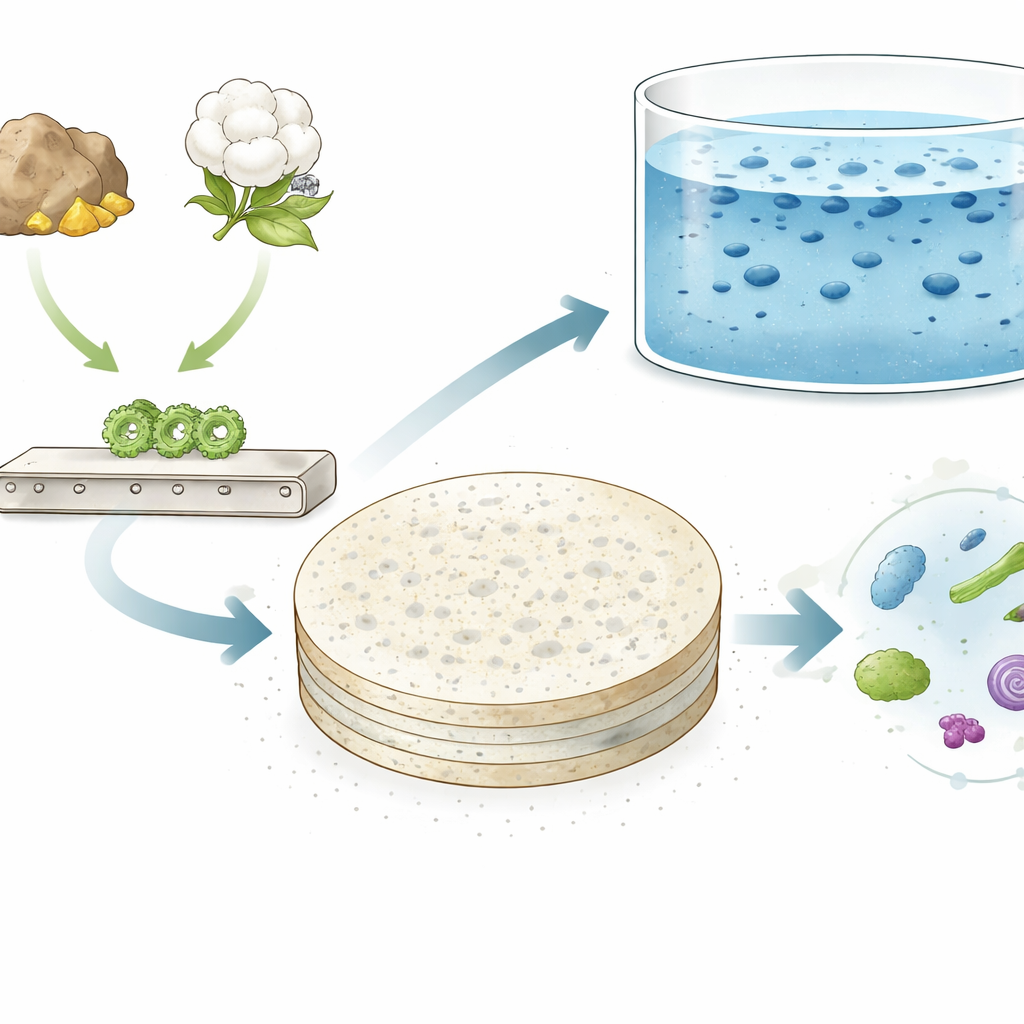
The researchers started with two widely available materials. Natural phosphate ore was processed into hydroxyapatite, a calcium phosphate mineral similar to the inorganic part of human bone. Raw cotton fibers, representing agricultural waste, were cleaned and bleached to obtain nearly pure cellulose, the world’s most abundant natural polymer. Instead of harsh organic solvents or high temperatures, the team used a cold, water-based mixture containing salt and urea to dissolve cellulose and then mixed in fine hydroxyapatite powder. By adjusting the ratio between the two, they cast smooth, thin films and dried them below 100 °C, creating solvent‑free, eco‑designed sheets ready for testing.
Inside the Film: A Porous, Active Network
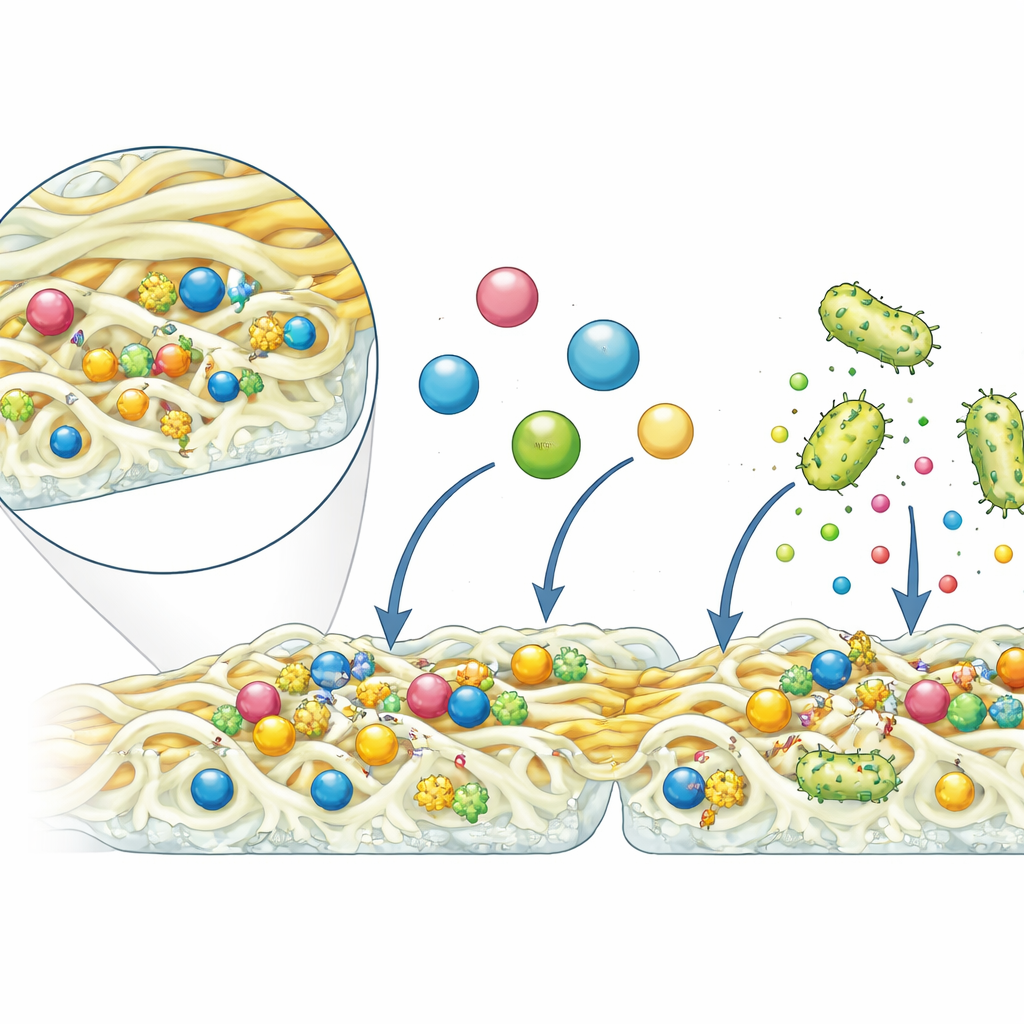
To see what was happening inside these films, the team used a suite of structural and imaging tools. X‑ray diffraction confirmed that hydroxyapatite kept its crystal structure but was broken down into tiny particles when trapped in the cellulose network. Microscopy images revealed that pure cellulose alone forms relatively smooth, compact surfaces, while pure hydroxyapatite clumps into weak, crumbly grains. In contrast, the mixed films showed a more rugged, porous landscape with hydroxyapatite particles well dispersed among cellulose strands, especially in the optimized composition called PC5. This rough, nanoscale architecture greatly increases the surface area and exposes many chemical groups that can interact with pollutants and microbes.
Cleaning Blue Dyes from Real and Model Wastewater
The films were then challenged with two types of blue colorants: methylene blue, a common test dye, and natural indigo collected from traditional tanning baths in Fez. When small discs of film were immersed in dye solutions, the optimized PC5 film removed up to about 85 milligrams of methylene blue per gram of material and cleared roughly 95% of indigo from water within half an hour. Detailed analysis showed that dye molecules first rush to the film surface and then form multiple layers, attaching through a mix of attractions: opposite charges between the positively charged dyes and negatively charged phosphate groups, hydrogen bonds with surface hydroxyl groups, and stacking interactions with the sugar rings of cellulose. Mathematical models of the data revealed that this is not just weak, reversible sticking: the process behaves like a stronger, chemically driven binding, and the irregular surface of the film supports many different kinds of sites.
Stopping Bacteria in Their Tracks
Beyond color removal, the same films strongly suppressed the growth of two key bacteria: Staphylococcus aureus, often linked to wound infections, and Escherichia coli, a common indicator of fecal contamination. Discs of pure cellulose showed no protective effect, while pure hydroxyapatite created modest clear zones around itself on bacteria‑coated plates. In the best-performing composite, those clear zones grew to about 25 millimeters for S. aureus and 20 millimeters for E. coli. The researchers attribute this to a combination of direct contact and controlled release of calcium and phosphate ions from the tiny mineral particles. These ions disturb the outer membranes of bacteria and upset their internal balance, while the charged film surface helps pull cells into close contact where damage is most effective.
Durable, Reusable, and Ready for Real-World Use
Practical water‑treatment materials must survive more than a single use. Here, the HAp@Cell films were recharged by washing in a mild acid–alcohol mixture and drying. After five cycles of dye removal and regeneration, the PC5 film still retained over 85% of its original cleaning capacity, and its antibacterial effect remained strong. Because the films are made from local minerals and cotton, require no organic solvents, and are processed at relatively low temperatures, they fit well within Morocco’s broader strategy for a circular, low‑impact economy. In plain terms, this work shows that a simple, sheet‑like material can both fade stubborn industrial dyes and knock down harmful microbes, offering a promising, sustainable option for cleaning wastewater and protecting against infection in one step.
Citation: Berrahou, S., Latifi, S., Saoiabi, S. et al. HAp@Cell bio-films engineered from local resources involving molecular mechanisms of dye adsorption and antibacterial activity. Sci Rep 16, 12927 (2026). https://doi.org/10.1038/s41598-026-42483-2
Keywords: wastewater treatment, bio-based materials, dye removal, antibacterial surfaces, hydroxyapatite cellulose films