Clear Sky Science · en
An advanced rapid-visual CRISPR assay for detecting porcine reproductive and respiratory syndrome virus
Why This Matters for Farmers and Food Security
Porcine reproductive and respiratory syndrome (PRRS) is one of the most damaging diseases in modern pig farming. It causes breathing problems in young pigs, reproductive failures in sows, and huge financial losses for producers around the world. Quickly spotting the virus behind this disease, PRRSV, is essential to stop outbreaks before they spread through barns and across regions. This study presents a new, rapid test that uses CRISPR gene-targeting technology and a simple fluorescent readout to detect extremely small amounts of the virus, offering a practical tool for improving animal health and protecting the pork supply.
A Costly Virus That Spreads Quietly
PRRSV is notorious for spreading fast and causing long-lasting damage. Infected herds suffer from high piglet mortality, stillbirths, and weak growth, leading to major economic losses—estimated at hundreds of millions of dollars annually in countries like the United States and across Europe. Traditional laboratory tests such as quantitative PCR are accurate and sensitive, but they require specialized machines, trained technicians, and well-equipped labs. That makes them less suitable for routine screening directly on farms, where rapid decisions about quarantine, treatment, or culling often need to be made.
Turning CRISPR Into a Simple Light-Up Test
The researchers built a new test around a CRISPR enzyme called Cas13a, which naturally seeks out and cuts specific viral RNA sequences. First, a quick warming step called reverse transcription–recombinase polymerase amplification (RT-RPA) makes many copies of a chosen PRRSV-2 gene segment at a constant, mild temperature. Then Cas13a is guided to that viral segment by small RNA guides, and once it recognizes the viral target, it begins cutting nearby reporter molecules that are attached to a fluorescent dye. When these reporters are cut, they glow under blue light. This means a farmer or technician can simply place a reaction tube under a portable blue-light device and see, with the naked eye, whether the sample contains virus: glowing tubes indicate infection, while colorless tubes signal a negative result. 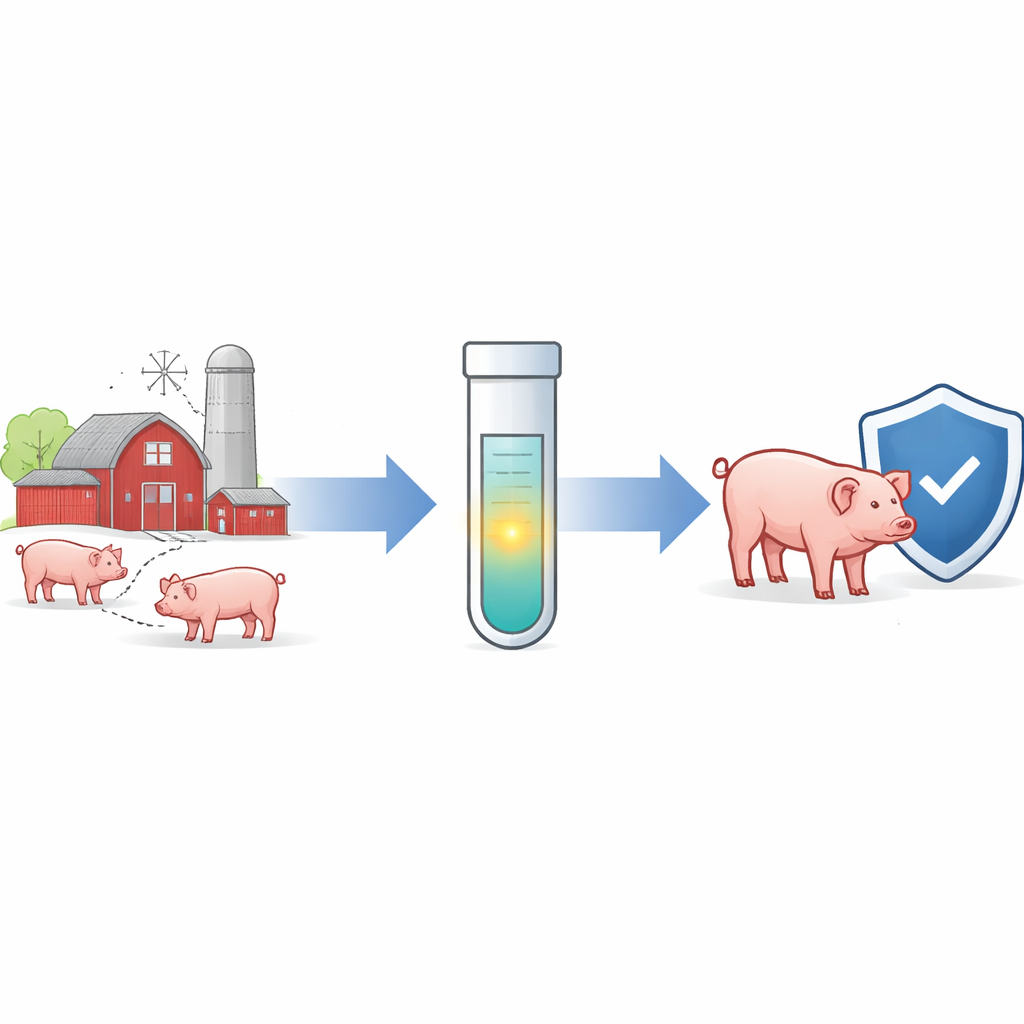
Boosting Sensitivity with Multiple Viral Targets
Not all CRISPR guides work equally well, so the team first tested a panel of twelve guide RNAs aimed at different parts of a conserved PRRSV-2 gene known as the M gene. They identified three guides that produced strong signals in positive samples with very little background glow in negative ones. Instead of relying on a single guide, they combined these three high-performing guides into a “cocktail” that latches onto several spots on the same viral gene. This multi-guide strategy sharply amplified the fluorescent signal, enabling the test to detect as few as 6 copies of viral RNA per microliter—about 28 times more sensitive than earlier CRISPR/Cas13a tests for this virus. At the same time, carefully screening out poorly behaving guides limited spurious background light that could cause false positives.
Checking Accuracy, Speed, and Specificity
To see how well the new method performs in realistic conditions, the researchers created simulated clinical samples by mixing known amounts of PRRSV-2 RNA into healthy pig serum, while keeping other samples virus-free. They then compared their CRISPR-based test to the current gold-standard RT-qPCR. The new assay correctly identified all positive and negative samples, matching PCR with 100% agreement. Importantly, when they tested other common pig viruses that cause diarrhea, such as porcine epidemic diarrhea virus and transmissible gastroenteritis virus, only PRRSV produced a fluorescent signal. The entire workflow—from amplification through CRISPR reaction—can deliver a visible result in as little as 5 to 30 minutes using only a simple heated block and a handheld blue-light viewer. 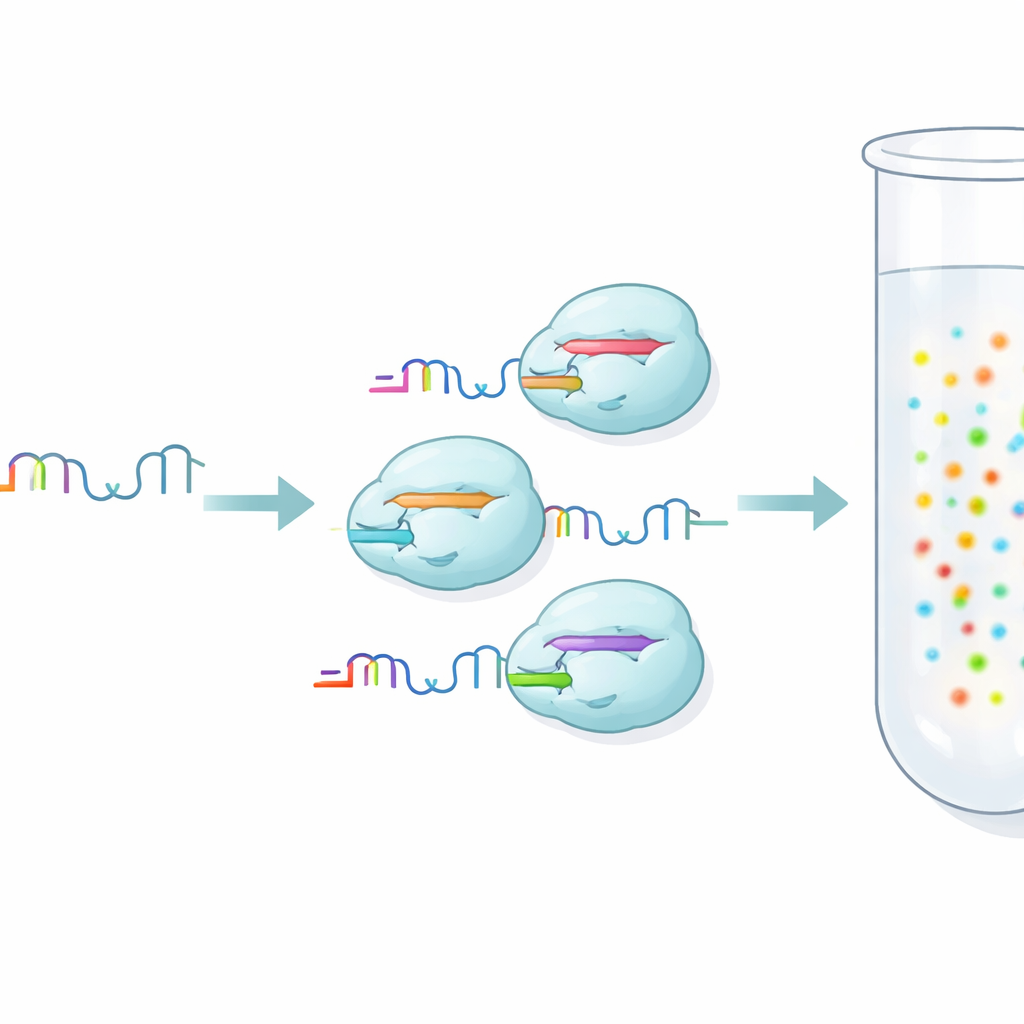
What This Means for Everyday Disease Control
For a layperson, the main message is that the authors have turned an advanced gene-targeting technology into a straightforward, light-up test for a costly pig disease. Their system is as sensitive as sophisticated laboratory PCR machines but uses simpler equipment and a visually obvious red fluorescence signal that can be read by eye. While the study mainly used controlled, “spiked” blood samples and still needs to be validated on large numbers of real farm samples, it demonstrates a practical path toward on-site PRRSV screening in barns and small clinics. Widespread use of such rapid, low-cost tests could help farmers catch infections earlier, limit outbreaks, and reduce the economic and welfare burden of PRRS on the swine industry.
Citation: Guo, J., Shi, S., Xie, S. et al. An advanced rapid-visual CRISPR assay for detecting porcine reproductive and respiratory syndrome virus. Sci Rep 16, 13176 (2026). https://doi.org/10.1038/s41598-026-42470-7
Keywords: PRRSV detection, CRISPR diagnostics, swine health, fluorescent assay, rapid virus test