Clear Sky Science · en
Unraveling the anthelmintic efficacy of Curcuma amada Roxb. extract: A multi-modal mechanistic study against Raillietina spp. infection
Why this matters for backyard eggs and family farms
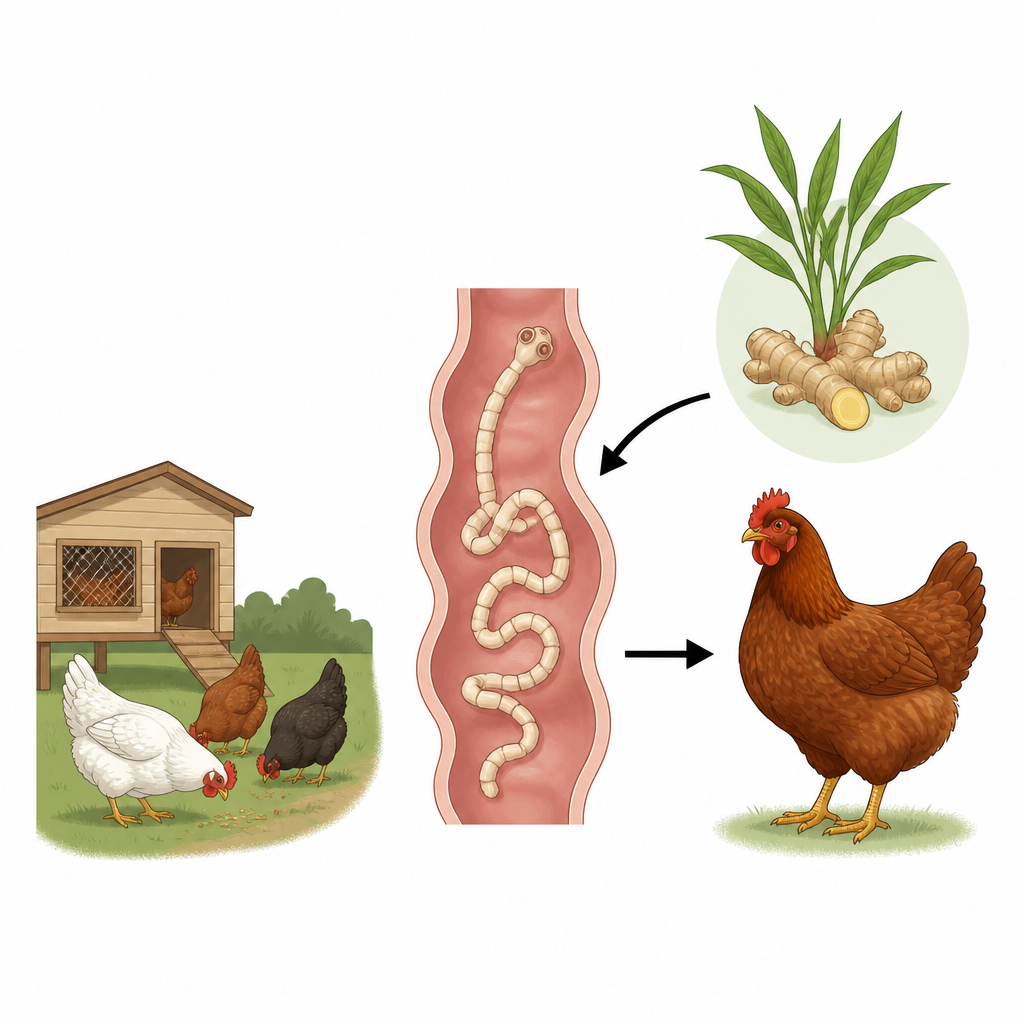
Backyard chickens and small poultry farms are becoming more common as people look for fresh eggs and local meat. But hidden parasites in a chicken’s gut can silently sap its health, leading to poor growth and fewer eggs. This study explores whether a familiar kitchen spice, mango ginger (Curcuma amada), could help fight a common tapeworm in chickens and offer a plant based helper alongside standard medicines.
A kitchen spice meets a stubborn worm
The researchers focused on Raillietina, a tapeworm that lives in the intestine of domestic fowl and can cause weight loss, gut irritation and reduced productivity, especially in young birds. Conventional deworming drugs work, but they can have side effects and overuse encourages drug resistant parasites. In many rural areas, farmers already rely partly on medicinal plants when veterinary care is scarce. Mango ginger, a relative of turmeric long used in traditional medicine and cooking, was chosen to see whether its root extracts could weaken or kill these worms.
Finding the most effective plant extract
The team prepared an alcohol based crude extract of mango ginger rhizomes and then separated it into several solvent fractions. They tested these on live Raillietina worms in warm salt solution, recording how long it took for the worms to become paralyzed and then die, and compared the results with the widely used drug praziquantel and with purified curcumin. At a concentration of 20 milligrams per milliliter, the plant material was clearly effective, and the ethyl acetate fraction stood out as the most potent, causing paralysis faster than the crude extract and performing on par with curcumin and the reference drug.
What is inside the active fraction
To understand what might be driving this effect, the ethyl acetate fraction was analyzed using gas chromatography mass spectrometry and infrared spectroscopy. These tools revealed a mix of fatty acids, plant sterols and phenolic compounds rather than a single magic bullet. A phenol called 2,4 di tert butylphenol was particularly abundant, along with fatty acids such as palmitic, linoleic and stearic acids, and sterols like stigmasterol and beta sitosterol. The infrared “fingerprint” confirmed the presence of many oxygen rich groups typical of polyphenols, lipids and related bioactive molecules. The authors argue that the strong worm killing action likely arises from several of these compounds working together, alongside curcumin that is less visible in this type of analysis.
How the extract injures the worm from outside to inside
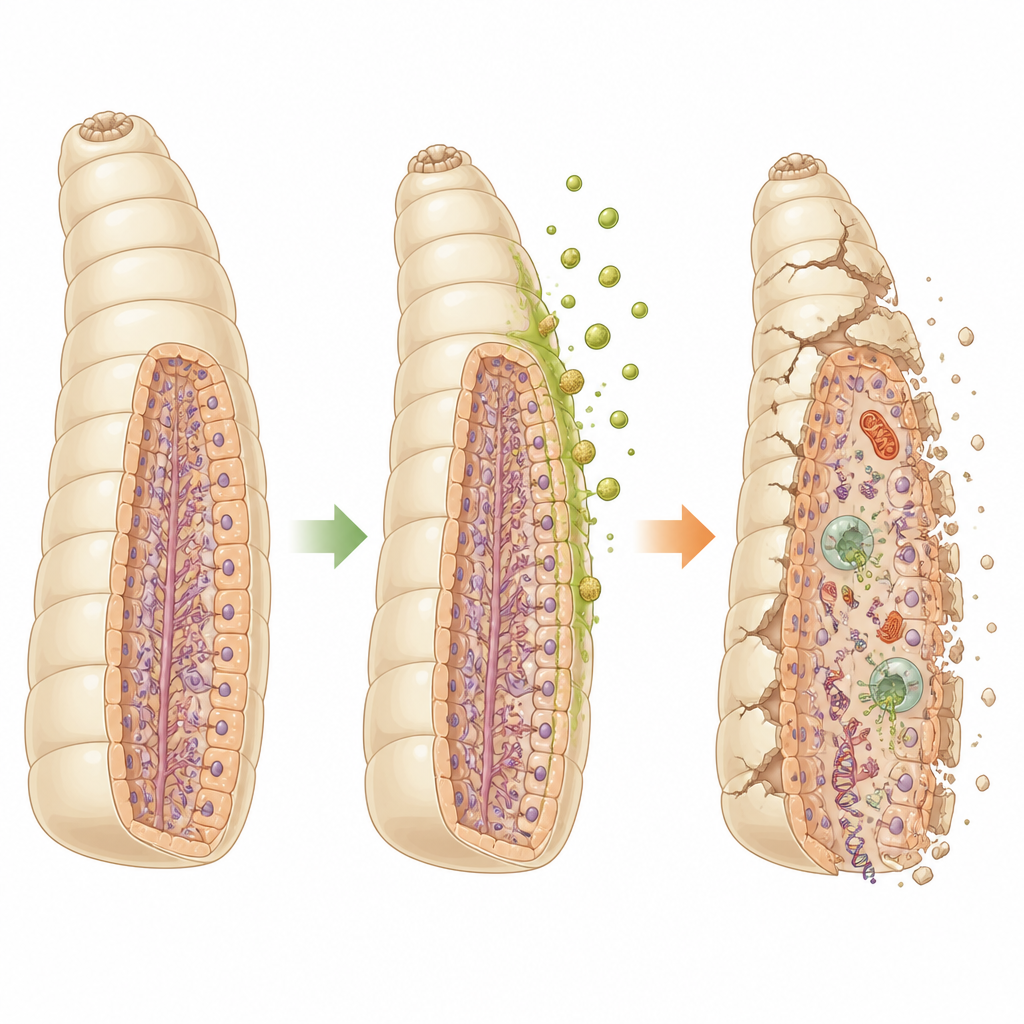
Detailed imaging showed how the mango ginger extract physically damages the parasite. Under a scanning electron microscope, untreated worms had a smooth body, a well formed head with strong suckers and hooklets, and a dense layer of tiny projections on the surface that they use to absorb nutrients and cling to the gut wall. After treatment with the crude extract or ethyl acetate fraction, the head region became distorted, suckers collapsed and lost their hooks, and body segments showed shrinkage, breaks and blister like bulges. Transmission electron microscopy revealed that the fine surface projections were eroded or detached, the underlying skin layers were vacuolated and scarred, and internal structures such as mitochondria and nuclei were deformed.
Damage deep inside the parasite’s cells
The researchers then prepared single cell suspensions from different parts of the worm to track what was happening inside individual cells. Special stains showed heavy DNA damage and chromatin condensation, signs that the genetic material was being compromised. Other dyes revealed that the membranes of mitochondria, the cell’s energy centers, became leaky and highly oxidized, while the recycling sacs known as lysosomes lost their integrity and spilled their contents into the cell. Standard viability tests confirmed that far fewer cells remained alive after exposure to the plant fraction or praziquantel. Even the protective shells of the tapeworm eggs were disrupted, which could reduce the parasite’s ability to infect new hosts.
What this could mean for future treatments
Overall, the study shows that mango ginger root extracts, especially the ethyl acetate fraction, can cripple poultry tapeworms by attacking their surface, breaking down their internal energy systems and damaging their DNA, much like an established deworming drug. For farmers and veterinarians, this points to a possible plant based partner in the fight against worm infections in chickens. However, the authors stress that they have not yet tested safety in mammals or defined how selectively the extract targets parasites over host cells. Before it can be considered for real world use, careful toxicology studies and more detailed work to pinpoint the key compounds and doses will be needed.
Citation: Bose, A., Chatterjee, R., Bharitkar, Y.P. et al. Unraveling the anthelmintic efficacy of Curcuma amada Roxb. extract: A multi-modal mechanistic study against Raillietina spp. infection. Sci Rep 16, 15615 (2026). https://doi.org/10.1038/s41598-026-42463-6
Keywords: mango ginger, poultry tapeworm, anthelmintic plant extract, Raillietina, chicken parasites