Clear Sky Science · en
Evaluation of photobioreactor designs for potential application as microalgal façade systems
Living Walls That Breathe
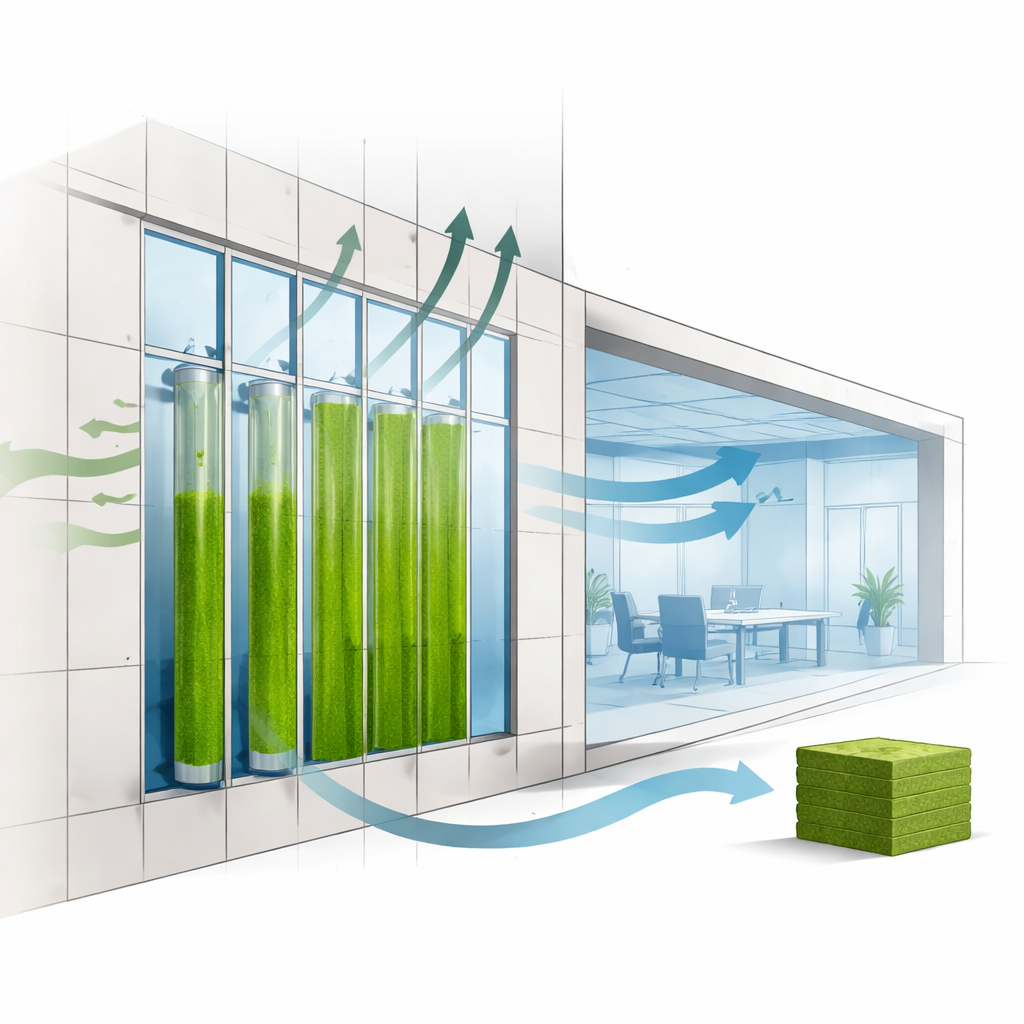
Imagine if the walls of a building could quietly clean the air, help fight climate change, and even make useful green products, all while letting in daylight. This study explores exactly that idea by testing new “living” window systems filled with microscopic algae. The researchers set out to design and evaluate small, water-filled reactors that could one day be built into façades, turning ordinary buildings into active environmental partners instead of passive energy users.
Tiny Plants With Big Potential
The heart of the concept is a single-celled green microalga called Chlorella vulgaris. These microscopic organisms grow quickly, thrive in simple nutrient solutions, and are extremely good at pulling carbon dioxide out of the air—much faster than trees on a per‑weight basis. When housed in transparent vessels attached to a building’s exterior or placed just inside windows, they use sunlight to grow and produce oxygen while locking away carbon in their biomass. That biomass can then be harvested for use in products ranging from bio-based plastics to specialty chemicals, making each façade panel a small, self-contained green factory.
New Reactor Shapes for Real Buildings
To move this idea from vision to practice, the team built and tested several compact photobioreactors—clear containers designed specifically to grow microalgae under real daylight. They focused on two main shapes that fit common building spaces: vertical columns that could occupy narrow corners, and flat panels that could sit in front of larger windows. Both were made from transparent, durable plastics to keep costs low and installation simple. Some of these reactors had added internal structures, such as a spiral insert inside a column or angled plastic “leaves” and S-shaped sheets inside flat panels, intended to improve how light, nutrients, and air are distributed through the growing culture.
How a Simple Spiral Boosts Growth
When the reactors were tested on a university campus in Türkiye, one design clearly stood out: a column equipped with a spiral baffle. Air was pumped in from the bottom, forming bubbles that were guided upward along the spiral path. This gentle swirling motion prevented bubbles from merging into large pockets, kept the algae evenly mixed, and helped light reach more cells throughout the reactor. As a result, this design achieved the highest cell counts and biomass—about 1.8 grams of dry algae per liter, roughly 1.5 to 1.8 times more than flat panels or plain columns. An added bonus was that much of the algae chose to grow directly on the spiral surface, which made harvesting as simple as removing and scraping the insert, cutting down on energy-intensive separation steps.

Counting the Hidden Footprint
Because “green” technologies are not automatically low-carbon, the researchers also examined the environmental impact of the best-performing reactor using a life cycle assessment. They traced the resources needed to produce one gram of algae—from nutrients and water to the electricity used for air pumps and centrifuges. The reactor materials themselves were treated as reusable equipment. The analysis revealed that nearly all of the climate impact, about 0.93 kilograms of CO₂ equivalent per gram of biomass in this small-scale setup, came from electricity use, especially for aeration. In other words, the cleanliness of the power grid largely determines how climate-friendly such systems really are. The team also estimated simple costs and found that the spiral column produced biomass at the lowest price among the tested designs, thanks to its higher yield and easier harvesting.
From Lab Windows to Green Cities
In plain terms, this work shows that carefully shaped, algae-filled window units could help buildings clean indoor air, capture carbon, and generate useful biomass—especially when powered by renewable electricity. The spiral column design proved that a modest tweak to how air and liquid move inside a reactor can dramatically boost growth while simplifying maintenance. Although the study was done at small scale and current electricity emissions in Türkiye are relatively high, scaling up with more efficient equipment and greener power could greatly reduce the carbon footprint. Integrated into building façades as modular units, these living panels could become practical tools for greener campuses and cities, supporting broader climate goals such as the European Green Deal and the drive toward net‑zero buildings.
Citation: Tekin, Z., Al-Hammadi, M., Çalişkan, G. et al. Evaluation of photobioreactor designs for potential application as microalgal façade systems. Sci Rep 16, 11871 (2026). https://doi.org/10.1038/s41598-026-42461-8
Keywords: microalgae façade, photobioreactor design, Chlorella vulgaris, building-integrated biotechnology, life cycle assessment