Clear Sky Science · en
Quantum-inspired workflow for processing distributed fiber-optic sensor data
Keeping Watch on Hidden Infrastructure
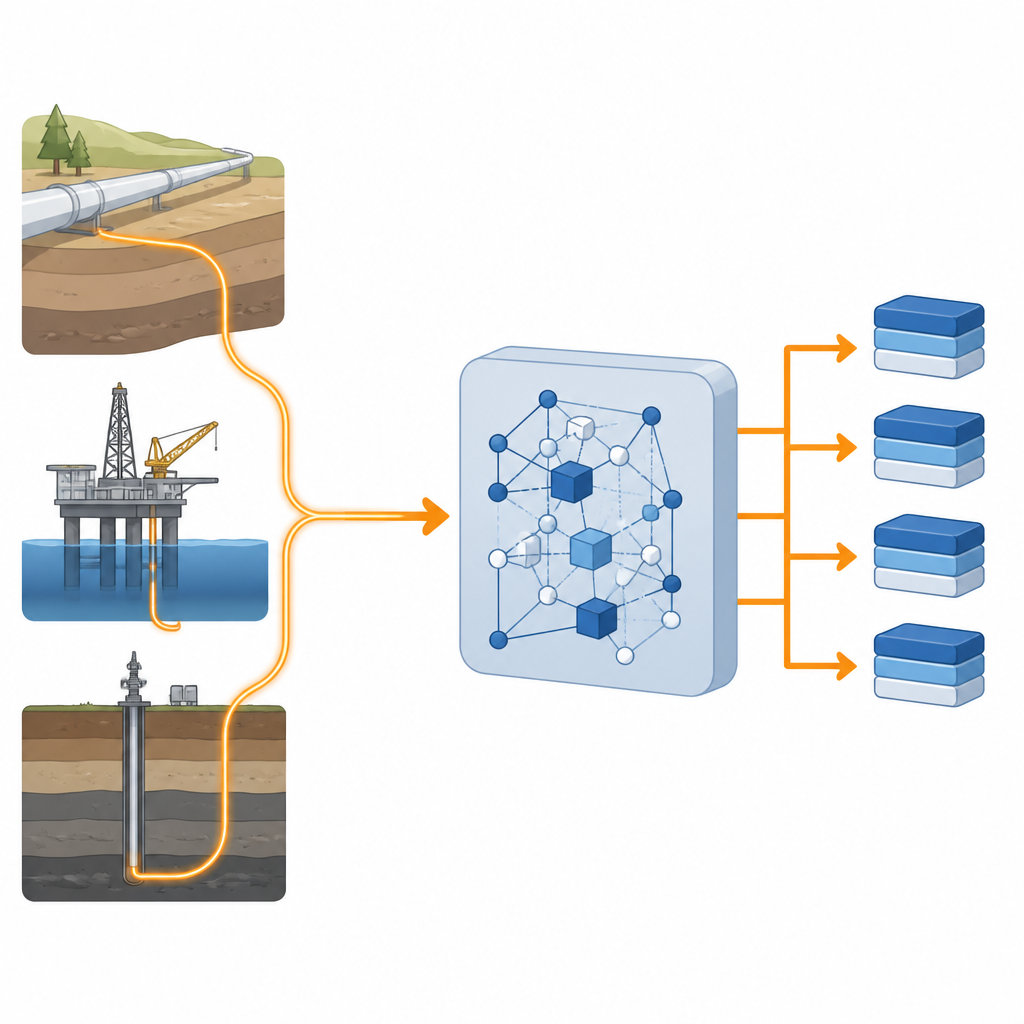
Many of the systems we rely on every day, from undersea cables to deep oil wells, run out of sight and are hard to inspect. A technology called distributed acoustic sensing turns a simple fiber-optic cable into thousands of virtual microphones that can listen for trouble along these structures. The catch is that this constant listening produces mountains of data so large that storing and analyzing them in real time becomes painfully expensive. This study explores a new, “quantum-inspired” way to shrink and process those data streams so that engineers can keep a closer eye on critical infrastructure using ordinary computers.
Listening with Light Along a Cable
Distributed acoustic sensing works by sending rapid pulses of laser light down a fiber-optic cable. Tiny imperfections in the glass scatter some of the light back to the instrument. When the cable stretches or vibrates because of movement in the surrounding environment, the returning light shifts slightly. By tracking these shifts at many points along the cable thousands of times a second, the system creates a detailed picture of how the ground, a pipeline, or a wellbore is moving. A single kilometer of cable can act like a dense line of sensors, but this power comes at a cost: even a modest installation can easily generate several terabytes of data per day, overwhelming storage and network capacity.
Why Simple Compression Is Not Enough
Researchers have tried many ways to tame this data flood. Traditional lossless compression squeezes files without changing any numbers, but it typically cuts the size by less than half, far short of what is needed. More aggressive “lossy” methods throw away some information to achieve much higher compression. For example, one popular approach converts the data into frequencies and averages energy within chosen bands. This saves a lot of space but permanently blurs fine details, making it impossible to fully reconstruct the original vibrations later. As a result, engineers often must choose between saving money on data handling and preserving subtle signals that might matter in future analyses.
Borrowing Ideas from Quantum Physics
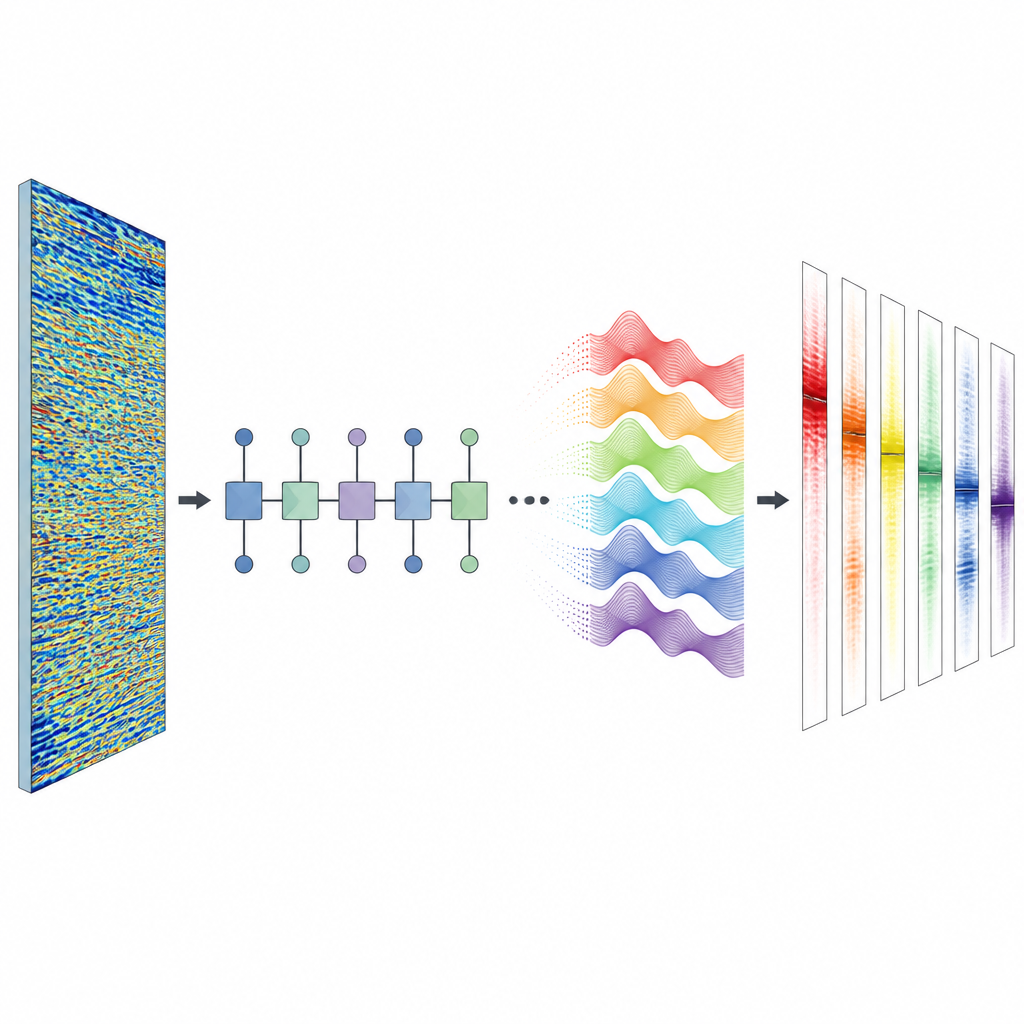
The authors turn to tensor networks, a mathematical tool developed for quantum physics, to offer a different trade-off. Instead of keeping every individual data point, tensor networks represent the data as a chain of smaller blocks whose internal connections capture the most important patterns. Many natural signals, including those in fiber sensing, can be described accurately this way because their complexity is effectively low. In this workflow, each one-second slice of distributed acoustic sensing data is reshaped and compressed into a structure called a tensor train, using a controlled approximation that trims away mostly noise while preserving key features. Multiple threads on a laptop can process different chunks in parallel and then “stitch” the compressed pieces together, keeping memory use and run time under control.
Processing Data Without Fully Unpacking It
A crucial advantage of this approach is that important calculations can be done directly in the compressed form. The study focuses on a common task: extracting energy in specific frequency bands to spot events such as gas entering a well. The team builds a tensor-network version of the Fourier transform, a standard tool for switching from time to frequency. This “quantum Fourier transform” operator acts on the tensor train without first expanding it back to the full data size. They then introduce quantum frequency band extraction, which gathers energy from chosen frequency ranges by partially expanding just the relevant parts of the compressed structure. This mirrors the traditional workflow but keeps most of the savings in storage and computation.
Real-World Test in a Deep Well
To see how well the method performs, the researchers apply it to field experiments in a 1.5-kilometer-deep test well. A fiber cable clamped to the production tubing recorded vibrations as nitrogen gas was injected under different flow conditions. Compared with the standard frequency band extraction, the quantum-inspired workflow compressed the data by roughly 40 to 60 times, cutting raw data rates from tens of megabytes per second to about one. Despite this drastic reduction, the processed results remained structurally similar to the conventional method, with similarity scores high enough that the key gas signals were clearly visible. Thanks to multithreaded stitching, the entire pipeline ran at or near real-time speed on a laptop.
What This Means Going Forward
For a non-specialist, the main message is that it may be possible to “zip” huge streams of sensing data into much smaller packages while still being able to work with them as if they were fully unpacked. This quantum-inspired compression allows engineers to store and transmit long stretches of distributed acoustic sensing data more cheaply, and to analyze them without relying on powerful computers right next to the sensors. The study shows that ideas from quantum physics and advanced mathematics can help bridge the gap between rich sensing technologies and practical, affordable monitoring of critical infrastructure.
Citation: Gemeinhardt, H., Sharma, J. & Kastoryano, M. Quantum-inspired workflow for processing distributed fiber-optic sensor data. Sci Rep 16, 14972 (2026). https://doi.org/10.1038/s41598-026-42453-8
Keywords: distributed acoustic sensing, fiber optic monitoring, tensor networks, data compression, quantum-inspired methods