Clear Sky Science · en
Energy-dissipative adaptive-step L1 discretisation for the Caputo time-fractional incompressible magnetohydrodynamic system
Why this matters for modeling cosmic and laboratory plasmas
Many of the most dramatic events in space and in fusion devices—from solar flares to sudden bursts in turbulent plasmas—evolve in a stop‑and‑go fashion, with quiet periods punctuated by violent outbursts. To capture this kind of history‑dependent behaviour, scientists use “fractional” time models that remember the past more strongly than standard equations. This article presents a new way to simulate such fractional magnetized flows efficiently and reliably, opening the door to more accurate long‑time predictions of turbulent plasmas in both nature and technology.
Plasmas that remember their past
In ordinary fluid and plasma models, the future state depends primarily on the present. But in many turbulent magnetized systems, observations suggest that past events leave a long‑lasting imprint. To account for this, researchers replace the usual time derivative with a fractional one, which mathematically encodes memory effects. The paper focuses on an incompressible magnetohydrodynamic (MHD) system with such a fractional time derivative, designed to describe electrically conducting fluids like solar wind plasma or liquid metals where intermittent, bursty turbulence dominates the energy transfer. These equations couple a velocity field and a magnetic field, and they must satisfy two strict constraints: the fluid must remain incompressible, and the magnetic field must stay free of fictitious magnetic sources.

Stripping away pressure to reveal the core dynamics
Directly solving the fractional MHD equations is challenging because the velocity, magnetic field, and pressure are tightly coupled, and any numerical error that breaks incompressibility or magnetic sourcelessness can quickly ruin a simulation. The author’s first step is to reformulate the equations so that the pressure terms disappear from the main evolution system. This is done using a carefully chosen double‑curl projection, a mathematical operation that extracts only the part of a vector field consistent with the divergence‑free constraints. The result is an equivalent system in which the unknowns are a divergence‑free velocity–magnetic‑field pair, while pressure is reconstructed afterwards from a simpler equation. This reformulation builds the physical constraints directly into the structure of the problem.
Adapting time steps to early‑time singular behaviour
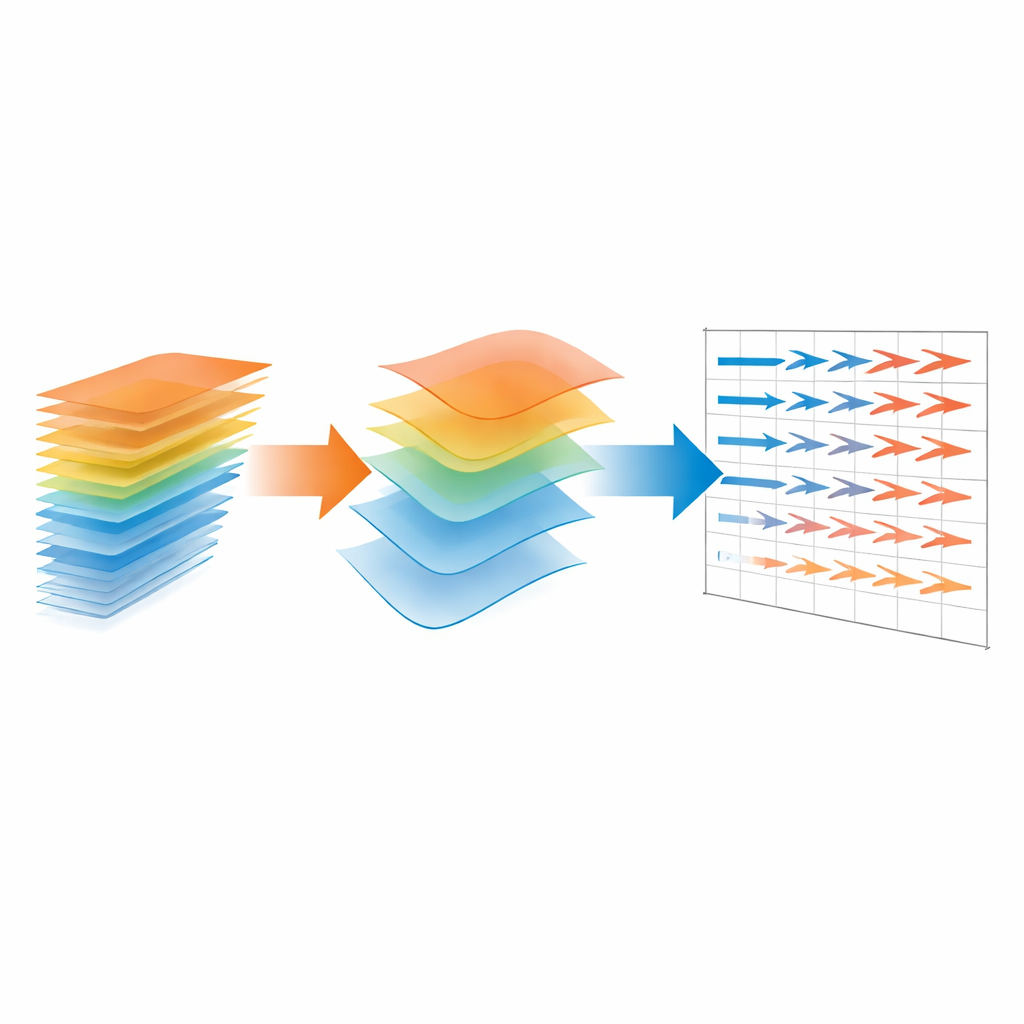
Fractional time derivatives cause the solution to behave unusually near the initial instant: certain quantities change very rapidly at first and then relax more gradually. A fixed, coarse time step would miss this sharp early‑time layer, while a uniformly tiny step would be prohibitively expensive for long simulations. To resolve this, the method uses an adaptive, non‑uniform time grid combined with an L1 convolution rule—a discrete analogue of the fractional memory integral. The time steps are very small near the start to capture rapid variations and grow larger as the system settles, all while preserving the delicate balance in the fractional energy of the system. In space, the scheme employs a divergence‑free Fourier spectral representation, which naturally respects periodic boundaries and keeps both velocity and magnetic fields exactly divergence‑free up to machine precision.
Guaranteeing energy decay and accurate predictions
A central test for any numerical scheme is whether it reproduces the correct energy behaviour of the underlying physics. The continuous fractional MHD equations possess a generalized kinetic‑magnetic energy that must decrease over time, reflecting viscous and resistive losses. The author constructs a discrete energy counterpart and proves that it also decays step by step, regardless of how the time step sizes are varied, and smoothly reduces to the familiar classical MHD energy law when the fractional order approaches one. Beyond stability, the paper establishes rigorous error estimates: under reasonable smoothness assumptions, the method achieves an optimal accuracy rate in time that depends on the fractional order, and spectral accuracy in space. Remarkably, these bounds cover not only the velocity and magnetic fields but also the pressure, which is often harder to control in fractional models.
Putting the method to the test
To demonstrate the scheme’s performance, the article presents a series of numerical experiments. Manufactured “test” solutions confirm that the observed convergence rates match the theoretical predictions over a range of fractional orders. Simulations of benchmark vortical flows—such as fractional versions of the Taylor–Green and Orszag–Tang vortices, and shear layers that roll up into rotating structures—show smooth, monotone decay of the discrete energy and clear formation of magnetic current sheets along vortex boundaries. Throughout long runs, the incompressibility and magnetic sourcelessness remain at machine‑zero levels, and the adaptive time‑stepping strategy automatically concentrates computational effort where the dynamics change fastest while using coarser steps once the system calms down.
What this means for future plasma modeling
In practical terms, the work delivers a numerically efficient and mathematically well‑founded tool for simulating magnetized fluids with memory effects over long times, without sacrificing the core physical constraints. Because the approach is built on Fourier representations and a general fractional‑time discretisation, it can be extended to three dimensions and combined with fast algorithms for handling the history terms. For scientists studying intermittent turbulence in the solar wind, fusion devices, or laboratory liquid‑metal flows, this method offers a reliable way to explore how energy is transported and dissipated in systems where the past never quite lets go of the present.
Citation: Abidin, M.Z. Energy-dissipative adaptive-step L1 discretisation for the Caputo time-fractional incompressible magnetohydrodynamic system. Sci Rep 16, 13093 (2026). https://doi.org/10.1038/s41598-026-42447-6
Keywords: fractional magnetohydrodynamics, adaptive time stepping, energy-stable numerical methods, spectral fluid simulation, plasma turbulence