Clear Sky Science · en
Synergistic optoelectronic and thermoelectric performance in Rb2AsAuBr6 and Rb2AsAuCl6 double perovskites for multifunctional energy conversion
Why one material that does double duty matters
Modern society needs materials that can squeeze as much useful energy as possible out of sunlight and waste heat. Today’s solar panels mostly turn light into electricity, while thermoelectric devices separately convert heat into power. This study explores two newly designed crystals that could potentially do both jobs at once, offering a path toward more compact and efficient energy-harvesting technologies.
Building blocks with a tidy atomic pattern
The materials at the heart of this work belong to a family called double perovskites, which arrange different atoms in a highly ordered, three-dimensional pattern. The researchers focused on two related compounds containing rubidium, arsenic, gold, and either bromine or chlorine. Using advanced computer simulations, they first asked a basic question: would these crystals actually hold together in the real world? By examining their structural and elastic behavior, they found that both versions are mechanically and thermodynamically stable, with the chlorine-based crystal coming out slightly more rigid and compact, while the bromine-based one is more flexible and spacious.
How they interact with light
To serve in solar and optoelectronic devices, a material must absorb visible light and promote electrons to higher-energy states. The calculations show that both crystals are semiconductors with band gaps—energy intervals that control light absorption—well suited for solar applications. The bromine version has a smaller band gap, meaning it starts absorbing light at lower photon energies, while the chlorine version needs slightly higher-energy light. Both show strong absorption in the visible and ultraviolet ranges, with absorption strengths comparable to established solar absorber materials. This suggests they could capture sunlight efficiently in thin layers, a desirable trait for lightweight and flexible solar technologies. 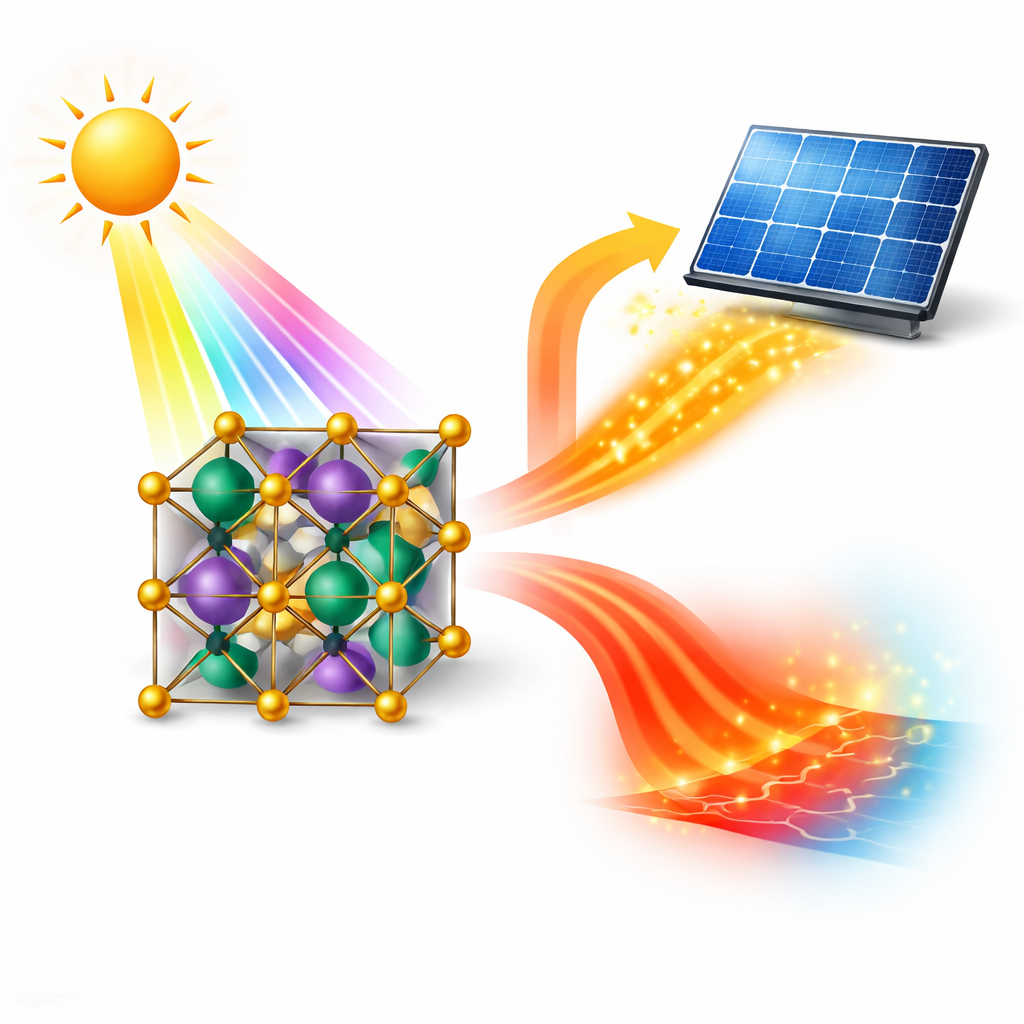
Turning heat into electricity
Beyond light harvesting, the team examined how well these materials can convert temperature differences into electrical voltage, a property measured by the Seebeck coefficient. Both crystals display relatively large positive Seebeck values, indicating that they naturally favor positive charge carriers and can generate significant voltages from temperature gradients. At the same time, they conduct electricity reasonably well and, crucially, they conduct heat poorly. This combination—high Seebeck coefficient, decent electrical conductivity, and low thermal conductivity—is exactly what is needed for good thermoelectric performance. The study estimates a respectable overall efficiency factor (ZT) of around 0.75 for both compounds, which is competitive with many known thermoelectric materials.
What happens inside when atoms vibrate
The researchers also probed how atomic vibrations carry heat and respond to changes in temperature and pressure. Their analysis shows that the heavy gold atoms and the complex bonding environment disrupt the smooth flow of vibrational energy, keeping lattice heat transport remarkably low. Calculated properties such as heat capacity, entropy, Debye temperature, and thermal expansion all behave in a physically reasonable way across a wide temperature range, reinforcing the conclusion that these crystals should remain stable while operating under real device conditions. 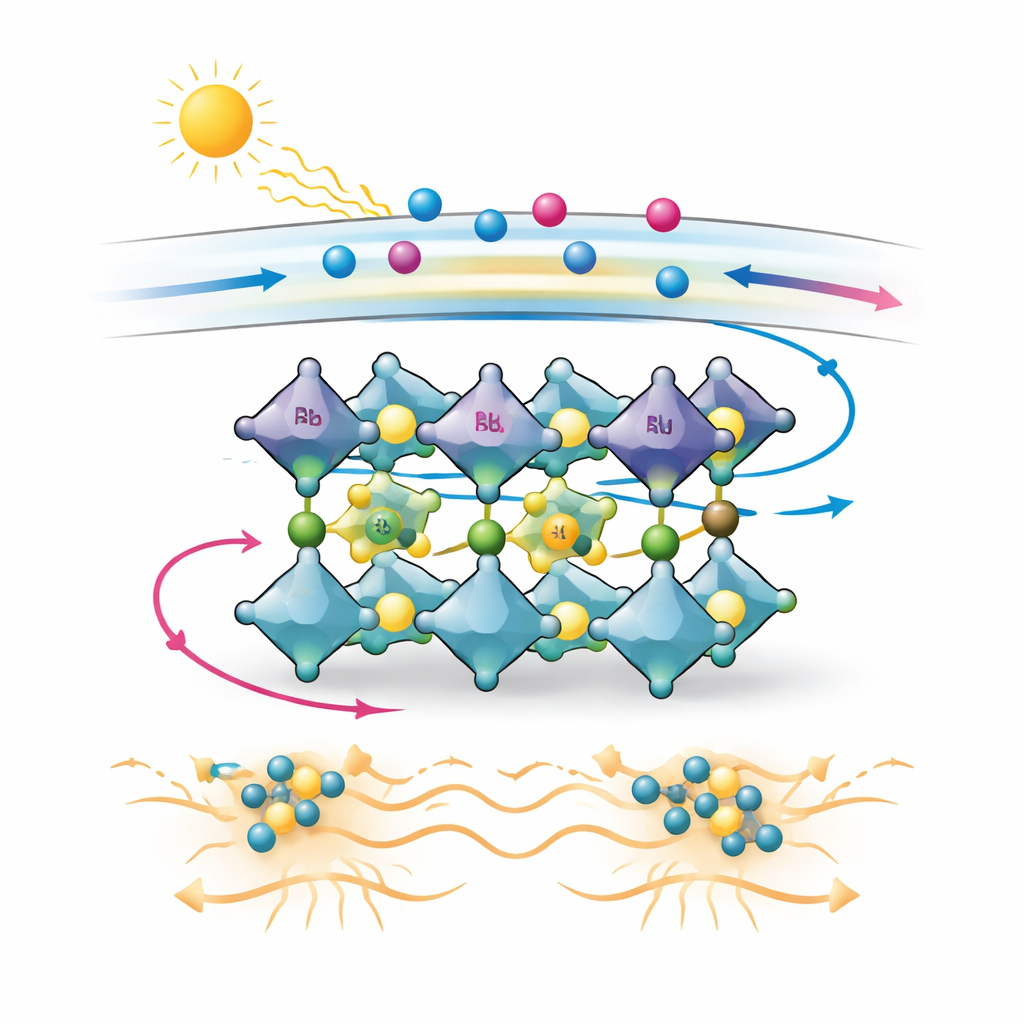
Why this work matters for future devices
In simple terms, the study identifies two closely related materials that are predicted to absorb sunlight strongly, generate useful electrical currents, and also harvest electricity from heat, all while remaining stable and workable. The bromine-based crystal leans toward stronger light absorption and higher thermoelectric response, while the chlorine-based one is slightly sturdier and more heat-resistant. Together, they showcase how careful atomic design can produce “multifunctional” materials that bridge the gap between solar and thermoelectric technologies, potentially enabling devices that capture both light and waste heat in a single solid-state platform.
Citation: Bouferrache, K., Ghebouli, M.A., Fatmi, M. et al. Synergistic optoelectronic and thermoelectric performance in Rb2AsAuBr6 and Rb2AsAuCl6 double perovskites for multifunctional energy conversion. Sci Rep 16, 13616 (2026). https://doi.org/10.1038/s41598-026-42440-z
Keywords: double perovskites, solar energy, thermoelectric materials, energy harvesting, halide semiconductors