Clear Sky Science · en
Retention of embryonic positional identity signatures in the adult sheep tail: evidence from HOXB13 spatial RNA expression gradients
Why sheep tails can teach us about body blueprints
Every vertebrate body, from mouse to human to sheep, is built using an internal “map” that tells cells where they are along the head‑to‑tail axis. This map is drawn early in the embryo by a family of genes called HOX genes. The study summarized here asks a deceptively simple question: do echoes of that embryonic map linger in adult animals, and can they still be seen in something as down‑to‑earth as the length of a sheep’s tail?
A genetic switch for long and short tails
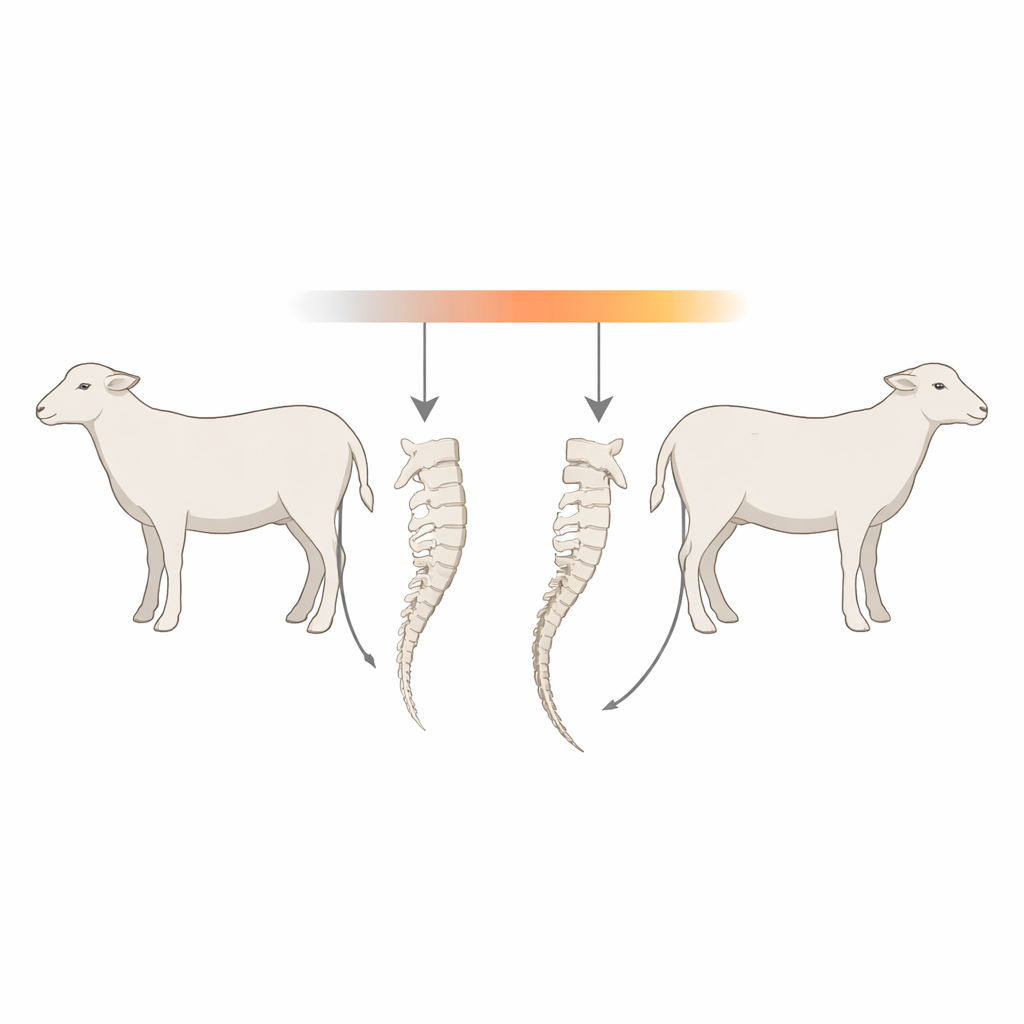
Sheep breeds differ strikingly in tail length: some have short, tidy tails, others long, flowing ones. Earlier work had pointed to a gene called HOXB13 as a key player in this variation. In this study, the authors focused on a Slovenian breed, the Improved Jezersko–Solčava sheep, which naturally includes animals with short, medium, and long thin tails. These sheep also carry different versions of the HOXB13 gene, making the breed a powerful natural experiment. By carefully measuring body size and tail length in dozens of rams, and by genotyping them for the ancestral (“A”) and derived (“D”) versions of HOXB13, the researchers showed that HOXB13 is the main determinant of adult tail length in this population, even after accounting for overall body size.
More tail means more bones, not bigger ones
To find out how HOXB13 affects tail length in physical terms, the team X‑rayed the tails of selected rams and counted the small caudal vertebrae that make up the tail. Rams carrying two copies of the derived version (D/D) had significantly longer tails than those with two ancestral copies (A/A), and this difference was explained almost entirely by having more tail vertebrae, not by each vertebra being larger. In other words, HOXB13 variants influence how many segments form at the end of the spine during early development. Occasional abnormalities, such as fused or wedge‑shaped vertebrae, appeared in both genotypes and did not track with tail length, suggesting they arise from unrelated developmental quirks rather than from HOXB13 itself.
Traces of the embryonic map in adult skin and bone
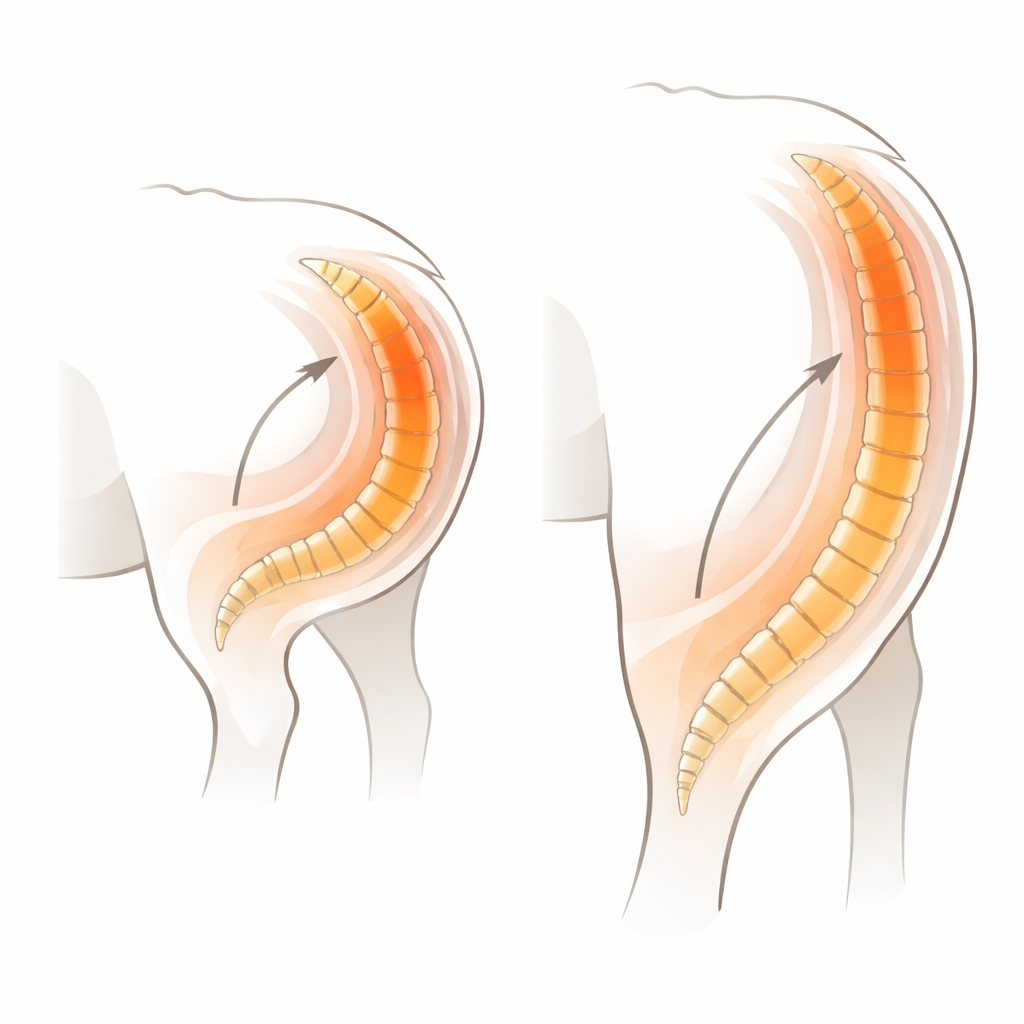
The most striking question was whether the positional information laid down in the embryo can still be detected in the adult tail. To test this, the scientists examined HOXB13 activity in skin and bone taken from different points along the animals’ bodies: neck, back, base of the tail, middle of the tail, and tail tip. Using RNA‑based methods, they found that HOXB13 is essentially silent in more forward regions and at the tail base, but its activity rises sharply toward the tail tip. This gradient appeared not only in skin but also in tail bones. Moreover, short‑tailed A/A animals consistently showed stronger HOXB13 activity at the tail end than long‑tailed D/D animals. Thus, a head‑to‑tail pattern that is classically described in embryos was clearly visible in fully grown sheep.
A wider network of positional genes still at work
To look beyond a single gene, the researchers sequenced RNA from tail skin of short‑ and long‑tailed rams at the base, mid‑tail, and tip. Hundreds of genes changed their activity along the tail, especially when comparing the tip to the base. Many of the most strongly enriched genes are well‑known from limb and tail development in embryos, including several other HOX genes and regulators of tissue growth and patterning. In short‑tailed animals, these developmental genes tended to be more active toward the tail tip, whereas long‑tailed animals showed more genes turning down their activity. This suggests that the ancestral short‑tail state is associated with a stronger “developmental” signature in adult tissue, while the derived long‑tail version reflects a subtle loosening of that ancestral program.
What this means for how bodies remember their past
Altogether, the work shows that adult sheep tails still carry a molecular echo of the instructions that shaped them before birth. The HOXB13 gene, in particular, links a subtle change in DNA sequence to the number of tail vertebrae and to a persistent gradient of gene activity from tail base to tip in skin and bone. For a non‑specialist, the key message is that our bodies may retain traces of their embryonic construction plans well into adulthood. In sheep, those lingering signatures help explain why some breeds have long swishing tails while others have short ones, offering a vivid example of how developmental genetics, evolution, and practical breeding intersect.
Citation: Horvat, S., Ellenrieder, R., Simčič, M. et al. Retention of embryonic positional identity signatures in the adult sheep tail: evidence from HOXB13 spatial RNA expression gradients. Sci Rep 16, 11776 (2026). https://doi.org/10.1038/s41598-026-42438-7
Keywords: sheep tail length, HOXB13, positional identity, vertebral number, spatial gene expression