Clear Sky Science · en
High-energy $$\gamma$$ -photons and pair electrons generation in polarized ultraintense laser fields
Light So Intense It Creates Matter
What happens when you shine some of the most powerful laser light ever produced onto a tiny puff of gas? In this study, physicists use supercomputer simulations to explore a future in which such lasers not only generate intense bursts of gamma rays, the most energetic form of light, but also create matter and antimatter from that light. They show that simply twisting the laser’s electric field in a circle rather than letting it swing back and forth can dramatically change how efficiently these extreme particles and rays are produced and how tightly they are beamed.
Why Polarized Light Matters
Modern high‑power lasers can reach intensities where the usual rules of light–matter interaction give way to the strange world of quantum electrodynamics, where electrons radiate away their energy in sudden, powerful flashes and single photons can transform into pairs of electrons and their antimatter twins, positrons. In this work, the authors study two common ways to “polarize” laser light: linear polarization, where the electric field oscillates in a fixed direction, and circular polarization, where that field rotates like the hand of a clock as the light travels. Although these two states carry the same overall energy, they push charged particles along very different paths, and those paths turn out to control both the brightness and sharpness of the resulting beams of radiation and matter.
A Virtual Experiment With Extreme Lasers
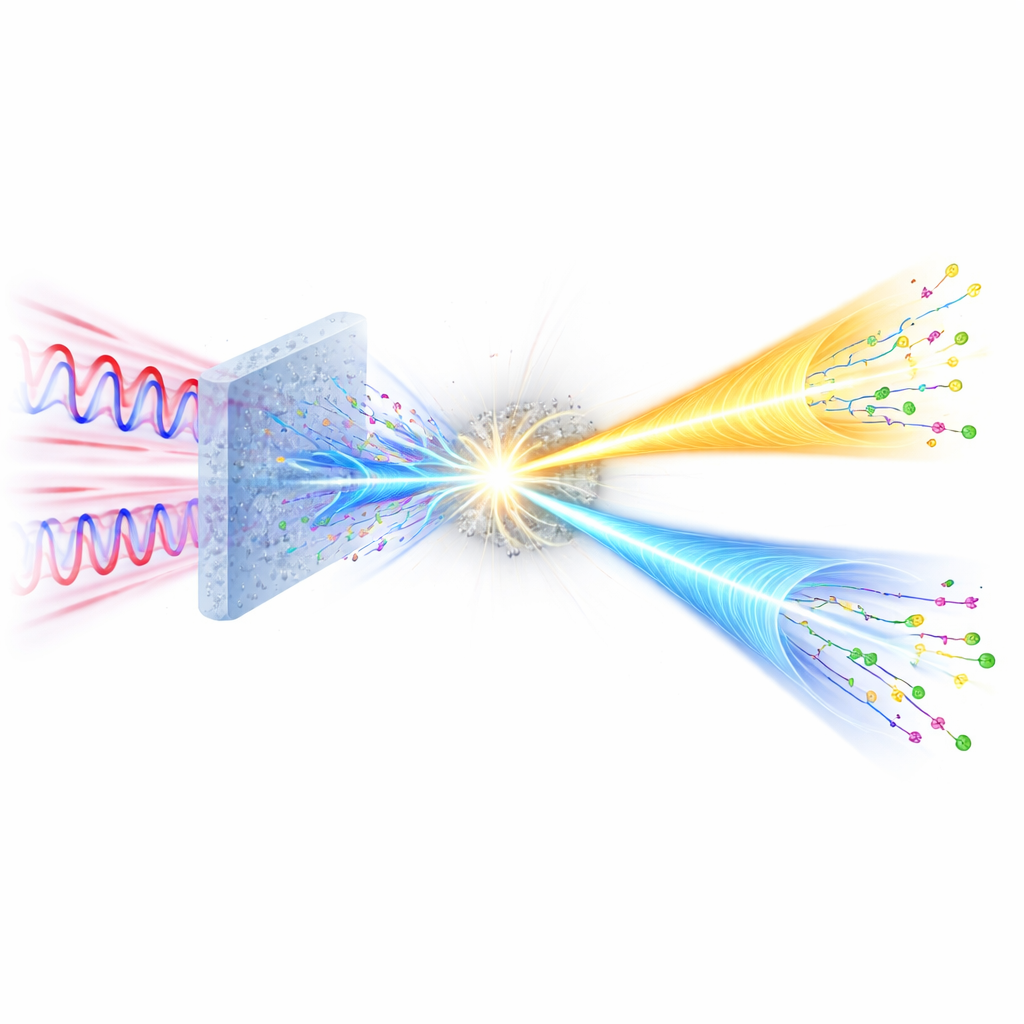
Because the intensities of interest are higher than what today’s multi‑petawatt facilities routinely provide, the team turns to three‑dimensional particle‑in‑cell simulations, a kind of first‑principles numerical experiment. They model an ultra‑intense laser pulse striking a block of ionized hydrogen gas whose density is chosen so that the laser can dig a channel through it while still strongly gripping the electrons. By tracking billions of computational “super‑particles” and including key quantum processes—radiation reaction, in which electrons lose energy by emitting hard photons, and a version of the Breit–Wheeler process, in which those photons convert into electron–positron pairs—the simulations follow the full chain from laser energy to plasma motion, gamma‑ray flashes, and finally pair production.
Shaping Beams of Light and Matter
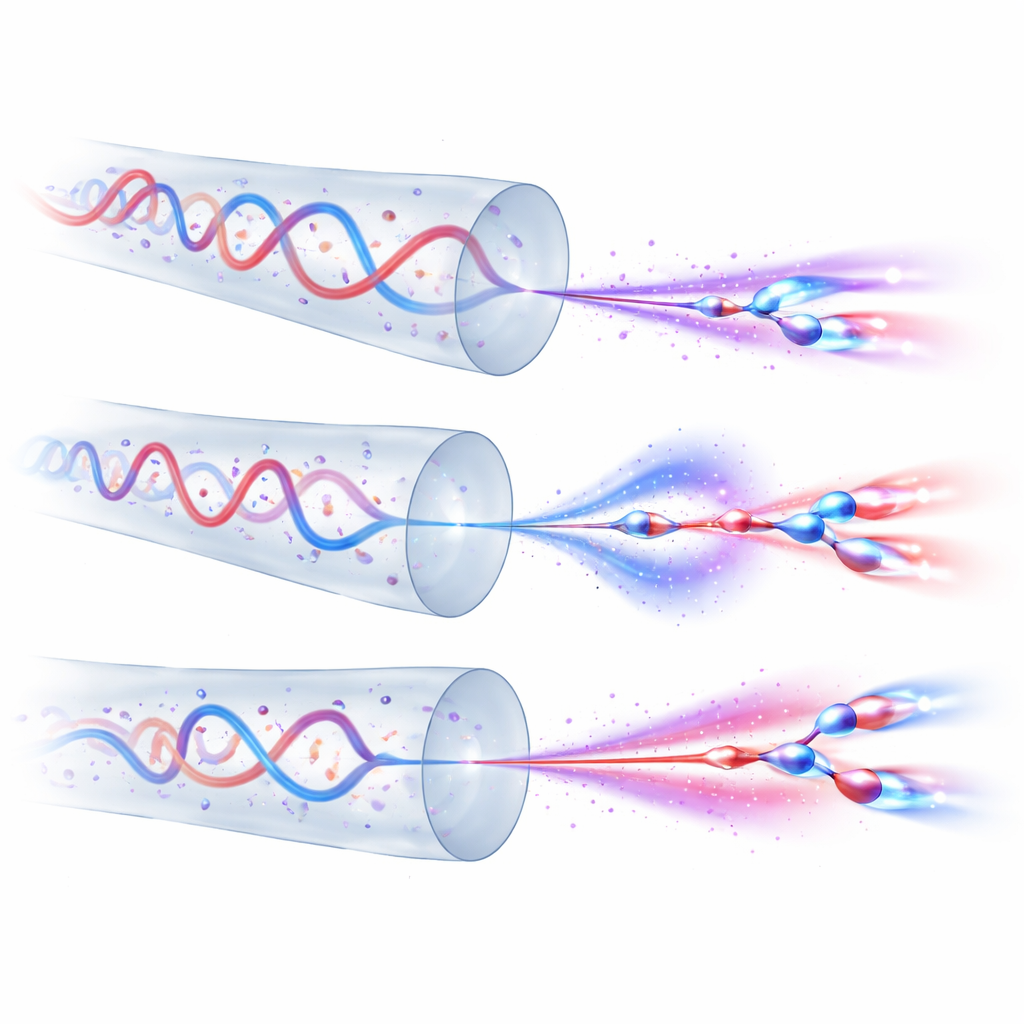
The simulations reveal that circularly polarized pulses guide electrons into smoother, more helical trajectories along self‑generated channels in the plasma. This steady motion keeps electrons exposed to strong fields for longer and maintains their energy, boosting a key parameter that measures how “quantum” their interaction with the light is. As a result, the circular case produces gamma rays that are both more energetic—reaching into the multi‑billion‑electron‑volt range—and more tightly collimated than those from a linearly polarized pulse. The same trend carries over to the electrons born from photon–photon interactions: pairs created under circular polarization form a narrower, higher‑energy beam, while linear polarization yields a broader spray of lower‑energy particles but in greater numbers.
Balancing Quality and Quantity
By comparing how much of the laser’s energy ends up in gamma rays and in the newly created electrons, the authors identify a trade‑off controlled by polarization. Circular polarization converts slightly more laser energy into high‑energy photons and channels that energy into a sharply focused, ultra‑relativistic particle beam—ideal for applications that need a bright, directional source. Linear polarization, on the other hand, generates a larger total number of pairs, even though each carries less energy and emerges over a wider angle. The study also checks that these conclusions remain valid when the laser hits the plasma at small angles rather than straight on, finding only modest changes in peak energies and no reversal of the overall trends.
Turning Laser “Twist” Into a Control Knob
The work demonstrates that, in the realm of extreme light, how you twist the laser’s electric field can be as important as how strong the laser is. Circularly polarized pulses act like precision tools, carving channels in plasma and launching tightly focused jets of high‑energy gamma rays and electron–positron pairs, while linearly polarized pulses act more like broad brushes, producing a larger but less organized cloud of new particles. As next‑generation facilities push laser intensities toward the levels explored here, polarization control could become a practical knob for tailoring future gamma‑ray and antimatter sources, with uses ranging from probing the structure of atomic nuclei to recreating astrophysical environments in the laboratory.
Citation: Agarwal, S., Gupta, D.N. High-energy \(\gamma\)-photons and pair electrons generation in polarized ultraintense laser fields. Sci Rep 16, 11945 (2026). https://doi.org/10.1038/s41598-026-42431-0
Keywords: ultraintense lasers, gamma rays, electron positron pairs, laser polarization, strong field QED