Clear Sky Science · en
Jichuan decoction alleviates constipation by inhibiting the PI3K/Akt/mTOR signaling pathway: an integrated network pharmacology and experimental study
Why this ancient remedy matters today
Constipation is more than an occasional inconvenience. For many people around the world it is a stubborn, long‑term problem that disrupts daily life, sleep, and overall well‑being. Modern drugs do not work for everyone and can bring unwanted side effects. This study looks at Jichuan Decoction, a classic six‑herb prescription from traditional Chinese medicine, and asks a modern question: how, exactly, does it work inside the body? By blending computer‑based analysis with lab and animal experiments, the researchers trace this old remedy’s effects down to the level of molecules and signaling pathways in the gut.

Old herbal recipe, new scientific lens
Jichuan Decoction has been used for centuries to relieve difficult or infrequent bowel movements. It combines several plant ingredients, including angelica root, cistanche, and citrus peel. Rather than acting like a single chemical drug, it is thought to work through many components and many targets at once. To untangle this complexity, the team first turned to “network pharmacology,” a branch of bioinformatics that maps how plant compounds might interact with thousands of proteins in the body. From databases of traditional herbs and known drug targets, they identified 41 likely active compounds in the formula and linked them to 750 possible protein targets. Comparing these with genes tied to constipation, they narrowed the list to 20 shared targets, highlighting two in particular—proteins called mTOR and PTGS2—as central hubs in the network.
Connecting targets to key gut control pathways
Next, the researchers examined what these protein hubs actually do inside cells. Using standard tools for functional and pathway analysis, they found that the shared targets cluster in parts of the cell involved in energy use, signaling, and nerve communication, especially within the mitochondria and nerve projections. Importantly, several well‑known signaling routes that control muscle tone and nerve activity in the intestine stood out. Among them, the PI3K/Akt pathway emerged as the most strongly enriched. This pathway, together with its partner mTOR, helps decide whether cells grow, survive, and recycle their own components. Prior work has linked overactivity in this pathway to disrupted gut movements. Computer docking simulations then showed that several major Jichuan components can bind tightly to mTOR and other key proteins, suggesting that the herbal mixture can directly influence this signaling system.
Putting the decoction to the test in animals
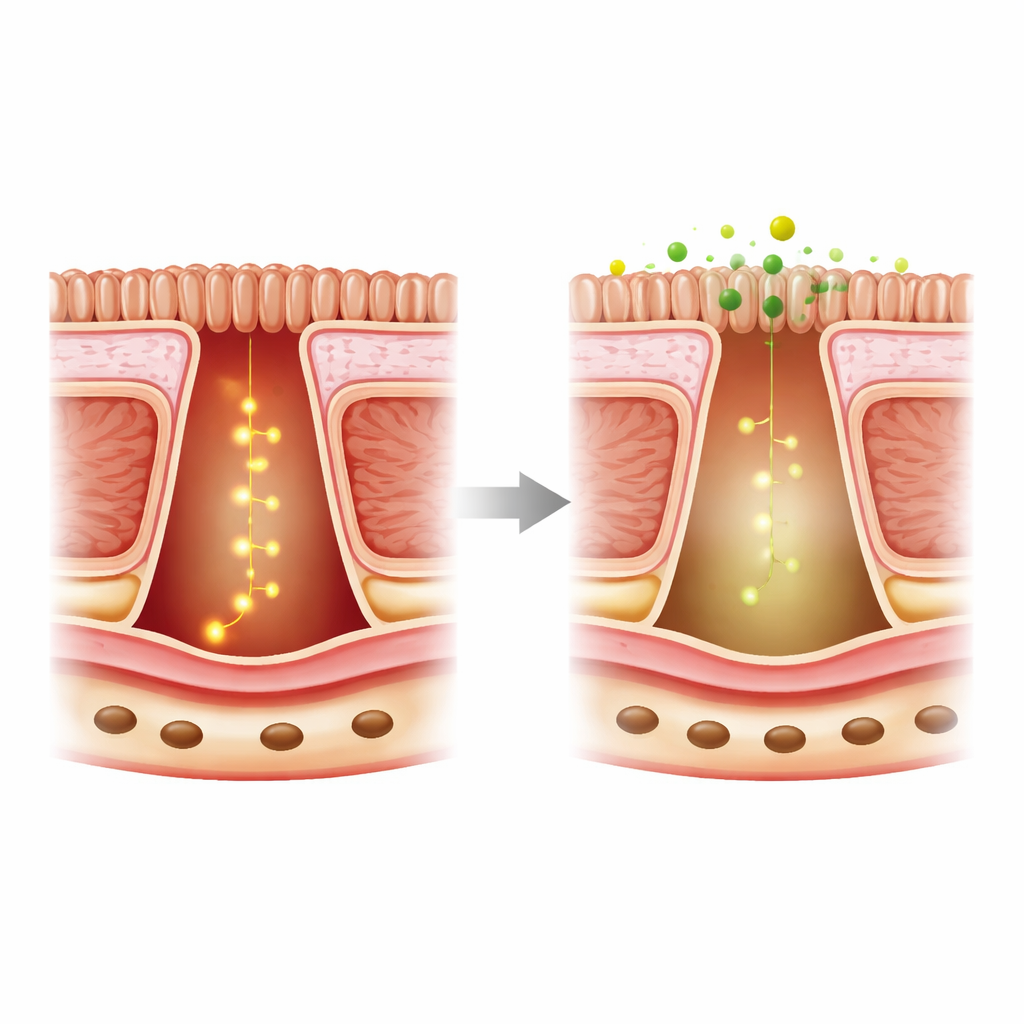
To see whether these predictions hold up in living organisms, the team used rats given loperamide, a drug that reliably causes constipation by slowing gut motion. Compared with healthy animals, these rats took longer to pass stool, had drier feces, and showed slower movement of material through the intestines. Their colon tissue also displayed clear damage under the microscope, with disrupted lining and inflammation. When the constipated rats received Jichuan Decoction, these problems eased in a dose‑dependent way. Higher doses brought bowel habits and stool water content closer to normal, sped up intestinal transit, and promoted healing of the colon’s inner surface.
Balancing gut messengers and calming a key pathway
The study also tracked chemical messengers that nerve cells in the gut use to coordinate contractions. In constipated rats, levels of substance P and serotonin—both of which normally promote movement and fluid secretion—were reduced, while levels of vasoactive intestinal peptide, which relaxes muscle and slows motion, were increased. Jichuan Decoction reversed this pattern, restoring a healthier balance of signals that favor regular peristalsis. At the same time, protein tests showed that the PI3K/Akt/mTOR pathway was more active in constipated animals and that treatment with the decoction reduced the phosphorylated, “switched‑on” forms of these proteins. When the researchers deliberately pushed the pathway into higher gear with a chemical agonist, Jichuan Decoction was still able to dampen its activity and improve gut function, supporting the idea that pathway inhibition is central to its action.
What this means for people with stubborn bowel problems
For non‑specialists, the message is straightforward: this long‑used herbal mixture appears to ease constipation by both protecting the gut lining and restoring the rhythm of intestinal muscle contractions. It does this in part by dialing down an overactive internal control circuit—the PI3K/Akt/mTOR pathway—and by rebalancing the nerve messengers that tell the bowel when to squeeze and when to relax. While these experiments were done in rats and more clinical trials in humans are needed, the work shows how an ancient prescription can be explained using modern science, and suggests that carefully studied herbal combinations may offer an alternative or complement to standard laxatives for chronic constipation.
Citation: Bao, X., Chen, Y., Zhu, Q. et al. Jichuan decoction alleviates constipation by inhibiting the PI3K/Akt/mTOR signaling pathway: an integrated network pharmacology and experimental study. Sci Rep 16, 11822 (2026). https://doi.org/10.1038/s41598-026-42428-9
Keywords: chronic constipation, Jichuan decoction, gut motility, traditional Chinese medicine, PI3K Akt mTOR pathway