Clear Sky Science · en
Impact of mode hybridization on spin-wave profiles in bi-component magnonic crystals
Waves That Could Power Future Electronics
Today’s computers mostly rely on electric currents flowing through wires, which wastes energy as heat. Researchers are exploring an alternative: using tiny ripples of magnetism, called spin waves, to carry and process information. This paper looks at how those ripples behave in an artificial magnetic material made from two different metals, and shows a new way to detect and control the subtle interactions between different wave patterns. Such insights could help design ultra‑efficient filters, switches and logic elements for tomorrow’s wave‑based electronics.
Building a Magnetic Checkerboard
The study focuses on a carefully engineered structure known as a magnonic crystal, the magnetic counterpart of photonic crystals that control light. Here, a thin film of cobalt acts as a continuous background, while circular dots of another magnetic alloy, permalloy, are embedded in a regular hexagonal pattern. An external magnetic field is applied in the plane of the film, aligning the tiny magnetic moments in both materials. Within this landscape, spin waves travel and reflect, forming standing patterns whose frequencies depend on the geometry, material properties and magnetic field. Because cobalt and permalloy respond differently, some wave patterns concentrate more of their motion in the dots, while others favor the surrounding cobalt matrix.
When Two Waves Share Their Energy
As the strength of the external magnetic field is changed, different spin‑wave patterns can approach each other in frequency. When their shapes in space are compatible, they begin to interact and form hybrid states, a process known as hybridisation. Typically, this shows up as a tell‑tale "avoided crossing" in a frequency plot, where two branches bend away from each other instead of cleanly crossing, and as a swap of the underlying spatial patterns. In the cobalt–permalloy crystal, the key ingredient enabling such interactions is the demagnetising field at the boundaries between the dots and the matrix. This internal field effectively lowers the magnetic field in the cobalt regions and raises it inside the dots, making the matrix increasingly attractive for low‑frequency waves as the external field is reduced. 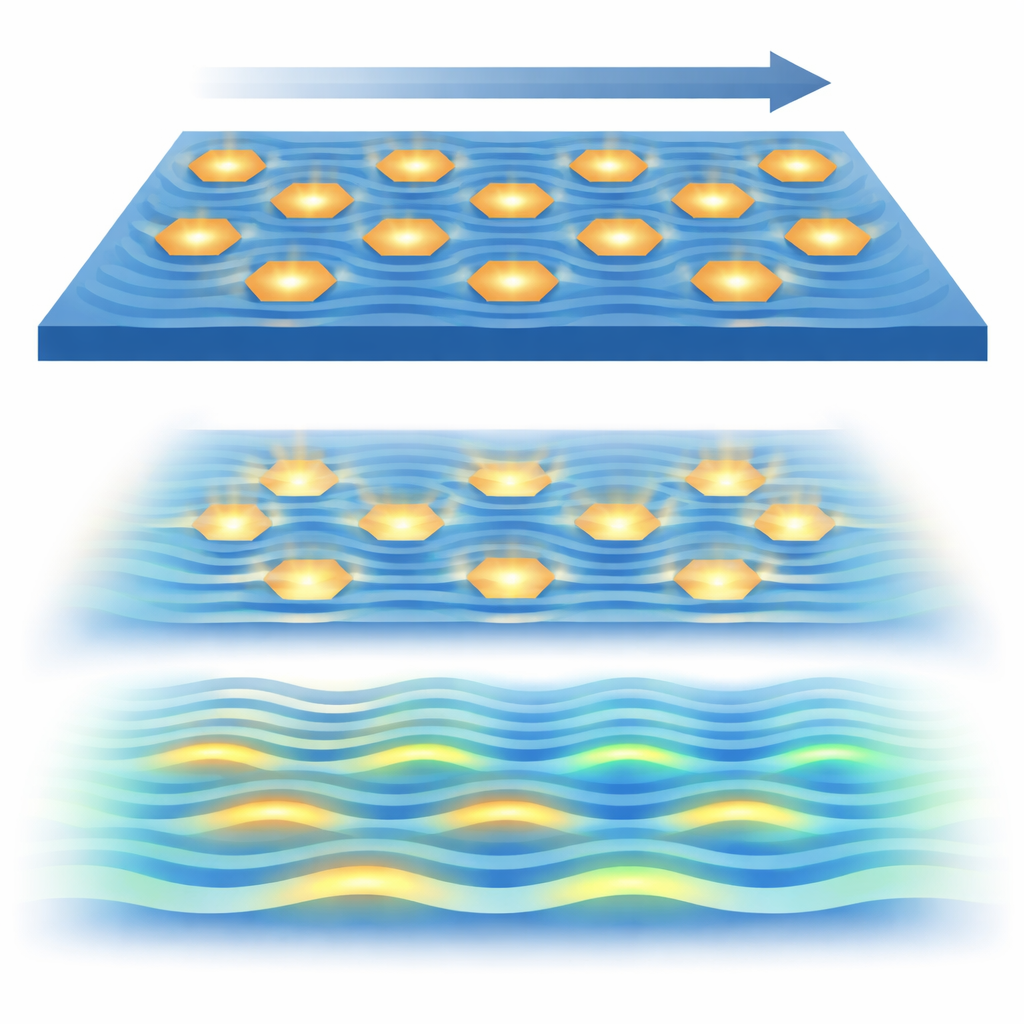
A New Gauge for Hidden Coupling
To track where the spin‑wave energy actually resides, the author introduces a simple but powerful quantity called the concentration factor. Instead of asking where the wave amplitude is largest at each point, this measure sums the total motion inside the cobalt and the permalloy and compares them. A value above one‑half means most of the energy is in cobalt; a value near zero means it sits mainly in permalloy. By following how this factor changes with magnetic field for each mode, the study can pinpoint hybridisation events even when the usual visual signs are faint or missing. In several clear cases, pairs of modes show pronounced swaps of their concentration factors and gentle bending apart of their frequency curves, matched by obvious mixing and re‑ordering of their spatial patterns. But the work also uncovers less intuitive situations: some modes exchange energy between cobalt and permalloy, revealed by a strong change in concentration factor, while their overall patterns appear to barely exchange at all.
Squeezing the Lattice to Tune the Waves
The article further explores what happens when the crystal is compressed along the direction of the applied field, effectively squeezing the hexagonal pattern in one dimension. This geometric change has two main consequences. First, it shifts the baseline frequencies upward, especially for modes that live largely in the permalloy dots, because there is less room for the waves to form. Second, it strengthens the internal demagnetising field, which favors waves concentrating in the cobalt matrix. Together, these effects reshuffle the order in which different modes appear as the magnetic field is varied, moving some hybridisation events to higher fields and creating new pairs of modes that can now interact. In the compressed structure, one mode can even participate in overlapping interactions with two others, leading to a three‑way sharing of energy that blurs the simple picture of a clean profile swap between just two modes. 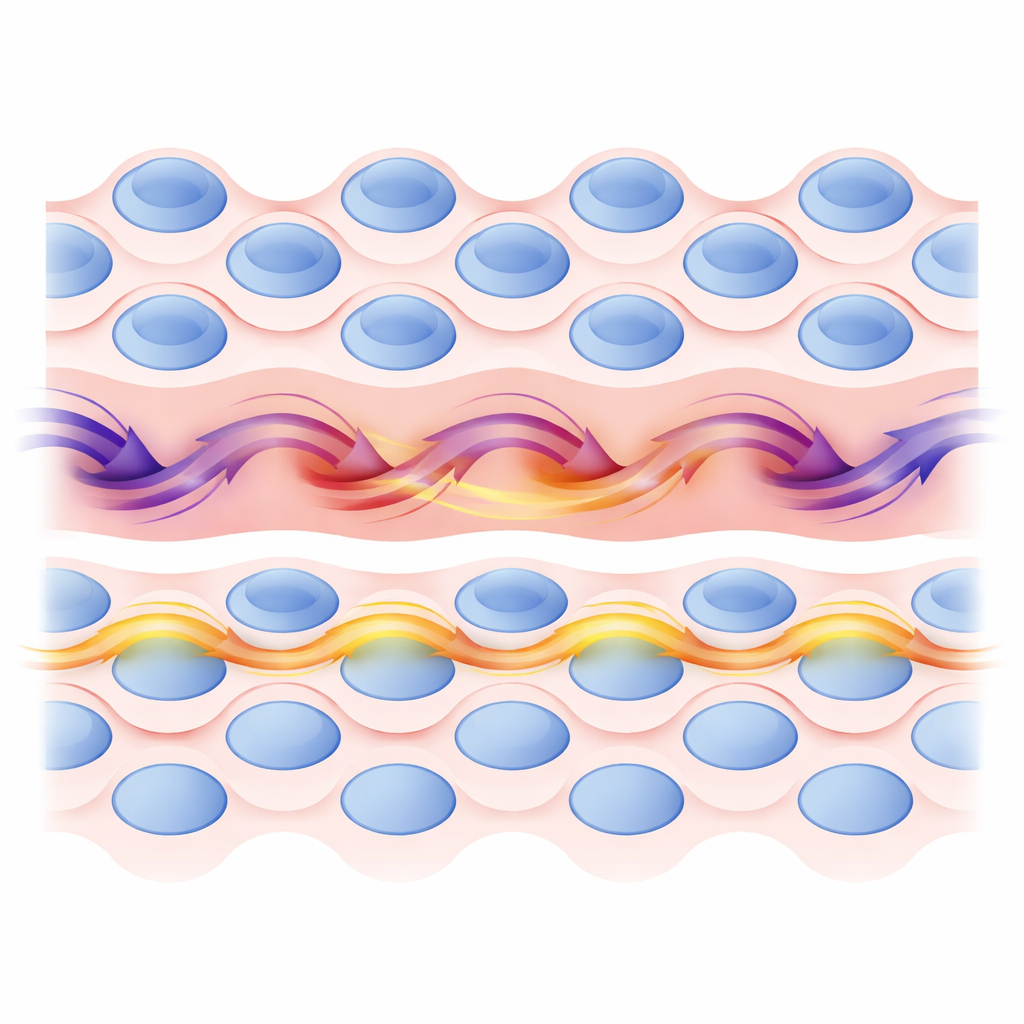
Why This Matters for Future Devices
For a non‑specialist, the main outcome of this research is a better way to see and control how energy moves between different parts of a composite magnetic material. The concentration factor acts like an energy gauge, revealing when two spin‑wave patterns are talking to each other, even if traditional visual clues are weak. By adjusting the shape of the magnonic crystal and the applied field, engineers can choose which modes interact, at what field strengths, and how strongly. This level of control is crucial for designing practical magnonic devices—such as filters, resonators, couplers and logic elements—that rely on precise, low‑loss manipulation of spin waves instead of electric currents.
Citation: Mamica, S. Impact of mode hybridization on spin-wave profiles in bi-component magnonic crystals. Sci Rep 16, 13532 (2026). https://doi.org/10.1038/s41598-026-42425-y
Keywords: magnonic crystals, spin waves, mode hybridisation, cobalt permalloy, wave-based computing