Clear Sky Science · en
Femoral finite element analysis of a novel cementless revision total knee arthroplasty system
Why this matters for knee replacement patients
As more people receive knee replacements and live longer with them, a growing number eventually need a second operation when the first implant fails. These revision surgeries are harder because bone has often been lost or damaged, making it difficult to anchor a new implant securely. This study explores a new, fully cementless revision knee system designed to lock into the stronger part of the thigh bone and encourage living bone to grow into the implant, potentially offering patients a more durable second chance. 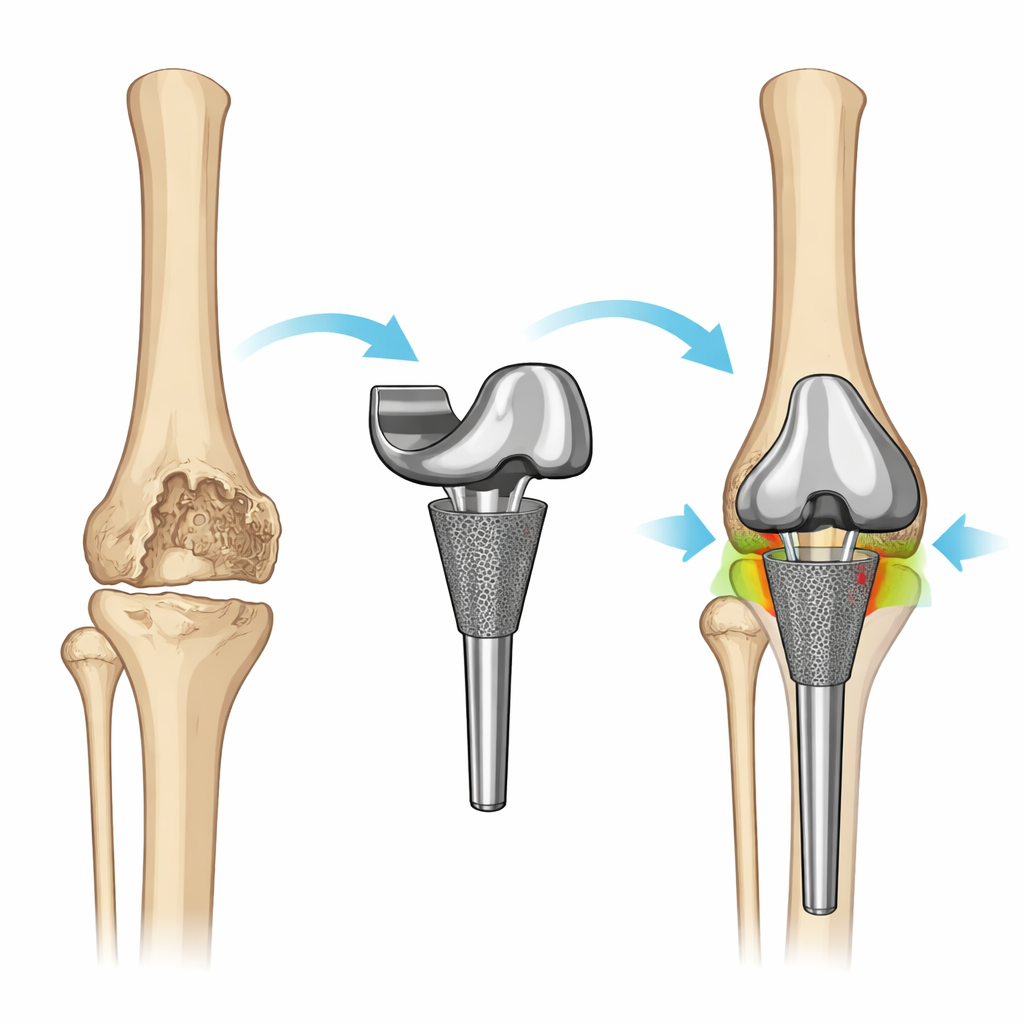
A new way to anchor a worn-out knee
Traditional revision knee replacements often rely on bone cement and long metal stems deep inside the thigh bone to hold the implant in place. Cement can work well at first, but over time it may crack, shed particles, or damage nearby bone. The new system studied here takes a different path: it uses a cone-shaped, 3D-printed metal piece that fits tightly into the widened, well-vascularized region of the femur just above the knee. This cone has a porous, sponge-like surface intended to let bone grow into it, aiming for a long-lasting, biological bond instead of a purely mechanical glue-like connection.
Testing the design on a virtual femur
Instead of trying the new implant immediately in many patients, the researchers first built a detailed computer model of a real human femur based on CT scans from a woman with knee arthritis. They then performed a series of virtual surgeries, adding the new cone-based implant under different conditions: with and without added bone defects, with damage on the inner, outer, or both sides of the joint, and with or without extra metal pieces or a long stem extending up the bone. Using finite element analysis, a powerful engineering technique, they simulated the forces a knee experiences during normal walking and examined how much the implant moved against bone and how stress was distributed inside the femur.
How stable is the implant without extra hardware?
The main questions were whether the cone alone could keep the implant steady and how much extra benefit came from adding a long stem or metal augments to fill bone gaps. Across all tested scenarios, the tiny back-and-forth movements at the bone–implant interface stayed well below a widely accepted safety threshold for bone ingrowth. Even when significant bone loss was simulated around the joint, the cone-based design kept motion low enough to be considered stable. Adding a long stem did reduce micromotion even further, but this added stability came with a trade-off: more of the surrounding bone experienced very low stress, a situation linked to “stress shielding,” where under-used bone can slowly weaken and shrink.
When added metal helps—and when it doesn’t
The team also studied small metal blocks (augments) used to rebuild missing portions of bone. In their simulations, these augments made only modest improvements in stability overall. The clearest benefit appeared when the main bone loss was on the inner (medial) side of the knee, which normally carries more body weight. In that situation, the augment slightly lowered peak stresses and increased the amount of bone experiencing healthy levels of loading, potentially lowering the risk of bone loss over time. In contrast, for defects on the outer side or affecting both sides, the augments changed the mechanical picture very little, suggesting they may be optional rather than essential for the initial fixation of this particular system. 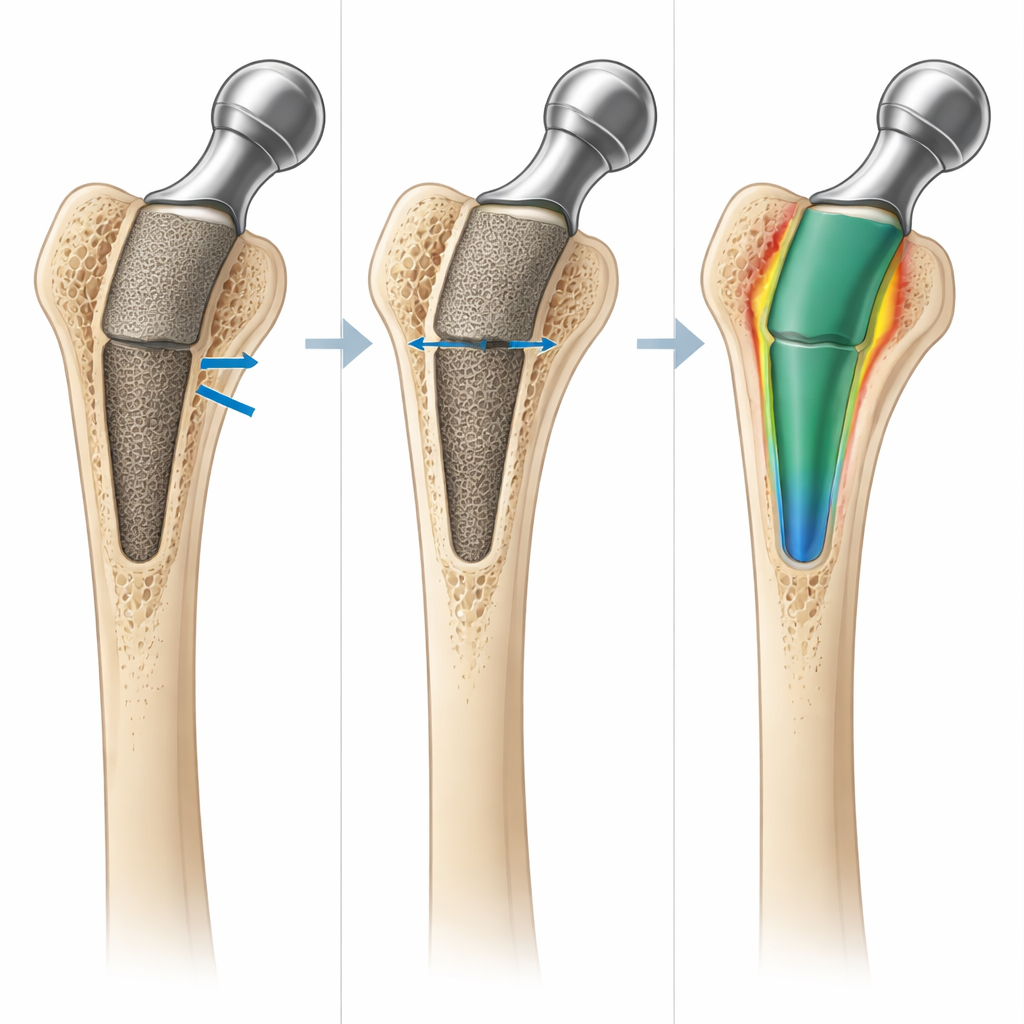
What this could mean for future surgeries
Overall, the computer models suggest that this novel cementless revision knee system can achieve solid early fixation by relying mainly on the cone in the stronger region of the bone, without always needing a long stem or extra metal blocks. That could simplify surgery and reduce the risk that deep parts of the bone become overloaded or, conversely, underused and fragile. However, the work is still at the engineering and modeling stage. Real patients move in complex ways, and bone changes over years, not milliseconds. The authors emphasize that laboratory experiments and clinical trials are needed before surgeons can confidently change standard practice, but their results point toward a future where revision knee implants depend more on living bone partnership and less on rigid cement and long stems.
Citation: Dong, Z., Wang, X., He, D. et al. Femoral finite element analysis of a novel cementless revision total knee arthroplasty system. Sci Rep 16, 13323 (2026). https://doi.org/10.1038/s41598-026-42423-0
Keywords: revision knee replacement, cementless implants, bone defects, finite element analysis, metaphyseal fixation