Clear Sky Science · en
Robustness of interstitial photodynamic therapy treatment planning under power and positional uncertainties in light delivery
Light to Fight Brain Tumors
Brain tumors such as glioblastoma are notoriously hard to treat: surgeons cannot always remove every last cell, and radiation or chemotherapy can damage healthy tissue. This study explores a promising alternative called interstitial photodynamic therapy, where light-delivering fibers are threaded into the tumor to activate a drug that kills cancer cells. The researchers ask a practical question that matters for real patients: how much do small real-world imperfections—slight variation in light output and tiny shifts in fiber position—actually change how well the treatment works, and can smart computer planning make the procedure more reliable?
How Light-Based Tumor Treatment Works
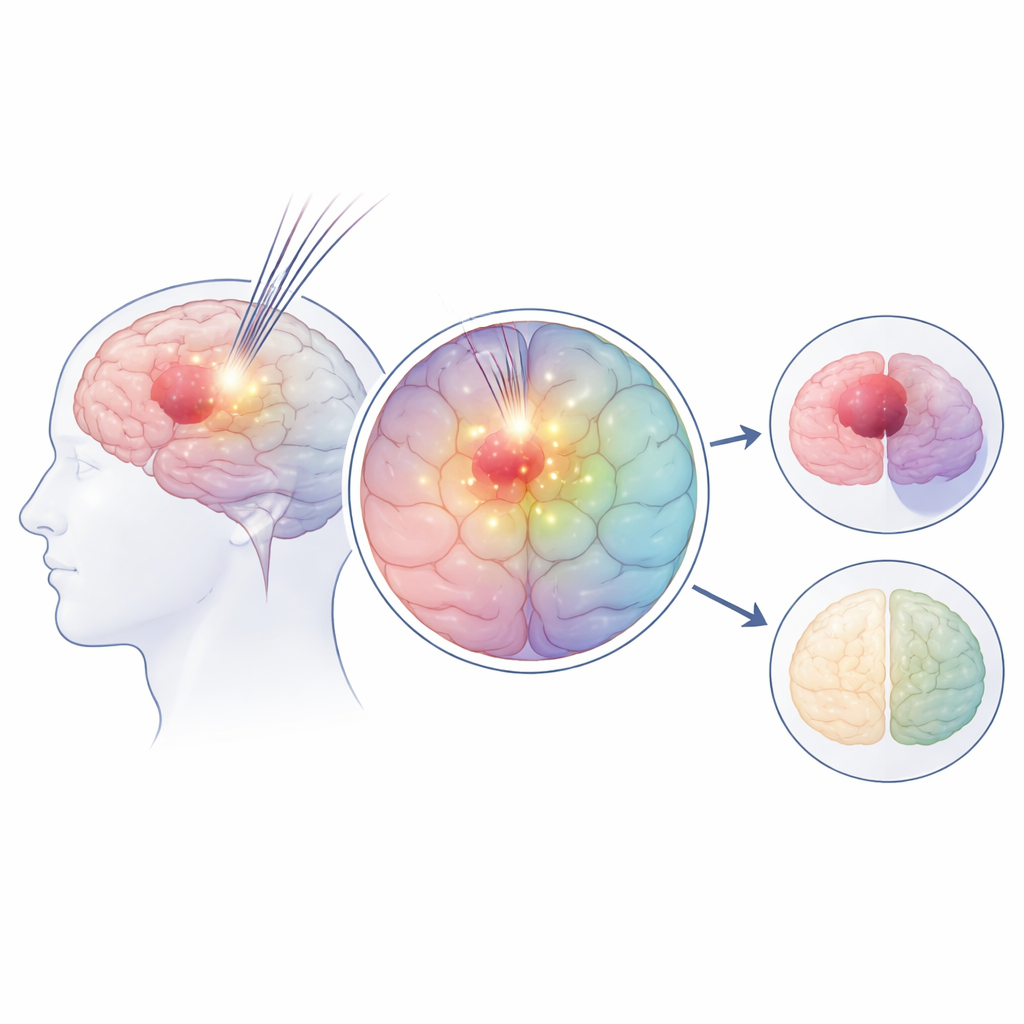
In photodynamic therapy, patients receive a light-sensitive drug that accumulates more in tumors than in normal tissue. When doctors shine light of a specific color onto these drug-loaded cells in the presence of oxygen, the drug produces reactive molecules that damage and kill the cells. For shallow skin problems, simply aiming light at the surface is enough. For deep-seated tumors in organs like the brain, however, doctors must guide thin optical fibers through needles into the tumor itself so that light is released from within. Because brain tissue has complex shapes and different optical properties, the only practical way to predict how the light spreads is to use detailed computer simulations of photon paths through a three-dimensional model of the head.
Planning Treatment in a Virtual Brain
The team built nine virtual brain tumor cases based on realistic anatomy and tumor shapes. Using an in-house simulation engine called FullMonte, they calculated how light from line-like and point-like sources would spread through gray matter, white matter, and tumor tissue. A second tool, PDT-SPACE, then automatically chose how strong each source should be and where it should be placed to achieve two goals at once: destroy at least 98 percent of the tumor volume while keeping the light dose to healthy, sensitive brain regions as low as possible. The key output measure was v100, the part of a region that receives at least the minimum light dose needed to either kill tumor or, in the case of healthy brain, to avoid damage beyond a chosen threshold.
When Power Varies, Little Changes
In real operating rooms, the power delivered by each fiber can drift slightly from its intended value, even after careful calibration. The researchers mimicked this by allowing each source to be up to 5, 10, or 20 percent stronger or weaker than planned and then recomputing the resulting light dose. Even under the most pessimistic ±20 percent scenario, the fraction of tumor adequately treated dropped only from the target of 98 percent to about 96.9 percent, and the change in damage to normal brain was under 9 percent. They also modified their planning software to deliberately design plans that remain safe even if every fiber delivers its minimum possible power. This “minimum-only” strategy further tightened the worst-case tumor coverage, nudging the minimum back above 97 percent without a meaningful extra hit to healthy tissue.
Position Errors Matter More Than Power
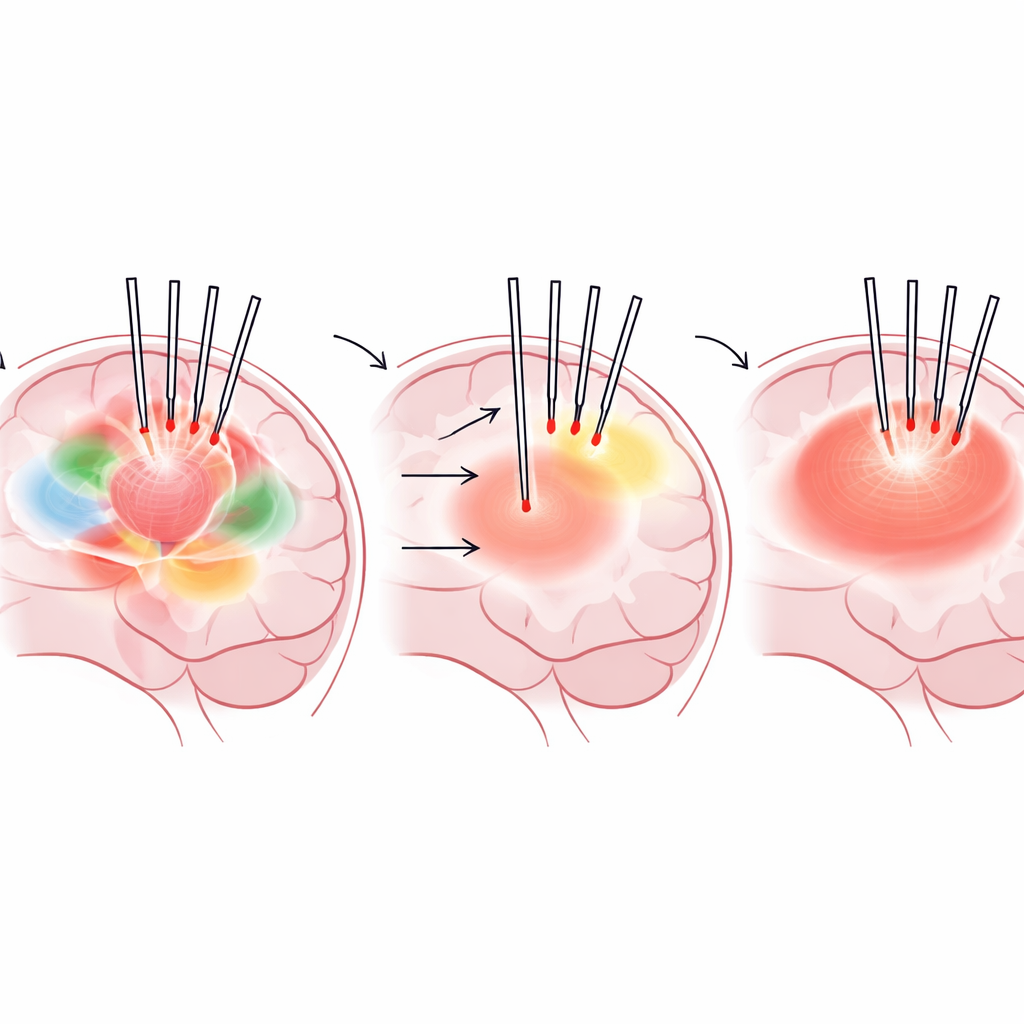
Guiding fibers through the skull and into the tumor inevitably introduces small placement errors on the order of a few millimeters. The authors modeled this by pivoting each source around its entry point and sampling many combinations of directions and angles, up to a maximum tip shift of 3 millimeters. Now the effects were stronger: in some scenarios, tumor coverage could fall to around 95 percent, and damage to healthy brain varied more than in the power tests. However, the picture improved dramatically once the model allowed a realistic clinical step: after fibers are placed, imaging can reveal their true locations, and PDT-SPACE can recompute the best power settings for those measured positions. This simple “power re-optimization” restored tumor coverage very close to 98 percent across many random samples, with only modest and statistically small changes in exposure to healthy brain.
Smarter Placement Reduces Collateral Damage
Finally, the team asked whether computers could also pick better insertion paths than a human planner using rules of thumb. Using a search method called simulated annealing, PDT-SPACE rearranged the same number of sources while respecting realistic access paths from the skull. Compared with human-designed placements, these optimized layouts cut average light overdose to healthy brain tissue by about 36 percent while keeping tumor coverage high. When combined with power re-optimization based on the fibers’ actual post-insertion positions, the system delivered the most reliable performance overall, especially for larger tumors with more overlapping light fields.
What This Means for Patients
For people who might one day receive interstitial photodynamic therapy for brain tumors, this work brings reassuring news. Normal fluctuations in laser power appear to have only a minor effect on whether the tumor is adequately treated, especially when the planning software is made aware of this uncertainty. Small misplacements of the light-delivering fibers are more important, but if doctors measure where the fibers truly end up and feed that information into an optimization tool, the tumor can still receive near-complete coverage while mostly sparing healthy brain. Overall, the study suggests that the biggest gains in safety and effectiveness will come from accurate knowledge of tissue properties and careful, computer-guided source positioning, rather than from chasing ever-tighter control of laser power.
Citation: Wang, S., Saeidi, T., Lilge, L. et al. Robustness of interstitial photodynamic therapy treatment planning under power and positional uncertainties in light delivery. Sci Rep 16, 12247 (2026). https://doi.org/10.1038/s41598-026-42421-2
Keywords: photodynamic therapy, brain tumor, treatment planning, medical imaging, light delivery