Clear Sky Science · en
Spatiotemporal differentiation and dynamics simulation of China’s industrial soot and dust emissions
Why these invisible particles matter
When factories run, they release tiny bits of soot and dust into the air. These particles are too small to see one by one, but they can cloud city skies, harm lungs, and drift across regions and even countries. China, as one of the world’s largest manufacturing centers, offers a powerful case study of how a nation can grow its economy while trying to clean up this hidden pollution. This study traces three decades of China’s industrial soot and dust emissions and asks a simple question with big stakes: how can a fast growing economy cut dirty air without slowing progress?
How the study looks across space and time
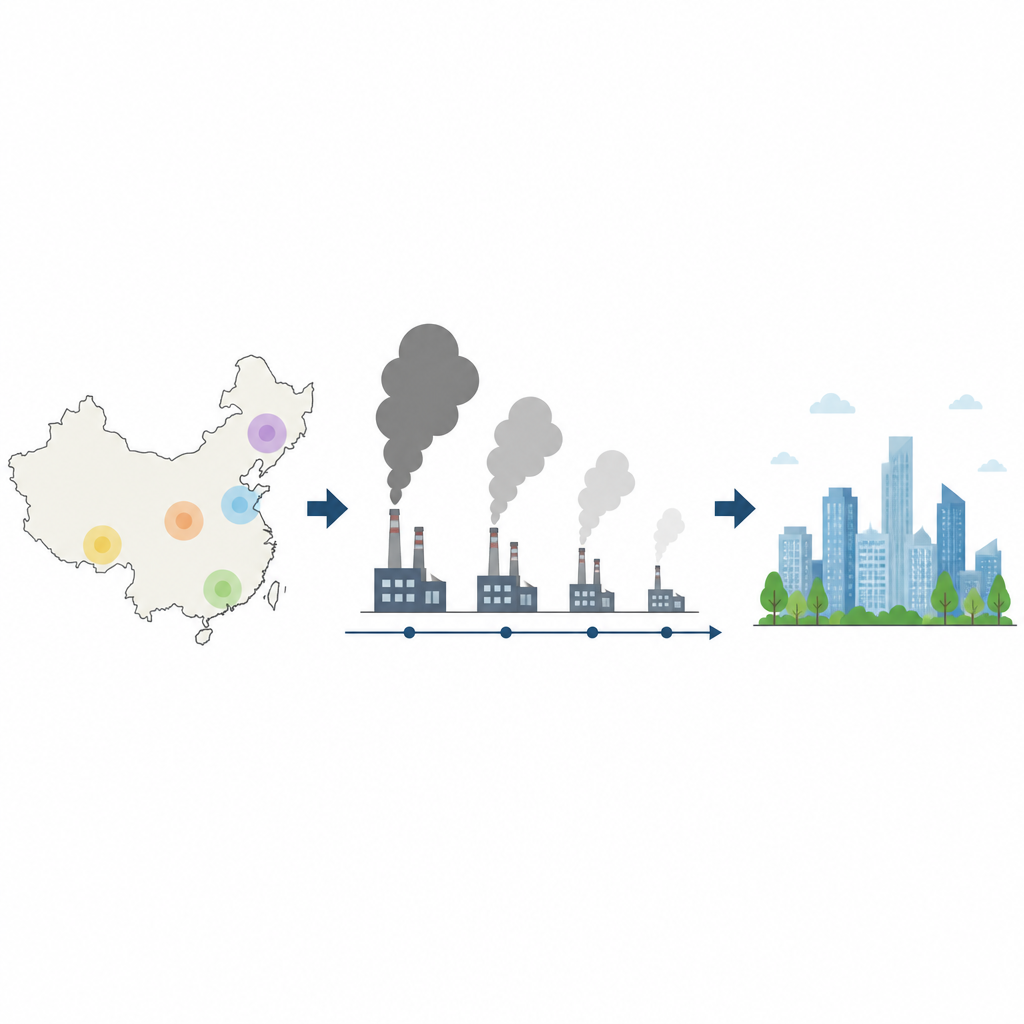
The researchers gathered data from 31 mainland provinces, tracking industrial soot and dust from 1992 to 2021 and then projecting trends to 2030. They examined not just “how much” pollution was emitted, but also “where” it came from and “how” it shifted over time. To do this, they mapped the center of gravity of emissions on China’s map and watched it drift south, then north, then toward the northwest as industry moved and policies changed. They also grouped provinces into different pollution levels over three broad periods, revealing an early pattern of “high in the east, low in the west” that later shifted toward a more even national picture with a few stubborn hot spots.
How provinces influence one another
Industrial pollution does not stop at provincial borders. To capture this web of influence, the team treated China as a network of linked regions rather than isolated dots. They built a “connection map” showing how changes in one province’s emissions were related to changes elsewhere. Coastal economic powerhouses such as Guangdong, Jiangsu, and Zhejiang emerged as central hubs, with many strong links to nearby provinces and major cities. Western regions like Xinjiang and Qinghai were more on the edge of the network, but still showed shared trends. Overall, the network proved dense and clustered, meaning that policies or economic shifts in one cluster can ripple quickly through neighboring areas.
Which forces drive dirty air
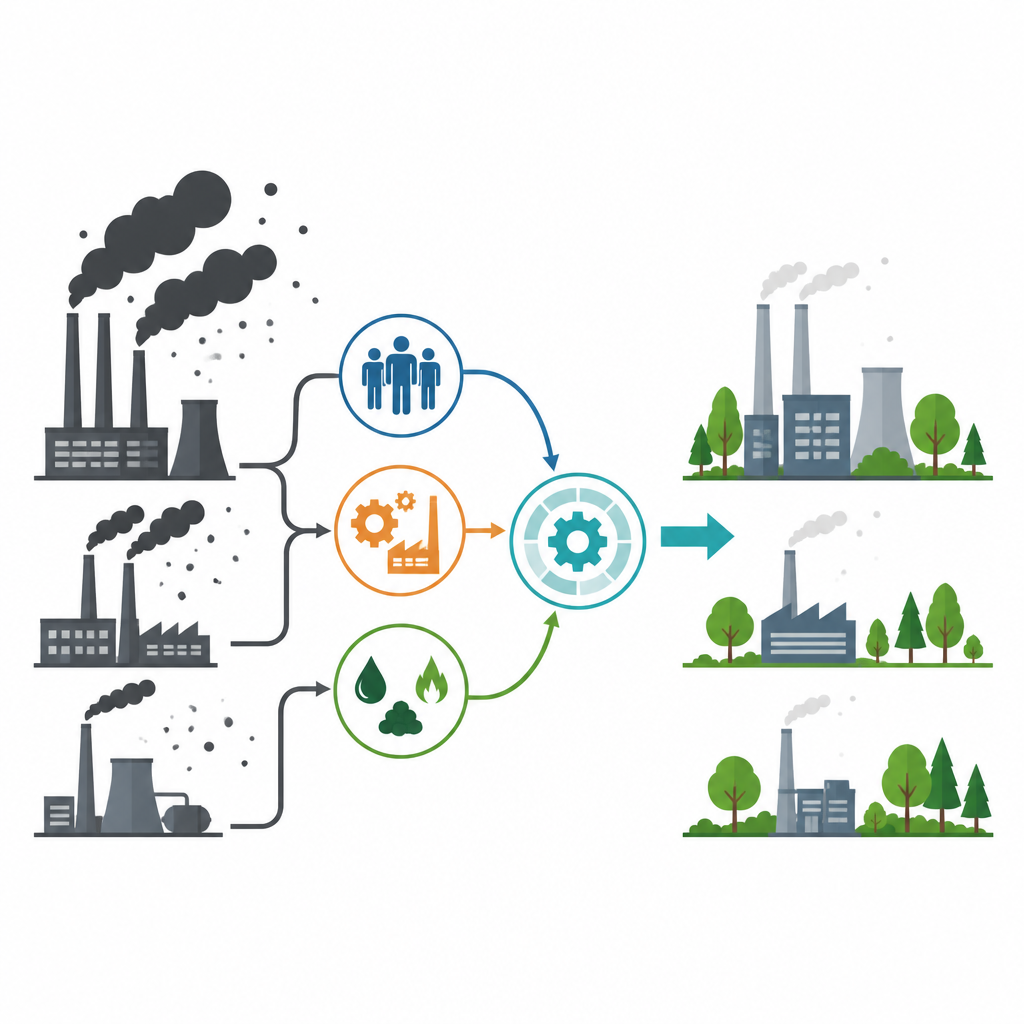
To understand what lies behind these patterns, the authors examined 17 potential driving factors, grouped into population, economy, energy use, industrial production, and technology and policy. Using a method that can handle messy, incomplete data, they ranked which factors mattered most in each province. Across much of China, the size of the permanent population, the number of people working in factories, and the use of coal and crude oil stood out as the strongest drivers of soot and dust. Still, there were local twists. In some places, cement and steel output played a key role; in others, the level of pollution control technology or the number of domestic patents was more important. This mix shows that there is no single “magic lever” and that solutions must match local conditions.
Looking ahead with virtual experiments
To see what the future might hold, the researchers zoomed in on Shanxi, a coal heavy province with some of the highest emissions but also a factor mix typical of many regions. They built a computer model that links population, economic growth, factory output, fuel use, and policy efforts into a feedback system. After checking that the model could closely reproduce past trends, they ran nine what if paths from 2020 to 2030. Each path combined different speeds of growth in the economy and population with faster or slower changes in industrial structure, factory demand, and energy intensity. The most effective path paired quick gains in income and population with slower growth in heavy industry and strong cuts in the amount of energy used per unit of output.
What this means for cleaner air
For a general reader, the core message is that dirty air from factories is not an unavoidable side effect of development. China’s past three decades show steep rises, plateaus, rebounds, and then clear declines in industrial soot and dust as policies tighten and industries change. The study suggests that the best route forward is not to halt growth, but to reshape it: shift from heavy, coal based production toward cleaner industries, use energy more efficiently, and strengthen local pollution control. Because regions are connected, the authors argue that policies must be tailored to local realities while also coordinated across provinces. If these steps are taken, even regions that still rely on heavy industry can move toward clearer skies without sacrificing their economic future.
Citation: Li, S., Zhang, G. Spatiotemporal differentiation and dynamics simulation of China’s industrial soot and dust emissions. Sci Rep 16, 15268 (2026). https://doi.org/10.1038/s41598-026-42409-y
Keywords: industrial air pollution, soot and dust, China emissions, energy and industry, system dynamics