Clear Sky Science · en
Molecular weight fractionated extracellular polymeric substances (EPS) impart different aggregation characteristics on polystyrene nanoplastics
Invisible plastic dust in our waters
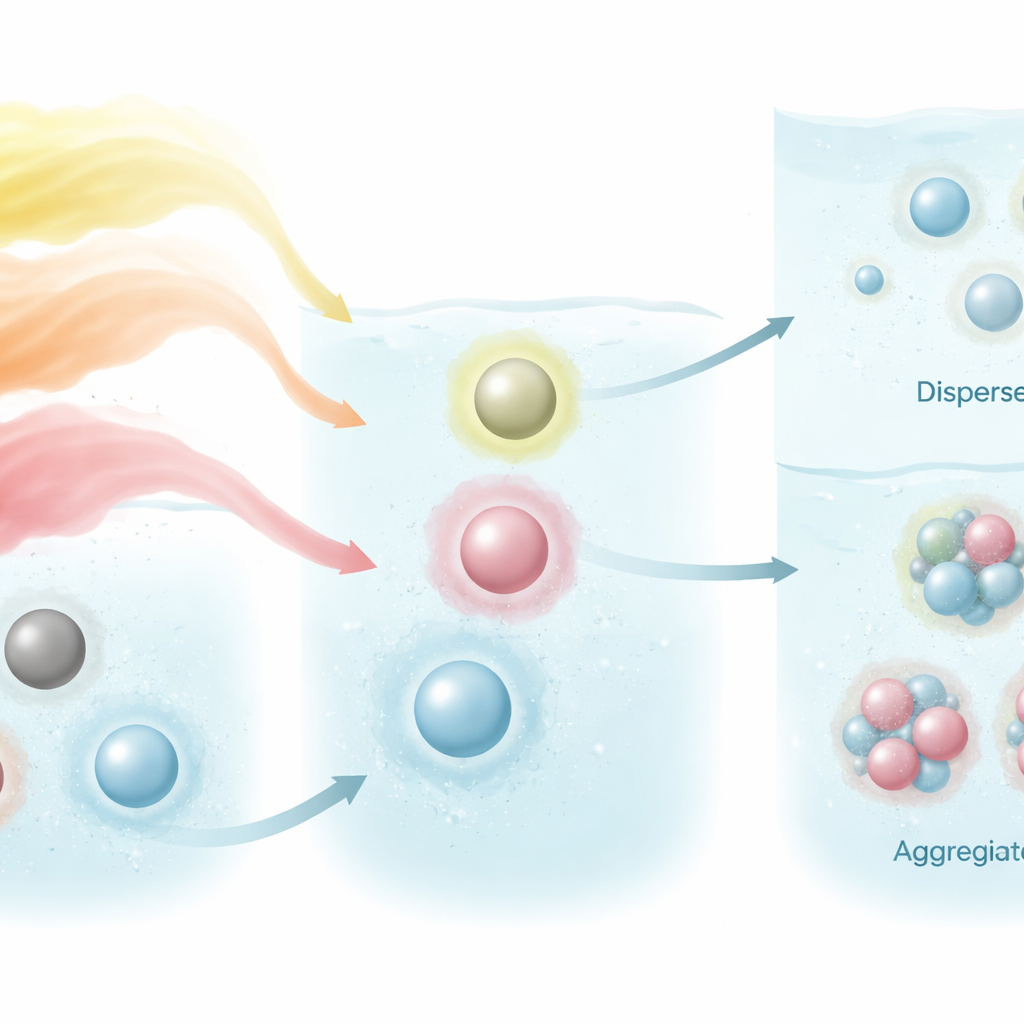
Microscopic plastic fragments, far smaller than a grain of sand, are now common in rivers, lakes, and oceans. Whether these nanoplastics stay floating, spread widely, or clump and sink helps determine where they end up and which organisms they can harm. This study looks at how natural "slime" produced by microbes—sticky mixtures of sugars, proteins, and other molecules—wraps around nanoplastics to form an "eco-corona" and, depending on its makeup, can either keep these particles apart or make them clump together.
Microbial slime as an environmental coat
In natural waters, bacteria release complex cocktails of large and small molecules known as extracellular polymeric substances, or EPS. When nanoplastics enter such environments, EPS quickly attaches to their surfaces, forming a coating called an eco-corona. The authors separated EPS from a common soil bacterium into different size groups, from very small molecules to very large ones. They then exposed three kinds of polystyrene nanoplastics—bare, negatively charged, and positively charged—to these EPS fractions in salty water containing either table salt–like ions or calcium ions, mimicking typical water chemistries.
How coat thickness changes plastic behavior
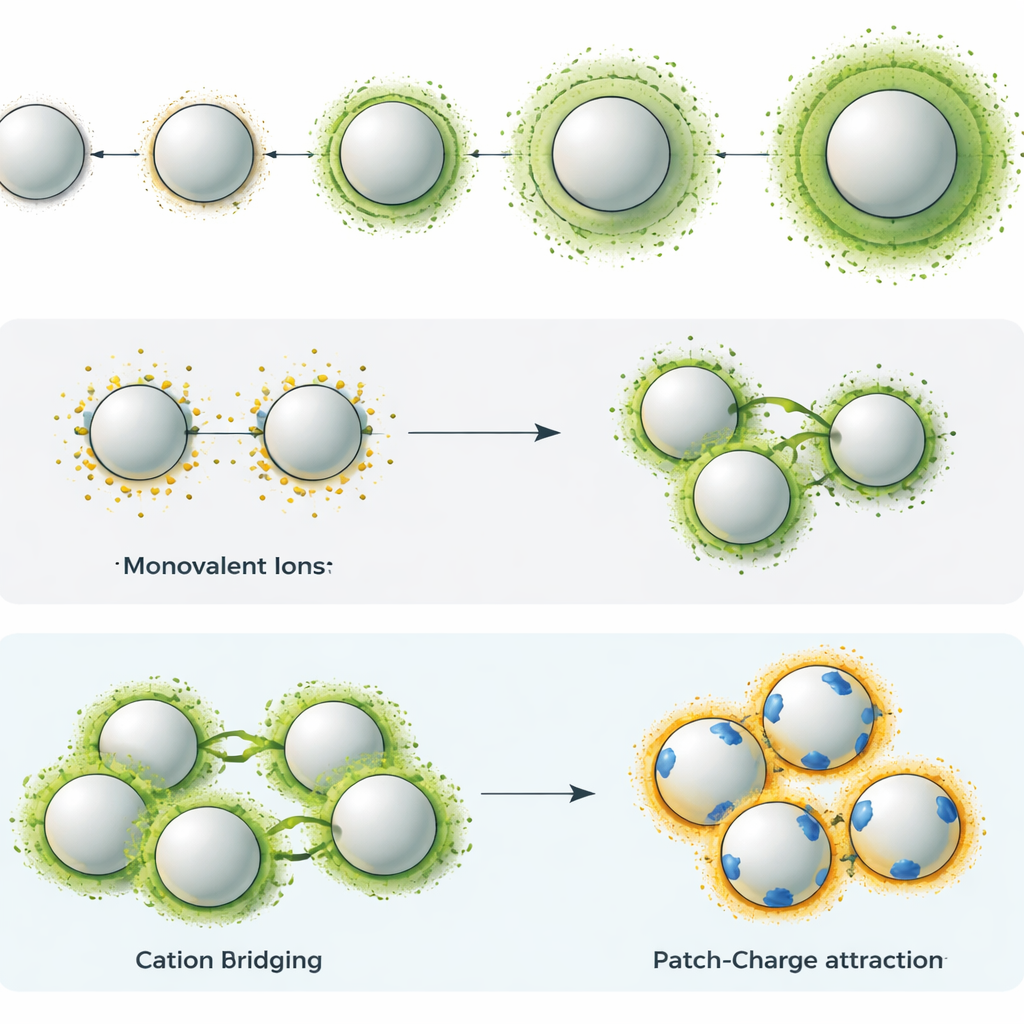
Despite having broadly similar chemical ingredients, the EPS size groups formed eco-coronas of very different thicknesses. Larger EPS molecules tended to pile up more heavily and create thicker, softer shells around the nanoplastics than smaller molecules did. For negatively charged and nearly neutral particles, thicker shells made it physically harder for particles to come close enough to stick together—a kind of "padded jacket" effect known as steric repulsion. As a result, higher amounts of large-molecule EPS raised the salt level needed before particles began to clump, meaning the coated plastics stayed dispersed and mobile over a wider range of conditions.
When salts turn padding into glue
The story became more complex in water rich in calcium ions, which carry two positive charges. At modest EPS levels, thick eco-coronas still acted mainly as cushions that kept particles apart, improving stability. But when both calcium and large-molecule EPS were abundant, the same coating could help particles stick together. Calcium ions acted like tiny staples, linking negatively charged groups within the EPS on neighboring particles. This "bridging" effect overcame the padding and encouraged aggregation, especially for nanoplastics whose surfaces carried carboxyl (acidic) groups that bind calcium strongly.
Patchy charges and sticky spots
Positively charged nanoplastics responded in yet another way. Large EPS molecules generally wrapped these particles in thick, mostly negative shells, turning them into well-separated, stable particles across both salt types. In contrast, very small EPS molecules behaved more like fine dust that settled unevenly onto the surface. Even when the overall particle charge stayed positive, these tiny coatings created scattered negatively charged patches. Neighboring particles could then attract each other face-to-face where opposite charges met, like magnets aligning at specific spots. This "patch-charge" attraction led to rapid clumping, especially when only low amounts of small EPS were present.
What this means for tiny plastics in nature
To a non-specialist, the key message is that the same nanoplastic can behave very differently depending on which pieces of microbial slime surround it and what salts are in the water. Thick coatings built from large EPS molecules usually keep particles apart, but in calcium-rich waters they can also help glue plastics together. Thin, patchy coatings of very small molecules can create sticky spots that drive clumping even when particles still look positively charged overall. By linking the size of EPS molecules to coating thickness, surface charge patterns, and resulting clumping behavior, this work provides a roadmap for predicting when nanoplastics will travel far in water and when they are more likely to settle or form larger aggregates.
Citation: Li, FY., Song, GY., Zhang, QX. et al. Molecular weight fractionated extracellular polymeric substances (EPS) impart different aggregation characteristics on polystyrene nanoplastics. Sci Rep 16, 11531 (2026). https://doi.org/10.1038/s41598-026-42401-6
Keywords: nanoplastics, eco-corona, extracellular polymeric substances, colloidal stability, aquatic pollution