Clear Sky Science · en
Optimized parameter estimation of solar PV models using an improved red-tailed hawk algorithm
Smarter Solar Power for Everyday Life
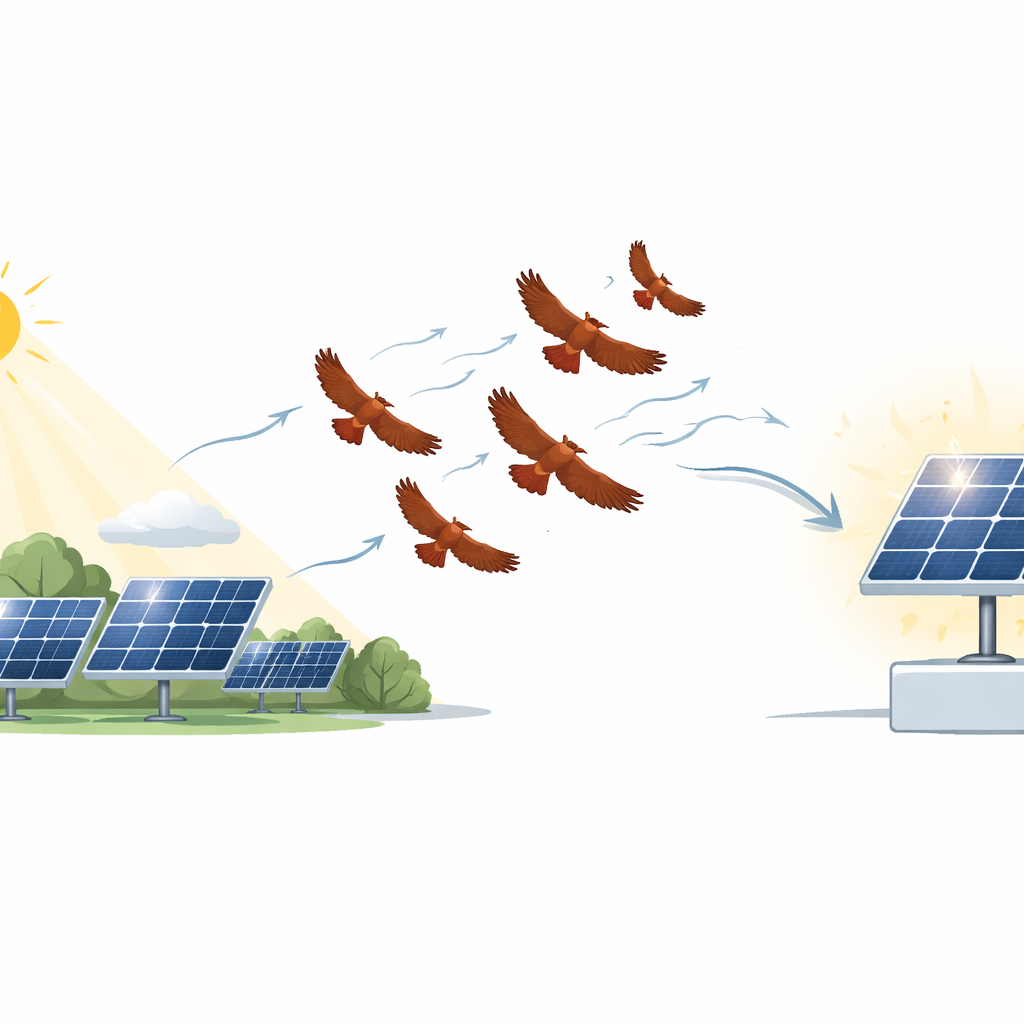
Solar panels are becoming a familiar sight on rooftops and in fields, but squeezing the most electricity out of every beam of sunlight is still a mathematical juggling act. This study introduces a new computer method, inspired by the hunting style of red‑tailed hawks, that helps engineers describe how solar panels behave much more precisely. Better descriptions, or models, mean better design, control, and forecasting of solar power in real‑world conditions.
Why Solar Panels Need Better “Maps”
Behind every solar panel is an invisible map that links sunlight and temperature to how much current and voltage the panel can produce. Engineers build these maps using electrical “equivalent circuits,” often represented as single, double, or triple arrangements of tiny electronic parts called diodes plus a few resistors. In theory, these circuits can mimic the real behavior of a solar cell under changing weather. In practice, they only work well if a handful of internal settings — such as currents, resistances, and ideality factors — are tuned just right. Getting these numbers slightly wrong can mislead designers about how much power a panel will deliver over a day, a season, or the lifetime of a solar farm.
From Traditional Tuning to Nature‑Inspired Search
Adjusting those internal settings is an example of an optimization problem: a computer nudges the parameters until the simulated panel output matches measurements from real hardware as closely as possible. Older “deterministic” methods can be fast but often get stuck in local dead ends or require gentle, well‑behaved equations. Over the past decade, so‑called metaheuristic methods — algorithms inspired by animals, swarms, or physical processes — have taken over this job. They roam widely through the space of possible parameter values, trading guaranteed perfection for robust, near‑best solutions on messy real‑world problems. Yet a central lesson from optimization theory is that no single method wins everywhere, so researchers keep seeking smarter, more flexible search strategies.
How the Red‑Tailed Hawk Idea Works
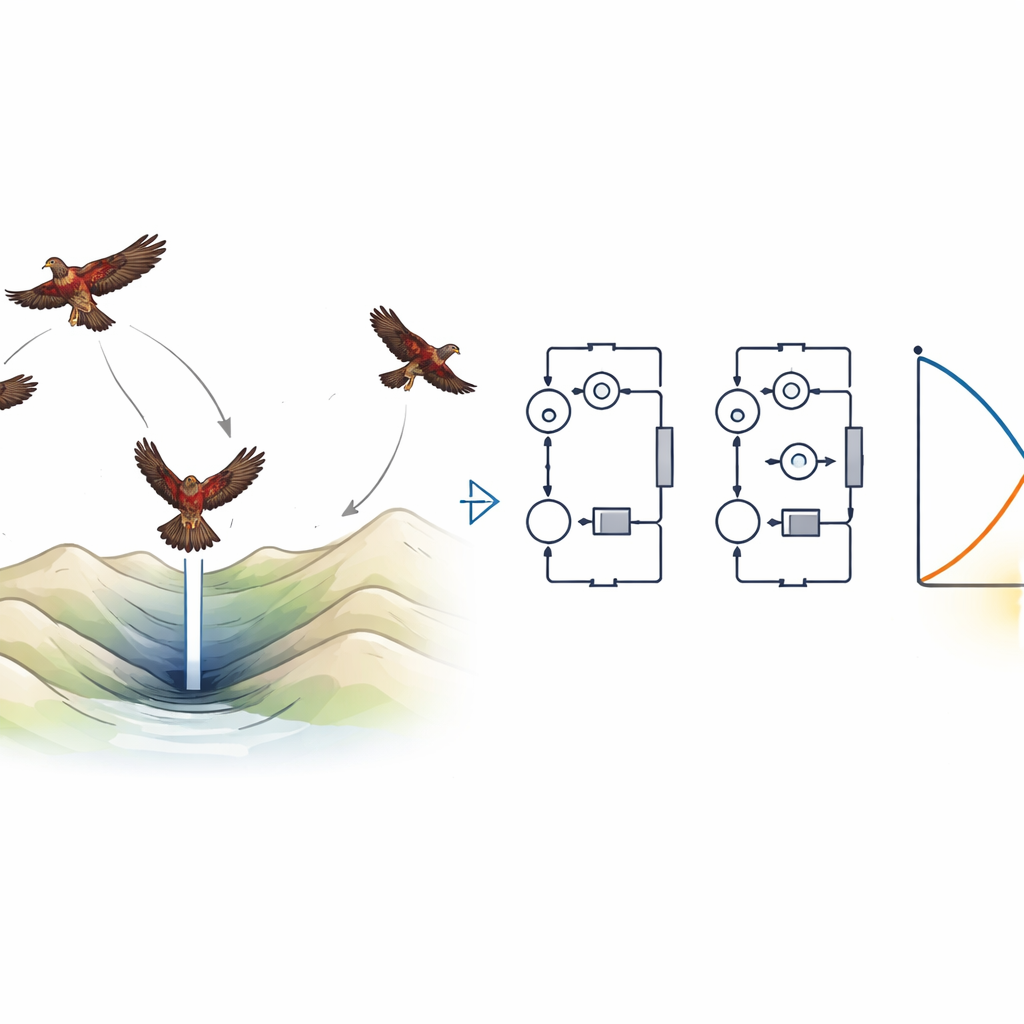
The authors build on an existing red‑tailed hawk algorithm that imitates how these birds soar high to scout, then spiral lower, and finally dive sharply toward prey. In the improved version, called IRTHA, the “hawks” are trial parameter sets flying through the search space. During the high‑soaring stage, they explore broadly using random long steps shaped by a mathematical pattern known as Lévy flights. A transition function, enhanced with nonlinear decay and chaotic mapping, gradually shrinks step sizes so the search becomes more focused over time. In the low‑soaring stage, the hawks move in spirals toward promising regions, and in the final stooping and swooping stage they home in aggressively on the best‑found solution. The method also uses a classical Newton–Raphson step locally, giving a precise polish once the hawks are already near a good answer.
Testing on Real Solar Cells and Panels
To judge whether this bird‑inspired strategy is more than a clever metaphor, the team tested IRTHA on a range of widely studied solar devices. These included a benchmark laboratory cell (RTC France) modeled with single, double, and triple diode circuits, as well as several commercial modules such as Photowatt‑PWP201, PVM‑752 thin‑film, and crystalline‑silicon panels STM6 40/36 and STP6 120/36. For each device, they fed the algorithm measured current–voltage data and asked it to find the internal parameters that best reproduce these curves. They compared IRTHA with ten other modern metaheuristic methods, from grey wolves and pelicans to hippos and coatis, along with many advanced techniques reported in recent literature.
Evidence of More Accurate Solar Models
The key score used for comparison was root mean square error, which summarizes how far the simulated currents and powers stray from the measurements. Across all cells and modules, IRTHA consistently reached the lowest or near‑lowest error values, often beating competitors by a noticeable margin. In several cases it drove the average mismatch between measured and modeled current to well below one thousandth of an ampere. Convergence plots showed that IRTHA not only found better fits but did so in a steady, reliable way, whereas some rival methods wobbled or plateaued early. Boxplots and radar charts confirmed that run‑to‑run variation was small, and non‑parametric statistical tests (Friedman and Wilcoxon rank‑sum) ranked IRTHA at or near the top for every test case. Although it required somewhat more computation time than simpler methods, the extra effort paid off in clearly superior accuracy.
What This Means for the Future of Solar Power
For a non‑specialist, the main takeaway is that the authors have found a more dependable way to “calibrate the ruler” used to measure and predict solar panel performance. By finely tuning the internal models of different kinds of solar cells, the improved red‑tailed hawk algorithm can help system designers estimate power output more accurately, track the best operating point under changing weather, and detect faults or degradation earlier. As solar power spreads and grids lean more heavily on it, such precise modeling tools become increasingly valuable. The study suggests that nature‑inspired search strategies, when thoughtfully refined, can play a practical role in making renewable energy systems smarter and more efficient.
Citation: Sharma, P., Ajay Rathod, A., Shukla, S. et al. Optimized parameter estimation of solar PV models using an improved red-tailed hawk algorithm. Sci Rep 16, 14016 (2026). https://doi.org/10.1038/s41598-026-42400-7
Keywords: solar photovoltaics, optimization algorithms, metaheuristics, renewable energy modeling, parameter estimation