Clear Sky Science · en
A parameter estimation method for modelling proton exchange membrane fuel cell based on enhanced meta evolutionary differential evolution algorithm
Smarter Tuning for Clean Energy Devices
Fuel cells are often held up as a promising route to cleaner cars, buses and backup power. But to design and control these devices well, engineers need mathematical models that behave like the real hardware. This paper presents a new way to fine‑tune those models automatically, so they match experimental data more closely. The work focuses on proton exchange membrane fuel cells (PEMFCs), a leading fuel cell type, and shows how an advanced search algorithm can uncover the hidden parameters that govern their performance.
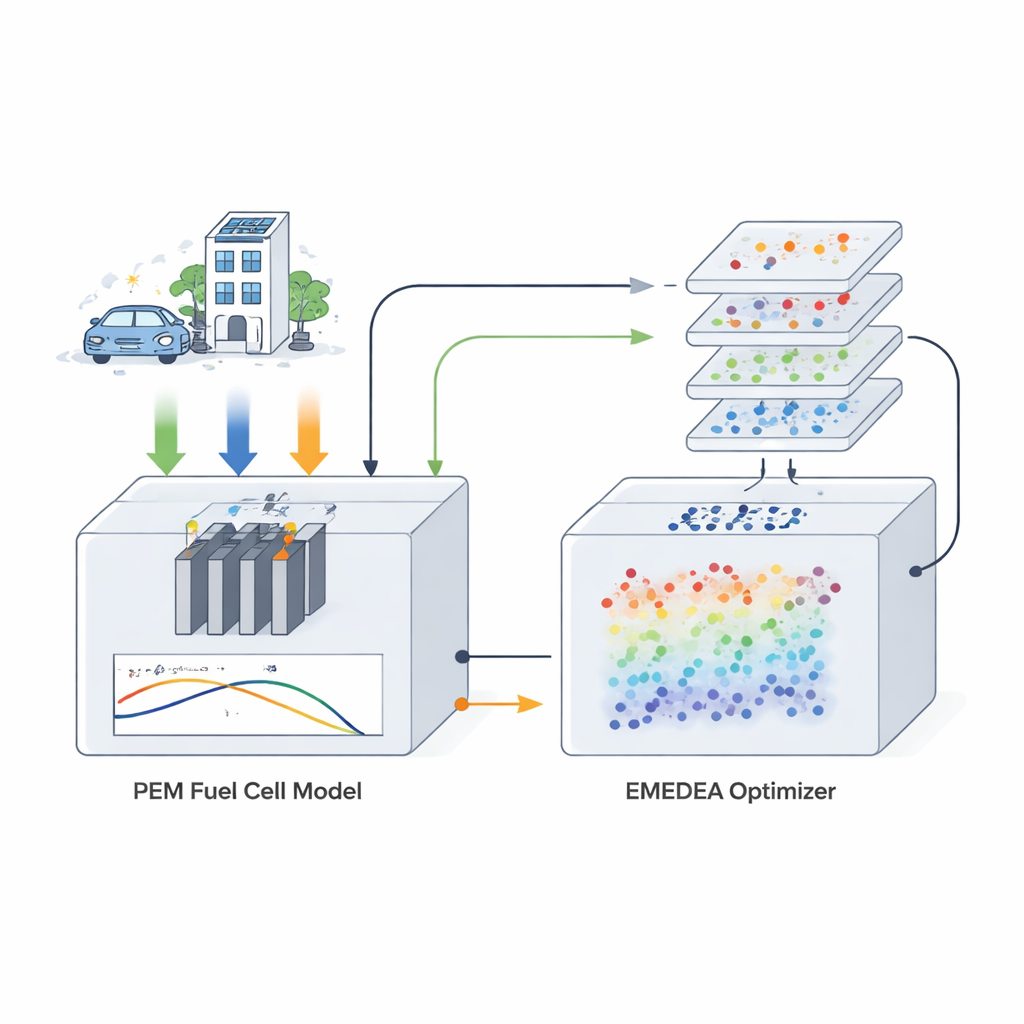
Why Fuel Cell “Knobs” Matter
Inside a PEM fuel cell, many physical and chemical processes happen at once: gases flow, reactions occur at electrodes, and ions move through a membrane. Engineers often cannot measure the key internal “knobs” of this system directly, such as contact resistances or how easily gases diffuse through tiny pores. Instead, they infer these values by adjusting a model until its predicted voltage–current curve lines up with what is seen in experiments. Doing this well is vital: accurate models help to design stacks for electric vehicles and power grids, plan maintenance, detect faults early and reduce the need for costly prototypes.
Why Traditional Methods Fall Short
Finding the right parameters is not a simple curve‑fitting exercise. The equations governing PEM fuel cells are highly non‑linear, and many parameters influence each other. Classical methods, such as least‑squares regression and gradient‑based search, often get stuck in poor solutions or require careful manual tuning. Over the past decade, researchers have turned to so‑called meta‑heuristics—search strategies inspired by evolution, swarms or predator–prey behavior—to roam through many possible parameter combinations. These approaches work better on difficult landscapes but still depend strongly on their own “settings,” such as how large a step to take when mutating a candidate solution.
A Self‑Improving Evolutionary Search
The authors build on a well‑known meta‑heuristic called differential evolution and wrap it in a second layer of evolution. In their enhanced meta‑evolutionary differential evolution algorithm (EMEDEA), one evolutionary process (“evolver”) searches for good settings of the inner optimizer—its mutation strength, mixing rate and preferred search strategy. The inner optimizer (“executor”) then uses those settings to search for the best fuel‑cell parameters, judged by how small the sum of squared differences is between measured and predicted stack voltages. Opposition‑based learning is added: for every trial setting, its “mirror” in the search space is also tested, keeping exploration broad. The allowed ranges for key settings are adjusted on the fly, narrowing when progress is good to refine promising areas and widening when progress stalls to escape dead ends. All of this is implemented on graphics processors so that many candidate solutions can be evaluated in parallel.

Putting the Method to the Test
Before turning to real fuel cells, the team benchmarked EMEDEA on standard mathematical test functions, where the true optimum is known. Statistical comparisons showed that their method consistently outperformed both the basic differential evolution and an earlier meta‑evolutionary variant, converging faster and more reliably. The authors then applied EMEDEA to three different PEM fuel cell stacks ranging from 250 watts to 5 kilowatts. For each device, the algorithm estimated seven key empirical parameters that govern activation losses, ohmic resistance and mass‑transport effects. In every case, the resulting model reproduced the experimental voltage–current curves with very small errors, and the total squared deviation was lower than that achieved by a wide range of recently proposed algorithms, including advanced swarm and hybrid strategies.
What This Means for Future Fuel Cells
The study shows that giving an optimization algorithm the ability to tune itself can pay off in practice. EMEDEA not only finds parameter sets that match experiments closely but also reaches those solutions in relatively few iterations, which matters when each model evaluation is computationally expensive. While the work focuses on steady‑state behavior and relies on good laboratory data, the authors argue that the same idea could be extended to track changing parameters over time, incorporate degradation and thermal effects, and run in real‑time control systems. In plain terms, they offer a smarter automatic “calibration engine” that could help future fuel cell systems run more efficiently, last longer and be integrated more confidently into vehicles and power networks.
Citation: Pattanaik, V., Parida, S.M., Malika, B.K. et al. A parameter estimation method for modelling proton exchange membrane fuel cell based on enhanced meta evolutionary differential evolution algorithm. Sci Rep 16, 12672 (2026). https://doi.org/10.1038/s41598-026-42394-2
Keywords: proton exchange membrane fuel cell, parameter estimation, evolutionary optimization, differential evolution, clean energy modeling