Clear Sky Science · en
Switching single and dual wavelength emission in a quasi-three-level Nd: YLF laser by adjusting pump beam waist position
Lasers That Can Change Color on Demand
Lasers power everyday technologies from barcode scanners to medical imaging tools. But most lasers are locked to a single color of light, which limits how flexibly they can be used. This study shows a new and surprisingly simple way to make a solid-state laser switch between one color and two colors of infrared light—just by shifting where the incoming pump light is focused inside the crystal. That kind of control can translate into more compact, efficient sources for blue light generation, precision medicine, and advanced sensing.
Why Laser Color and Power Matter
Many modern applications need laser light at specific colors and with high, stable power. In the near‑infrared range around 900 nanometers, such lasers can be converted into bright blue beams for displays and micro‑fabrication, or used directly for medical diagnostics and biological imaging. Traditionally, getting a laser to operate at a weaker color, or at two colors at once, requires inserting special optical elements into the laser cavity. These parts add loss and complexity, cutting down the useful power. The authors instead exploit the crystal’s own internal properties so that the same device can deliver either a single color or a dual‑color output without any extra pieces.
A Special Crystal and a Clever Pumping Trick
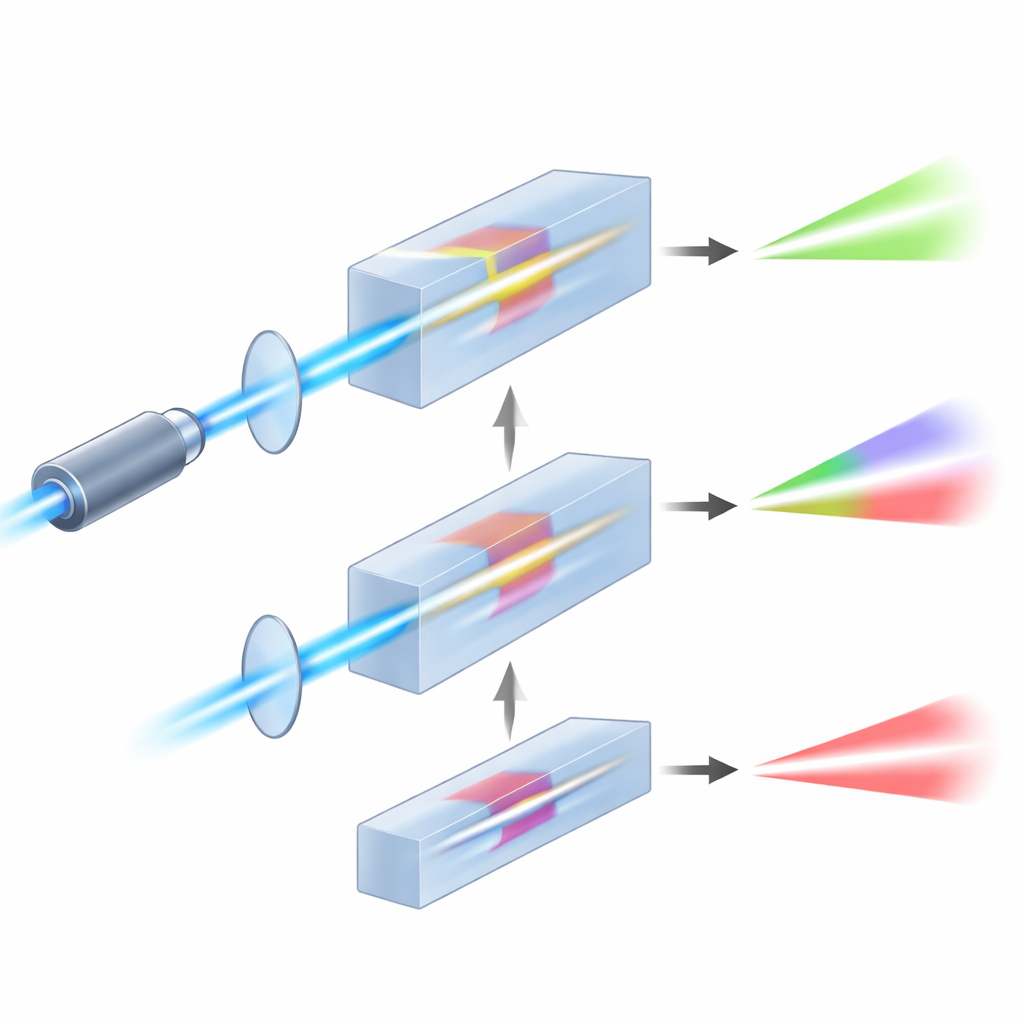
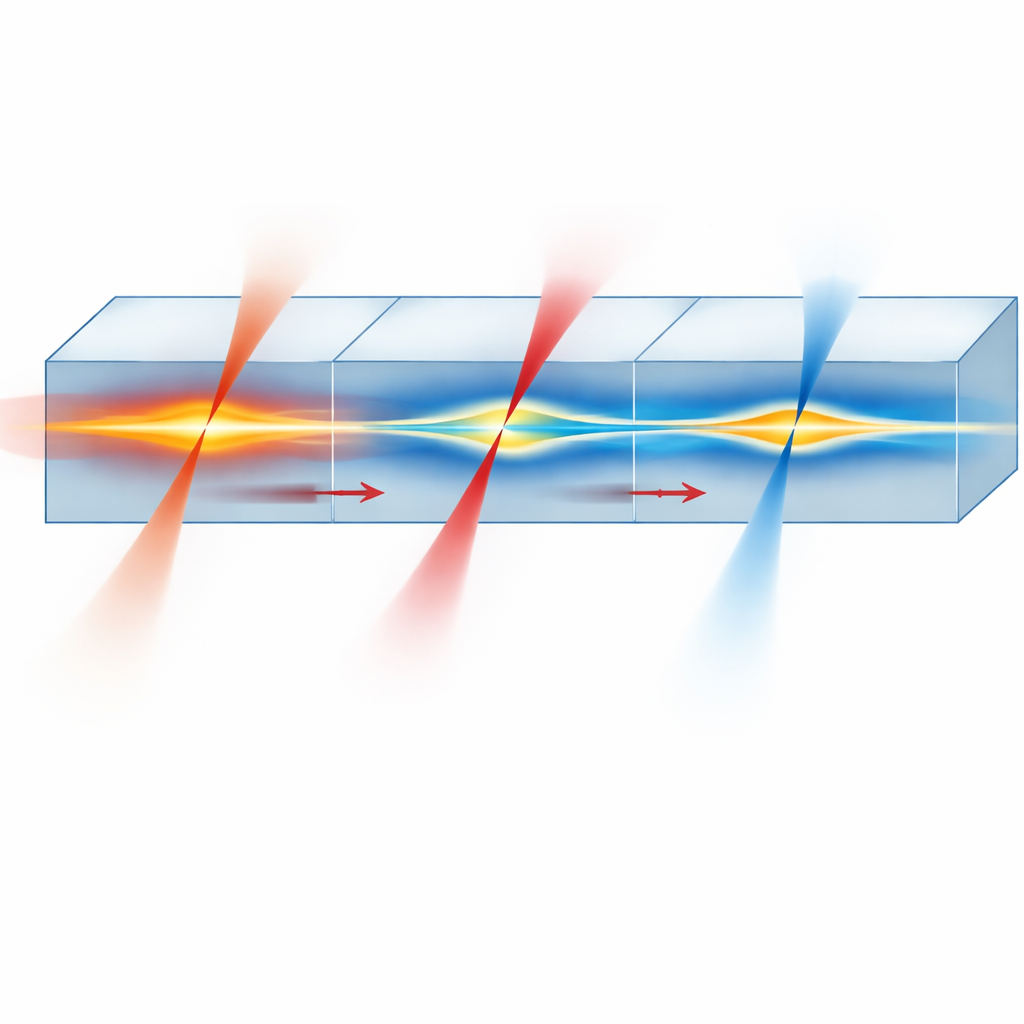
The team works with a crystal called Nd:YLF, a well‑known solid‑state laser material. When excited by a diode laser at 880 nanometers, this crystal can emit light at two very close infrared colors around 903 and 908 nanometers, each with a different polarization (direction of the light’s electric field). Inside the crystal, heat from the pump light and the material’s natural anisotropy subtly reshape the laser beam paths, favoring one color or the other. Instead of adding filters or mirrors to pick a wavelength, the researchers simply move the narrowest point (the waist) of the pump beam along the length of the crystal. This small adjustment changes how well the pump overlaps with the possible laser modes and how much loss each color experiences.
From Theory to Tunable Output
To understand and control this effect, the authors model how the pump beam and the laser beams overlap inside the crystal, including how heating alters the internal focusing. They calculate key quantities such as the threshold pump power—the minimum power needed for each color to start lasing—as a function of the pump waist position. The simulations predict that at one crystal position the 908‑nanometer line has the lowest threshold, at another the 903‑nanometer line wins, and in between there is a sweet spot where both reach threshold together, allowing dual‑color operation. These predictions guide the experiment, in which lenses focus the pump light into a 20‑millimeter‑long Nd:YLF rod mounted on a temperature‑controlled copper holder.
Switching Between One Color and Two
Measurements confirm the theoretical picture. When the pump beam waist is placed near one end of the crystal, the laser emits a single, 908‑nanometer beam with a maximum output power of 3.22 watts and a slope efficiency of about 21 percent, meaning a substantial fraction of the absorbed pump power is converted into laser light. As the waist is shifted deeper into the crystal, the thresholds for the two colors cross, and the device emits two orthogonally polarized beams at 903 and 908 nanometers simultaneously, with a combined power of 2.25 watts. Moving the waist still farther tips the gain balance again, leaving only the 903‑nanometer beam, which reaches 2.27 watts. Throughout, the output beams remain of high optical quality and reasonably stable in power over time.
Simple Control for Future Laser Tools
The main message of this work is that fine‑tuning where the pump light is focused inside a crystal can serve as a powerful control knob for laser color, without sacrificing much efficiency or adding complicated components. For users, that means a single compact device that can be configured for high‑power single‑color operation or for dual‑color output simply by adjusting the focusing optics. Because the approach relies on general thermal and geometric effects rather than on a unique property of Nd:YLF alone, it could be extended to other rare‑earth‑doped crystals to build a family of flexible, wavelength‑switchable solid‑state lasers for imaging, spectroscopy, and advanced light‑conversion schemes.
Citation: Huang, H., Li, Y., Xia, J. et al. Switching single and dual wavelength emission in a quasi-three-level Nd: YLF laser by adjusting pump beam waist position. Sci Rep 16, 11452 (2026). https://doi.org/10.1038/s41598-026-42383-5
Keywords: wavelength-switchable lasers, Nd:YLF, dual-wavelength emission, solid-state laser design, pump beam focusing