Clear Sky Science · en
An efficient prediction based data collection method for wireless sensor networks using hybrid fuzzy clustering and optimized deep maxout neural networks
Smarter sensors for a connected world
From smart farms to citywide air-quality trackers, wireless sensors quietly monitor our surroundings and feed data into the Internet of Things. But tiny battery-powered devices can only send so much information before they run out of energy. This paper explores a new way to organize, route, and predict sensor data so that networks last longer, waste fewer transmissions, and still deliver accurate readings about the environment they watch.
Why sensor networks need a tune-up
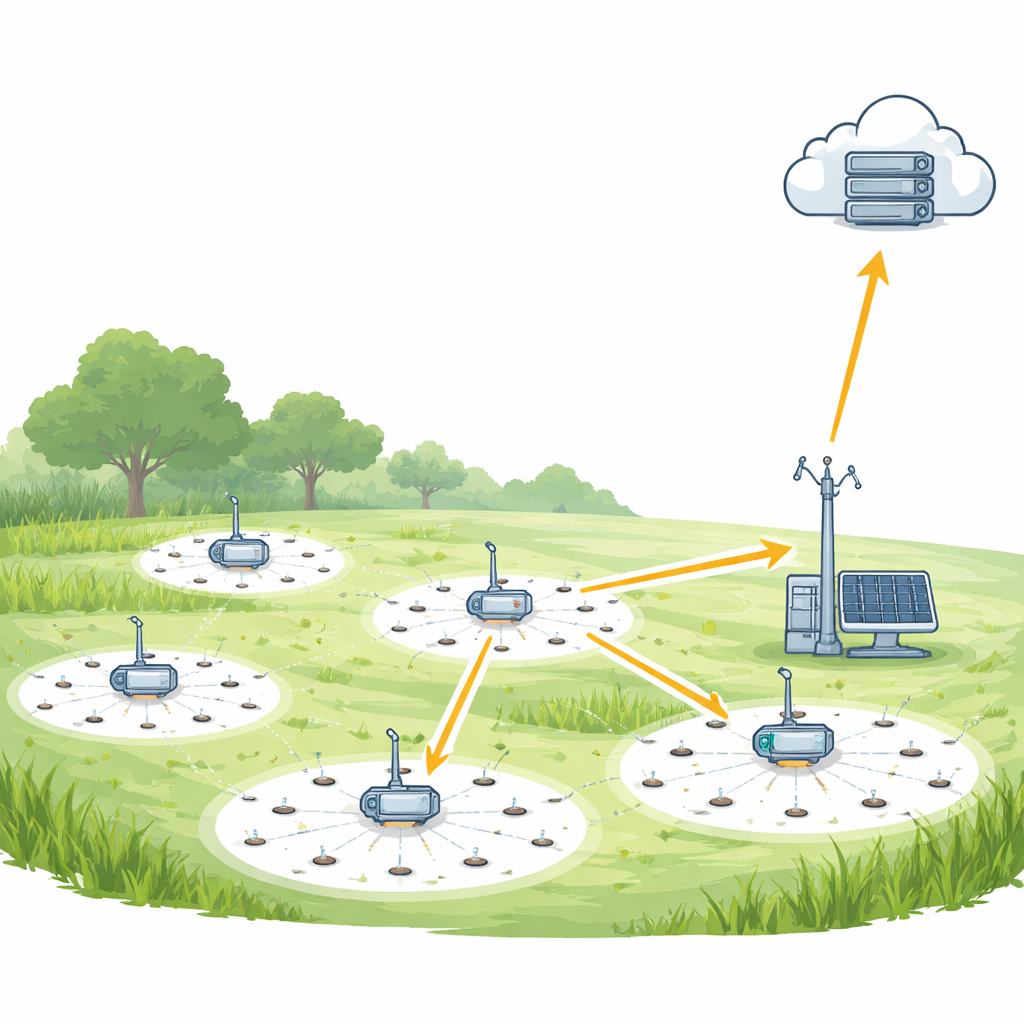
Modern sensor networks may scatter hundreds or thousands of devices across a field, building, or city. Each sensor measures things like temperature or humidity and forwards that data to a central station. If every sensor talks all the time, batteries drain quickly and the network collapses. Existing methods try to group sensors into clusters and plan paths for messages, but they often ignore subtle issues like overlap between regions, sudden changes in conditions, or the limits of small batteries and processors. The result is wasted energy, uneven workloads, and missed chances to predict what will happen next instead of constantly asking every sensor for updates.
Gentle grouping and clever paths
The authors propose a framework that tackles these weak spots step by step. First, they group nearby sensors using a soft, or “fuzzy,” notion of membership: a sensor can belong partly to more than one cluster, which better reflects messy real-world layouts than rigid borders. Within each cluster, a special node called a cluster head is needed to gather and forward data. Choosing this node wisely matters because it will burn more energy than its neighbors. To make that choice, the system uses an algorithm inspired by the hunting behavior of red piranhas. It searches through many possible leaders and favors nodes that still have plenty of energy, sit near the center of their group, have a reasonable number of neighbors, and are not too far from the base station. This careful balance spreads the workload and helps the network stay alive longer.
Finding energy-saving routes on the fly
Once cluster heads are chosen, the next challenge is how messages travel from these leaders to the base station. Here the framework turns to another animal-inspired strategy, based on the way leopard seals hunt. This routing method explores many possible paths, then gradually homes in on those that keep hops short, avoid overloaded nodes, and prefer devices with higher remaining energy. By continuously adapting to changing battery levels and traffic, it chooses routes that cut delays and reduce the chance that a few unlucky sensors will die early while others sit mostly idle.

Teaching the network to predict instead of chatter
Even with efficient clustering and routing, constantly transmitting raw measurements is costly. To trim away unnecessary messages, the authors add a deep learning model called a deep maxout neural network. Before training, the system cleans the data, fills in missing readings, smooths out noise, and scales temperature and humidity values to a standard range. The neural network then learns patterns over time so that, for many moments, the base station can accurately guess what a sensor would have reported. Only when the real reading is likely to differ too much from the prediction does the sensor actually send data. This turns the network into a kind of "silent observer"—talking less, but still keeping an accurate picture of conditions.
Putting the framework to the test
To see how well this combined approach performs, the researchers built a large virtual network of 1,500 sensors and used real temperature and humidity recordings as input. They compared their method with several popular alternatives, including other deep learning models and clustering schemes. Across a range of settings, the new framework used less energy, suppressed up to about 98–99 percent of possible transmissions, and kept prediction errors very low. It also maintained more live sensors and higher remaining energy over many communication rounds, and achieved lower communication overhead and fewer packet transmissions, even as the number of nodes grew.
What this means for everyday technology
In simple terms, this work shows how blending smart grouping, nature-inspired search strategies, and modern deep learning can make sensor networks both leaner and more reliable. By letting sensors send fewer but more meaningful messages—and by carefully choosing who leads and how data travels—the proposed system greatly extends network lifetime while preserving data quality. For everyday users, that could translate into farm sensors that run for years without battery changes, building monitors that quietly keep watch with fewer failures, and more dependable data streams powering the next generation of connected devices.
Citation: Padmini Devi, B., Gunapriya, D., Sivaranjani, S. et al. An efficient prediction based data collection method for wireless sensor networks using hybrid fuzzy clustering and optimized deep maxout neural networks. Sci Rep 16, 13851 (2026). https://doi.org/10.1038/s41598-026-42380-8
Keywords: wireless sensor networks, energy efficient routing, IoT data prediction, deep neural networks, metaheuristic optimization