Clear Sky Science · en
Probabilistic modelling of material properties based on structural design and testing standards and its impact on the assessment of structural service life
Why longer-lasting concrete matters
Bridges, tunnels and other concrete structures are the silent workhorses of modern life. We expect them to stand safely for decades, yet replacing or strengthening them is costly, disruptive and carbon intensive. This paper explores how we can make critical concrete structures, such as highway bridges and tunnels, last far longer—up to 150 years—without compromising safety. The key idea is to use better statistics and stricter production control to reveal “hidden” safety reserves already present in modern concrete, and to turn those reserves into extra service life rather than extra conservatism.

How engineers judge safety and risk
When engineers design a structure, they do not rely on a single “best guess” for loads or material strength. Instead, they use safety formats that treat both loads and resistance as uncertain. Design codes translate this uncertainty into partial safety factors, which make sure that the chance of failure stays extremely small over a chosen service life, often 50 years. This chance is described by a reliability index, a single number that condenses the combined effect of all uncertainties. The authors start from the reliability framework behind European and international standards, and ask: if we know more precisely how concrete actually behaves in production and in tests, can we keep the same safety format but safely extend the design service life?
Measuring how concrete really behaves
Concrete is not perfectly uniform. Its strength varies between batches and even within a single batch, depending on raw materials, mixing, curing and testing. Modern standards already require regular sampling and testing to keep this variation in check. The study first reviews European and American rules for concrete production and testing, focusing on how they limit the spread of strength results. The authors then quantify this spread using the coefficient of variation, a simple measure that compares the typical fluctuation of strength to its average value. They compare the assumptions embedded in design codes with the tighter variation actually enforced in production standards, and examine how different mathematical models of strength distributions capture these observations.
From statistical spread to extra service life
Using a reliability method that links failure probability to the spread in material strength, the authors derive threshold values for the acceptable coefficient of variation if a structure is to remain safe for 100 or 150 years instead of the usual 50. They show that when concrete strength is treated with a distribution that cannot go below zero and naturally accounts for a long “tail” of higher strengths, it can tolerate somewhat larger relative variation while still meeting strict safety targets. For typical concrete strength classes used in infrastructure, the variation assumed by design standards already supports extending the life of many structures to 100 or even 150 years, especially for medium-consequence applications. Only the lowest strength class examined struggles to meet the toughest requirements for the longest life span.
What real tunnel data reveal
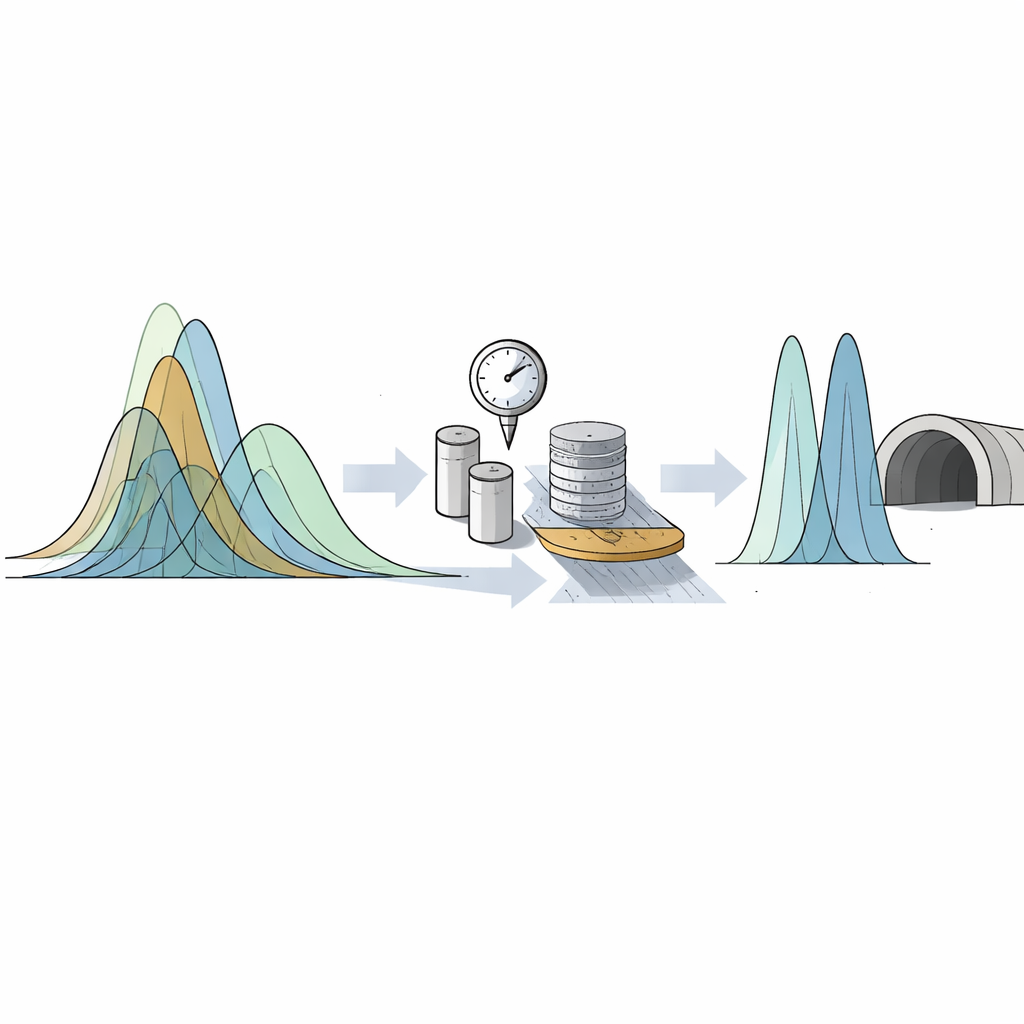
The authors test their approach on a large set of strength measurements from concrete used in Austrian tunnels. These cubes were taken and tested under normal production and quality control rules. When they fit statistical models to this data, most samples show a very modest spread in strength: in the majority of cases, the variation is well below the threshold required for a 150-year life in high-consequence structures like major tunnels and bridges. In addition, the weakest five percent of measured strengths lie safely above the minimum values assumed in design. Together, this indicates that, in practice, modern production and conformity checks deliver concrete that is more consistent—and often stronger—than the conservative assumptions baked into current design rules.
Turning quality into durability
The study concludes that by explicitly linking measured concrete variability to reliability targets, infrastructure owners can safely unlock extra service life from existing and new structures. Instead of increasing safety factors or replacing elements early, they can use quality-controlled production data and probabilistic models to show that many structures already meet the reliability needed for 100 to 150 years of operation. This approach supports more sustainable infrastructure, reducing unnecessary material use and interventions while preserving high safety standards. Future work will add time-dependent damage and advanced data-driven methods, but the core message is clear: better statistics on concrete quality can be converted directly into longer, safer lives for critical structures.
Citation: Faghfouri, S., Feiri, T., Ricker, M. et al. Probabilistic modelling of material properties based on structural design and testing standards and its impact on the assessment of structural service life. Sci Rep 16, 14138 (2026). https://doi.org/10.1038/s41598-026-42352-y
Keywords: concrete durability, structural reliability, service life extension, quality control, infrastructure resilience